We should maintain that if an interpretation of any word in any religion leads to disharmony and does not positively further the welfare of the many, then such an interpretation is to be regarded as wrong; that is, against the will of God, or as the working of Satan or Mara.

Buddhadasa Bikkhu, a Thai Buddhist Monk


Showing posts with label Theology. Show all posts

Monday, February 23, 2015

God: the Problem

It is often claimed that the great doctrinal issue among Christians today is the nature and authority of the Bible.  It is a divide between literalists and non-literalists on the one hand.  Or, again, it a division that pits those hold a high regard for the scriptures versus those who have a less lofty view of the Bible.  It may well be true that the Bible is the great doctrinal issue of our time.  If so, however, the problem of God is not far behind—and probably linked.

In fact, God has always been a problem for the followers of Christ.  Almost from the beginning, we inherited two distinct traditions concerning the nature of God, one from Jewish theology and the other from Greek philosophy.  From Judaism we learned that God is intimately involved in the affairs of humanity, hears and sometimes answers prayers, appears in various guises, and speaks to us.  Yes, God is also the creator of all that is and thus far beyond us—yet the psalmist affirms that God has made us "little lower" than the messengers of heaven (Psalm 8:5).  And we Christians are convinced that Jesus in preeminently God With Us.  Our Greek heritage, however, throws all of this into doubt.  It affirms that God is Beyond all beyonds, unnamable, unimaginable, and even non-existent in the way the created universe exists.  We are warned that the moment we call anything by the name "God," that thing is not God.  We are warned that we cannot even say that, "God is love," because such a statement reduces God to human terms, puts God on a human scale.

If the Bible is the great doctrinal divide of our time, then the nature of God is the great theological divide—and long, long has been.  Stated most directly, the divide is between those who understand God to be in some sense an independent entity that is real as the universe is real and those who believe that God is not an entity in any way that we can call an entity and does not exist as we understand existence.

Like the various doctrines of scripture, so too the various theological positions on the nature of God cannot actually be so easily divided into two neat camps.  But they do represent two tendencies, one seeing God primarily as Present with us and the other understanding God to be Beyond all possible beyonds.

Monday, September 1, 2014

Avatar & Incarnation

Quite a bit has been written in the blogosphere about the theological implications and message of the 2009 movie, Avatar.  From a sample supplied for me by a Google search on the subject, "avatar and theology," there is obviously the usual range of responses from appreciation to deprecation.  A couple of the ones I looked at, however, caught my attention because they wrestle with the nature of Jake Sully's incarnation in a Na'vi avatar designed by human exobiologists.

One is a post entitled, "Scalp Locks, Gaia, and the Incarnation: History and Theology in James Cameron’s Avatar," by Wen Reagan, which comments on the manner in which a human is put into a Na'vi body. Reagan points out the obvious parallel between the movie's version of incarnation and the Christian understanding of the Incarnation of God in Christ.  He esp. highlights the way in which by the end of the movie the human Jake Sully has become a Na'vi, actually leaving his human body entirely.  Reagan observes, "But in the end, we don’t get a glimpse of Vishnu, safe to retreat from his current avatar and come again in another one. Instead, we get a glimpse of Christ, as Jake takes on the risk of fully embracing the Na’vi by becoming one of them, forever." Garrett East in a post entitled, "James Cameron's Avatar and the Critical Response: An Alternative Perspective," picks up on this same theme of the transformation of a human into another species by arguing that the central theme of the whole movie is the conversion of Jake Sully. He writes, "In essence, I think Avatar could be described as a conversion story," and goes on to observe that this conversion,
requires not only a change of mind and intellectual assent, but a whole new embodied way of life. It requires new eyes, new ears, a new language, and a new heart. It is a relearning of what is right and what is wrong. It is a transfer of allegiance from one people to another (the Na'vi), from one God to another (Eywa). It requires that Jake become nothing less than a new creature in a new creation...We are watching the story of a man who moves from despair, death, hate, and disbelief to hope, life, love, and even faith. When we watch Jake Sully’s story, we are watching a story about conversion.
All of which is to say a central dual theme of the story of Avatar is incarnation and conversion.

Most practicing Christians for most of the last two thousand years have held a view of incarnation not very different from that described in Avatar.  In Jesus of Nazareth, the essence of God was transferred into a human body.  God was in Christ just as Jake was in a Na'vi body.  Now, if we start to think about it, there are differences; but most of the time we don't think about it.  God was in Jesus; Jake was in a Na'vi body.  The movie makes a very important observation, however.  You can't place a person into another body and expect that there won't be any change.

One of the themes of the Book of Genesis is that God does indeed change.  In the story of the Flood, God set a rainbow in the sky as a promise that God would never again use violence against the human race and the rest of creation (Genesis 9:1-17).  Did, then, becoming incarnate in Jesus change God?  If so, how so?  If not, then how can we claim that Jesus was at one and the same time fully God and fully human?  Is it not change an essential element of our nature?

Wednesday, August 27, 2014

Cane Toads & God

Source: animals.nationalgeographic.com
Cane toads are a large, poisonous species of toad that originates in South America that has spread widely throughout northeastern Australia.  A recent ABC Science article entitled, "Toad personalities key to territorial takeover," cites scientific evidence that suggests that the key to the cane toads ability to expand its territory in Australia has to do with "personality".  Some toads are more adventerous than others—bolder, more likely to head off into new feeding territory on their own.  Other toads are more timid and unlikely to go into new feeding territory.  The article concludes that the mix of bold and timid toads is a factor in the cane toads success in Australia.

Who would have thought that cane toads even have personality, let alone that it is apparently important to the species ability to adapt?  Such a possibility causes one to consider the potential role that personality plays in the larger, evolutionary scheme of things.  We know from experience that many other species have personality and that personality is of crucial importance in human social interactions.

The concept of personality is also important theologically.  Christian theology across the board assumes and asserts that God is a person and has the marks of personality (loving, compassionate, cares about justice, is "slow to anger") exemplified for us in Christ.  Trinitarian Christians believe that God is actually three persons (persona), Father, Son, and Holy Ghost.  While professional theologians understand that the Latin term persona does not mean "person" in our English sense, the vast majority of English-speaking Christians translate the "personhood of God" as meaning God has personality.  It can be argued that this idea that God is a person who has personality is but another case of us creating God in our own image, which has pretty much been my own personal view for a long time.  It seems ludicrous on the face of it that the Divine Creator Beyond could in any sense have something as human and mundane as personality.

Still, it is worth considering that personality as a tool of our evolutionary development reflects a predisposition of the Creator, perhaps even an aspect of divine reality.  It remains entirely speculative to assert the personality of God, but it is less speculative to claim that personality is somehow within the "providence of God" and again somehow compatible with "God's will for humanity."  At the very least, it would seem that our having personalities is not a barrier that stand between us and God as such.  Certainly, the way we express personality can be a barrier, but it is not inherently so.

If, then, we apply the English-language conception of person to God as a metaphor we are not asserting something necessarily illogical or out of sorts with modern science—so long as we remember that we are using personhood metaphorically.  It functions thus as a helpful "mask" (the original Latin meaning of persona) of the Divine Beyond, which remains unknown to us directly.  It is not wrong to think of God in personal terms including the ides of having a personal relationship with God.  Whether or not God is a person or has personality, we can legitimately experience God in these terms—and think of God in this way.  It is, we might say, in our God-given nature to do so.

Thursday, June 26, 2014

Beyond the Newtonian Jesus

Christian orthodoxy across all denominations and traditions affirms the dual nature of Christ as both human and divine, man and God.  In the Age of Science, the European branches of the faith have largely treated the Doctrine of the Incarnation as if it is a fact on the order of scientific factuality.  Gravity attracts, Columbus discovered the Americas in 1492, and Jesus was human and is divine.  These three "facts," however, exist in three different realms of their own.  Gravity is an observable physical phenomenon.  It requires research to explain it, but explain it or not it is.  The discovery of the Americas is a historical fact, which itself is not observable.  It does not even exist because it lies in the past, which by definition no longer exists in the present.  It is over and done.  We require research to know that it even took place.

The doctrine of the incarnation takes us into a third realm.  All spiritual experiences do.  In and of itself the dual nature of Jesus of Nazareth was not observable, even after his resurrection.  It took the early church centuries of controversy and debate to develop the doctrine.  It cannot be established by observation or by research.  It is a matter of faith that is both experiential and philosophical.  It is philosophical in the sense that it had to be thought through using the powers of reflection and reason.  It is experiential in the sense that on reflection the earliest church saw in their experience of Jesus an experience with God and succeeding generations of Christians have affirmed that we too see in our experience with Christ an experience with God.  None of this fits the profile of a physical phenomenon or historical event.  Jesus did not have a special God organ.  According to the biblical accounts, he was observably human.  And while the doctrine of the incarnation and its development is historical as a doctrine, the purported divinity of Christ is not itself a historical fact.  All that historians can establish is that there was and is a belief in Christ's divinity, not the divinity itself.  Historians are not equipped to deal with spiritual events any more than carpenters are equipped to drill teeth.

For those of us living on the postmodern bridge between the Newtonian world (a.k.a. "modernity") and whatever is coming next, it is excruciatingly difficult to separate divinity from factuality.  For us, God is not a physical phenomenon.  There is no science that deals with God or has the tools to establish the factuality of God in any way that makes scientific sense.  I am personally convinced that one day future science (or whatever comes after science) will discover God, but I don't have a clue what that even means.  Future science will rely on technologies and ways of thinking that have yet to be developed.  In the meantime, we must rely on spiritual sensitivities and the insights we draw from them to discern the Beyondness and the Presence of God.  And we have to unlearn our worshipful respect for facts.  We have to move beyond the doctrine that only what is factual is real.  We have to stop thinking that science is the last stop in our cognitive evolution.

We have to live in faith.

This does not mean we stop thinking critically but precisely the opposite.  It means that when we sense the divine in a sunset and find peace in meditation we accept that we are participating in a different realm of reality—one where Christ is human and divine for those of us who put our faith in him and where the logic of science is flawed, open to criticism.

Tuesday, June 17, 2014

Preaching and Local Theology


In a posting back in September 2012 entitled, "All Theology is Local," I suggested that our geographical and social locales play a role in how we understand God.  Different cultures also play a powerful role in our perception of the divine, as does the language we speak.  As a rule, preachers and local churches, however, devote little thought to the particular nature of their local theology and its spirituality.  The truth is, most preachers most of the time call on a mixture of personal experience, the Bible, personal theology, and pop culture to shape their preaching.  Some will draw on literature or the arts from time to time.  And preachers will more-or-less naturally draw on local images and stories for their sermons, especially if they have been in the same locale for a longer period of time.

There is less evidence of preachers consciously reflecting with the church they serve on the ways in which they experience God in their setting including their natural environment and local culture.  In Lewis County, New York, for example, many people continue to reside here because of its proximity to the northern wilderness.  Many hunt and/or fish.  Others are hikers or ride horses or engage in other outdoors activities.  Many live in the forest as a conscious choice, and in all of this there is often enough a spiritual component to their decision to live in or near the wilderness.  It is quite possible to speak of a "north country spirituality," which spirituality should inform the content of preaching in north country churches and from time to time be addressed directly.

In many locales, there would be a combination of local theologies and spiritualities, such as a farm country spirituality that combines with a Great Plains theology or a hillbilly theology.  An urban theology could well also encompass black theology or hispanic spirituality perhaps in tandem with a North Atlantic costal theology.  The larger point here is that we always experience God through our culture, local history, and natural environment and that fact should be incorporated into local preaching in a conscious way.  Amen.


Tuesday, March 25, 2014

Theology For Our Day - An Example

It looks like I've fallen into yet another series of sorts, more or less unintentionally—a series looking at Internet as a context for contemporary theological reflection.  Jonathan Merritt has recently posted a good example on his blog, On Faith & Culture, that is entitled, "Sochi Cadillac ad encourages worship at the altar of work and stuff."  His posting critiques a Cadillac commercial that was shown during the Sochi Olympic games and that aggressively promotes a set of materialistic values, which Merritt feels reflects some of the worst aspects of American values including especially materialism and work-aholism.  In the process, Merritt lays the values reflected in the commercial side-by-side with biblical values, and he observes,
In my faith tradition—evangelical Christianity—I’m struck by an absence of preaching, teaching, and talking about these kinds of Biblical ideas. Perhaps it is because materialism has become a respectable sin or maybe it is because we need the wealthy to bankroll our massive ministry budgets and mammoth church building projects.
Evangelical silence regarding materialism and its associated values, he concludes are a sign of how much all of our churches have Americanized the Christian gospel.

Merritt is surely correct in his analysis, but my point here is merely to illustrate a crucial approach to theological reflection in the 21st century.  His subject is a commercial, which is a key form of contemporary communication—a form loaded with values of all kinds packed into neat flavorful, colorful sound and image bites.  His approach is to expose the assumed values of our society to the light of biblical narratives, while his medium is a blog.  Merritt mixes, that is, the ancient and honorable Christian task of exposing culture to the judgment of scripture with a form of communication that did not even exist a few short years ago.  We, of course, still need the more traditional kind of theological reflection that leads to books and retreats, but even those enterprises need to be and inevitably will be informed by e-theological reflection.

Wednesday, March 19, 2014

Another Context for "Doing Theology"

If the internet provides one crucial context for theological reflection today (as I argued here), then a recent posting by Jay Parini entitled, "Why Vermont is not Godless," suggests another obvious but potent context, the decline of religiosity as opposed to spirituality. In a previous posting (here), I defined spirituality as an inner state and religiosity as being a set of practices.  We feel spiritual; we do religion.  It's an oversimplification to be sure.  Until relatively recently, in any event, the church was the key social and cultural context within which the great majority of theological reflection took place.  In Vermont apparently that is no longer the case.  Presumably, it is also no longer the case in New Zealand (see here).

What seems to be happening is that we are returning to something like the state of the earliest church in the time of the Roman Empire when there was a hodge lodge of religious thinking going on without an effective central agency to exercise control over it.  In the churches themselves, there was a whole range of theological responses to the person of Christ, which flourished for centuries before the Bishop of Rome gained some control of the situation.  In Protestantism, we returned to a similar situation to a degree although most Protestant denominations have sought to exercise control over the range of "acceptable" theological reflection.  Now, control is gone.  It is certainly gone in mainline American denominations such as the PC(USA), which has been one reason many evangelical congregations have fled for places where control remains an ideal.

For those who do not concern themselves primarily with the institutional maintenance of existing congregations and denominations, this is an exciting time.  For those tasked with that maintenance it is a scary, anxious time.

Tuesday, March 18, 2014

Belief In God - Why All the Sweat?

In a recent New York Times interview entitled, "Arguments Against God," philosophy professor Louise Antony was asked if she thought if it even much matters whether we believe in God or not." She responded,
Well, I do wonder about that. Why do theists care so much about belief in God? Disagreement over that question is really no more than a difference in philosophical opinion. Specifically, it’s just a disagreement about ontology — about what kinds of things exist. Why should a disagreement like that bear any moral significance? Why shouldn’t theists just look for allies among us atheists in the battles that matter — the ones concerned with justice, civil rights, peace, etc. — and forget about our differences with respect to such arcane matters as the origins of the universe?
From reading the rest of the interview one does not get the impression that Antony is a hard-shell religion hater, and her observations in this answer reflect a real puzzlement about why theists frequently take their theism so intensely seriously.  What's the big deal?  It is a good question honestly asked.  It deserves an answer.

But I'm not sure that there is an answer that is really going to make sense to her.  Earlier in the interview she implies that religious belief systems are all based on rationalizations rather than on rationality as she understands it.  What she considers "reasons" for believing are largely "the result of automatic unconsciousness processing, involving lots of unarticulated judgments."  She apparently feels that beliefs are an inferior way at arriving at truths based on a-rational considerations.  Her puzzlement and views on believing, if I've read them correctly point to a gap in understanding between theists and non-theists concerning the nature of reality that seems almost impossible to cross.  On the theist side of the gap, we make connections that make little sense on the other side.  Let me be clear that I am not talking here about hard-core religious fundamentalists who, in truth reside in another corner of reality much closer to hard-core atheists than to the rest of us.  Both of them live on the other side of another chasm, between dualist/absolutist and non-dualist/relativist ways of thinking, which is if anything wider and deeper than the one between theists and non-theists generally.

So, in any event, it appears almost impossible to explain to Antony in ways that she would comprehend why our faith in God is so important to us or why there is far more at stake for us than a "difference in philosophical opinion."  We can agree with her that we should seek allies among the non-theists when it comes to the struggle for a more just and peaceful society, but be that as it may fundamental questions about the origins and nature of reality are not merely "arcane matters" to us—even those of us who are not intent on defending a seven day creation myth or taking literally cherry-picked dogmas and prejudices from an ancient text that requires a wiser reading than it frequently receives.

It may be that in another entry here I will try to answer Antony's questions about why our faith in God is so important, but before trying such a thing it is important to acknowledge that the answer probably won't be of much help to her.  There is a gap that is really difficult to cross.  What is to be appreciated is that while she doesn't understand theist thinking she is reasonably respectful of it.  That, at least, is a start.

Thursday, March 13, 2014

The Inter-webs and Theology

The website Digital Book World (DBW) recently posted a review entitled, "Pew: Internet Will Be Like ‘Electricity’ in 2025," which reports on a research publication, "Digital Life in 2025," put out by Pew Research Center "to mark the 25th anniversary of the creation of the World Wide Web."  It makes the point that as important as the Internet has become to us, it is going to become only more significant, ubiquitous, and seamlessly woven into daily life in the years ahead.  Both the DBW review and the report itself observe that there will be both immense benefits to be gained and serious dangers to be addressed as the Internet becomes ever more a dominant part of our world.

The one thing that struck me personally from reading the review article and skimming parts of the report itself is that the Web has become a setting in which to reflect on important theological subjects raised in its various corners by a variety of sites. If all theology is culturally bound and if it must finally be culturally relevant, then it is not too much to say that the Web has become a cultural medium of immense significance not only for life generally but also for theological reflection in particular.  Blogs like this one thus become a vehicle for theological reflection, and theology itself becomes a more fragmented, helter-skelter, on the fly, piecemeal enterprise.  It is also more 3-dimensional in that we can move around in Web space quickly pulling up links from here and there.  And while we can and should debate pros and cons of Internet as a context and medium for theological reflection, the reality is that we have no choice in the matter.  Theology has to take place in the world in which it finds itself.  It has to use the language, media, and reflect the cultural context of that world.

The ongoing spiritual and intellectual theological enterprise may not change in the ultimate sense, that is in its stretching to understand the incomprehensible and in its quest for the Kingdom, which is the reign of divine peace on this planet.  But surely it is having a significant influence on how we "do theology' in a cultural medium that is the very essence of scientific technology.  The trick for us is to see the Internet and its scientifically-driven ethos as another arena for the work of the Spirit and the task of theology.  I guess that is a prayer.  Amen.

Thursday, March 6, 2014

God and Exclusivism—A Trend

In a posting entitled, "COMMENTARY: The rise of the diminished, ordinary God," Mitchell Stevens argues that people today generally don't see God as the all-powerful deity worthy of worship that they once did. He writes, "Many individuals, particularly athletes or those caught in difficult situations, may still say little prayers, but God is also being given less credit for the outcomes of our struggles. The course of human events — wars, finances, love affairs, basketball games — is more and more seen as determined by humans, not by an increasingly ordinary God."  We, thus, no longer look to God to explain happenings in the world.  We attribute events to human behavior rather than divine intervention.  Fewer people feel bound by the demands that religious institutions make on them.  Stevens concludes, "Religion’s supporters can take comfort in the fact that, so far, most minds still find room for some sort of God. But as religion recedes and we contend less and less with the strictures of ancient holy texts, it is an increasingly distant, indistinct, uninvolved, ordinary God."

The argument is an interesting one and worthy of debate, but at one important point it fails.  In the course of his argument, Stevens claims that, "Most today also hold their religious beliefs more lightly than did their ancestors. And we seem less sure of the beliefs we do have: According to a 2007 Pew survey, only about a quarter of Americans are convinced that their “religion is the one, true faith leading to eternal life.”  Our God, in other words, has grown smaller and become "ordinary" because fewer people are exclusivists.

The assumption is that those who do not believe in an exclusivist religion take their religion less seriously.  Firmly held religion, that is, must be narrow minded.  Thich Nhat Hanh, by this logic, must be somehow less religious or less serious in his religion than was Jerry Falwell.  This is simply not the case.  Quite often those who reject exclusivism exhibit the same depth of commitment to their faith as do those who embrace a one-gospel-saves-all doctrine.  And the fact that three-fourths of Americans reject the idea that their religion is the only path to salvation could well be seen as a mark of a growing spiritual maturity rather than an indication that people take their faith less seriously.  That, indeed, is the key distinction here: the difference between practicing a faith and holding certain beliefs.  The intensity with which we hold certain doctrines, such as the doctrine of salvation, is not in and of itself a measure of the seriousness with which we approach a life of faith.  In Peace Is Every Step, Thich Nhat Hanh goes so far as to make the rejection of exclusivism his first "precept of the Order of Interbeing."  That precept reads, "Do not be idolatrous about or bound to any doctrine, theory, or ideology.  All systems of thought are guiding means; they are not absolute truth."

It may be that today the general public takes God less seriously, but the decreasing prevalence of exclusivism is not a measure of the seriousness with which people take their religion.  That's the point.

Monday, February 3, 2014

Einstein On Prayer

Albert Einstein (1879-1955)
In 1936, Albert Einstein wrote a letter to a sixth grader named Phyllis who had written him on behalf of her class asking, "Do scientists pray, and what do they pray for?"  In his reply (see here), dated January 24, 1936, Einstein wrote, "Scientists believe that every occurrence, including the affairs of human beings, is due to the laws of nature. Therefore a scientist cannot be inclined to believe that the course of events can be influenced by prayer, that is, by a supernaturally manifested wish." He went on to say, however, that, "everyone who is seriously involved in the pursuit of science becomes convinced that some spirit is manifest in the laws of the universe, one that is vastly superior to that of man. In this way the pursuit of science leads to a religious feeling of a special sort, which is surely quite different from the religiosity of someone more naive."

An appreciative thought: whether we capitalize it as Spirit or not as spirit, there is here a recognition of a higher "something."  Einstein avoids the word, God, but no matter.  "Something" lurks behind the physical world and its laws, dimly perceived in a corner of science's pursuit of knowledge.  In some vague sense, it seems to us to be a "phenomenon" parallel to the "phenomenon" of the human spirit, but vastly greater.  "Something" is there.  Science alone will never figure out what that something is.

A critical reflection: a couple of years ago, I shared with readers a series of four postings (beginning here) on the relationship of prayer to science, making the point that non-theistic scientists often dismiss prayer on the basis of their own theological bias against the idea of god rather than on the basis of the nature of prayer itself.  Einstein does precisely that here.  Since for him there is no personal god involved in the workings of nature, he reasons that prayer does not work.  The experience of people of faith across many faiths and over thousands of years finds that assertion itself to be naïve.  Always, always, always beware of non-theistic scientists when they write about matters of the Spirit and theology.  Their ignorance of what they write about is generally abysmal.

Tuesday, January 14, 2014

A New Review at RPKR

I have just posted a review of David Backes, A Wilderness Within: The Life of Sigurd F. Olson (Univ. of Minnesota, 1997) on Rom Phra Khun Reviews.  Olson was a woodsman, educator, writer, conservationist, and rough-hewn philosopher-theologian who had a wide following beginning in the 1950s.  Backes' biography of him is a good book.  More is told in the review, which I recommend to you.

Friday, September 6, 2013

Faith Ask

When faith no longer frees people to ask hard questions, it becomes inhuman and dangerous.  Unquestioning faith soon slips into ideology, superstition, fanaticism, self-indulgence, and idolatry.  Faith seeks understanding passionately and relentlessly, or it languishes and eventually dies.


Daniel  L. Migliore
Faith Seeking Understanding: An Introduction to Christian Theology (2nd ed., 2004)
Page 6

Wednesday, August 28, 2013

Jesus the Post-Exilic Messiah

The Gospel of Matthew opens, famously, with a genealogy (1:2-17), which is divided into three sets of generations with 14 generations to a set.  The first set of generations runs from Abraham to David, the second from David to the Babylonian Exile, and the last set from the Exile to Jesus.  In the whole genealogy only one historical event named (other than births) is the Exile.  Jesus was, that is, a post-exilic Jew living in post-exilic times.  While biblical scholars may generally understand the power and importance that the Exile had in the history of the Jewish people right down to the New Testament, that understanding has not for the most part reached the churches.  Out here in the real world of the church, we tend to divorce Jesus and earliest church history from its Jewish post-exilic historical context.  We shouldn't.  Again, as we saw in yesterday's post on Matthew 1:1, "Jesus the Messiah," the first verses of the first book in the New Testament highlight the fact that Jesus was situated in a real time and place.  Our faith is that he is God With Us in a unique way, that is that God was incarnate in Jesus of Nazareth.  Matthew 1 drives home both the centrality and historicity of the Incarnation for us.

The text thus invites the historical investigation of the events recorded in the New Testament including most especially the life of Jesus himself.  That is to say that Matthew 1 and what follows in the gospels and the rest of the New Testament inspires both a theological and an academic response.  Theologically, it drives us in the direction of the Incarnation.  Academically, it invites us to engage in historiography.  In their own way, each of these intellectual responses to Matthew 1 and beyond are faithful to the text itself.  They each reflect the realities of the earliest church's faith in Jesus, namely that he was the "son of Abraham, the son of David" (Matthew 1:1) who was born fourteen generations after the Babylonian Captivity.  For Christian theologians, then, he was God's Son.  For the historians, he was a post-exilic rabbi and prophet.  From our pulpits and in our prayers, we need to pay attention to both of these faithful perspectives on Jesus of Nazareth.  Amen.

Saturday, August 17, 2013

Starting in the Wild

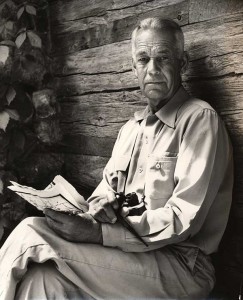
Sigurd Olson (1899-1982)
As is the case in most intellectual endeavors, where we begin our theology pretty much determines our direction and destiny.  By and large, theologians begin in one of two places, some with God and some with humanity.  The 20th century naturalist and amateur philosopher-theologian, Sigurd Olson, started in a third place, the wilderness.  According to Olson, our race was born in the wild and retains a deep connection to it, which connection modern society is severing to our vast detriment.  In the wild, we experience serenity, silence, and peace.  We discover wisdom.  The wilderness is a place where mystical experiences are always possible; when we go there our spirits are renewed and we touch God. Olson's God is an emerging deity embedded in the course of evolution.  (See, David Beackes, "The Land Beyond the Rim: Sigurd Olson's Wilderness Theology").

In a sense, Olson began his nascent theology in what we might call a "third place," the wilderness.  In another sense, however, he actually begins with both God and humanity at the same time because for him the wilderness is a revelation of both.  By wilderness, Olson meant the North Country that stretches from northern Minnesota and western Ontario to the Atlantic and northward to the Arctic.  It is a land of lakes and forests, loons and wolves.  Those who travel into the great silence of this vast land will discover themselves and come closer to God.  Thus the discovery of God and of self are not separated into compartments or chapters but are part of one spiritual process.  The human spirit and divine spirit are not to entirely separate and distinct entities.  They have a unity.  Olson's starting point is thus both God and us, and his holiest book of revelation is the Wilderness, not just because it reveals God through the divine creation but also because it is the place where God emerges onto the human stage in the human spirit.

For Olson, there was much at stake in preserving the wild places of our planet.  When (dare we anymore say, "if"?) they are gone, we will have lost both ourselves and God.  It is hard to say, "amen," to that thought.

Wednesday, August 14, 2013

A North Country Metaphor


We recently went out to land owned by friends and picked wild blackberries.  It was a wet spring and there has been plenty of rain all summer here in the North Country of New York, which means that the forests are especially green and verdant—and that there is a ton of blackberries out there just for the effort of picking them.

So, I was picking away at one particularly berry-laden spot working up the patch, getting all the berries that I could reach.  Blackberry plants have these nasty thorns, and the ground was rough, uneven, and the plant growth fairly thick.  Soon I had picked my way around to the back side of the original spot, and lo and behold looking back through the growth I could see that there were more berries back there, which I didn't see first time around.  Pushing my way toward the backside of that spot, I picked several more hands full of berries that I would have missed otherwise.

When picking blackberries, perspective is everything, but it is always limited.  It is never absolute.  There is always another side to it.  And if one insists that they've seen and picked all the berries there are without changing their perspective, chances are they haven't seen and picked all the berries.  Out in the woods of the North Country, perspective is everything.  You can canoe up to a lovely little bit of quiet water or hike to an equally beautiful place in the forest and look around carefully seeing as much as you can, but if you come back tomorrow it will be different because in the North Country perspective is always changing.  Amen.

Monday, July 22, 2013

American Theological Orientations

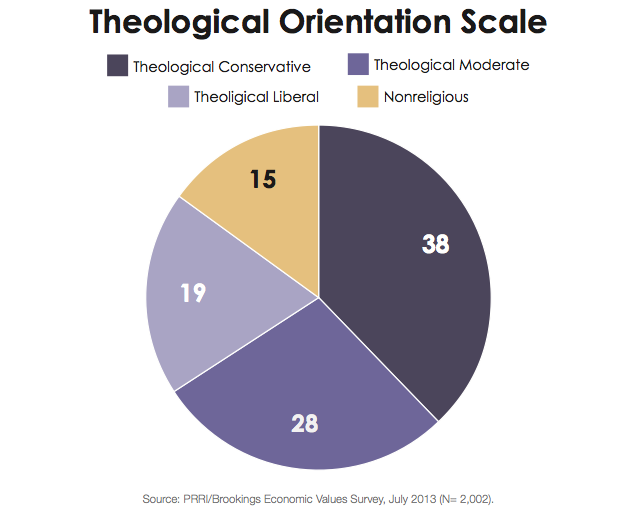
Source: PPRI/Brookings Economic Values Survey, 2013
The Public Religion Research Institute and the Brookings Institute have just released their 2013 Economic Values Survey, which includes a major section on religious orientation in the U.S. today.  The survey found that among Americans irrespective of religious affiliation, 38% are theologically conservative, 28% moderate, 19% progressive, and 15% are nonreligious.

There is, of course, a good deal of variation in these percentages among the various religious groups.  Evangelical whites are the most conservative (80%), as would be expected.  Among mainline white Protestants, conservatives number 36% and among white Catholics they are 29%.  Interestingly, some 28% of white Catholics are progressive.  Only one category among religious believers showed a plurality of theological liberals, that being "non-Christian" religious Americans of whom 43% are liberal and only 7% conservative.  This group includes Jews, Buddhists, Hindus, Muslims, and members of other "non-Christian" groups.

One other trend described in the report has to do with age.  Younger generations show a greater percentage of liberals and nonreligious while the older generations show higher proportions of conservatives and moderates.

There are no surprises here.  From a liberal-progressive perspective, there is hope in the figures for the Gen-X and Millennial generations.  Millennials in particular show just 17% being theologically conservative and 61% moderate or liberal.  One would hope that these figures foreshadow the decline of the Christian hard right and its influence in American politics as well as religion.  Along those same lines, the report shows one of the fastest growing ethnicities in the U.S., Hispanics, as already being markedly less theologically conservative (28%) and more liberal (23%) than other white Americans (40% and 18% respectively) or black Americans (49% and 14% respectively).  In terms of American theological orientations, the general trend is away from conservative and toward moderate and liberal.

However, as an editorial posting entitled, "Religious Progressives Predicted To Outnumber Conservatives, Survey Finds," notes, a significant part of this trend away from religious conservatism is toward "non-religion".  That posting also argues that progressive Christianity will never have the kind of unity and power that the Religious Right has exhibited in recent decades.  The religious left is too diverse and disinclined to exercise political power for that.  Honestly, that is not a bad thing.  A good deal of the hard right's power has been based on fear, and one would trust that a more moderate to left-leaning religiosity would be less fearful and more inclined to promoting a more Christ-like compassion for and acceptance of the Other.  Amen.

Wednesday, July 17, 2013

North Country Theology

The North Country (in blue)
Modern, Newtonian Christian theology begins with God and proceeds systematically from the divine to the mundane.  The human condition is an important downstream concern, but one that is somewhat distant from the headwaters of the Trinitarian Deity.  Modern theology is a book theology, a professional theology.

Postmodern theology begins with where the theologian is and proceeds from the human condition toward God. Place and people matter a good deal, and it is these things that determine the scope, direction, themes, and content of the theological enterprise.  Modern theology starts with God and works its way to humanity; postmodern theology starts with humanity and works back toward God.  In this mode, theology is black, feminine, Asian, tribal, African, and even Korean and Karen.  Postmodern theology is diverse and local.  It thinks a good deal about culture.

So, here is a fact:  54.3% of Lewis County, NY, falls under the category of "Forested/Wild."  And another fact: some 72% of the county's residents live in rural areas.  Many of those living in rural areas live in or near "Forested/Wild." Lewis County, as a part of New York's North Country, is also cold and snowy even in these days of global warming.  Summer comes late and is relatively cool.

These facts imply a theology.  North Country Theology.  The symbol of this theology is a sound, the sound of the loon haunting the darkening evenings of lakes and forest.  The Spirit blows across the lakes and forest in several guises from gentle almost motionless morning breezes to water lashing, tree bending storms.  It is a creation theology, a natural theology, a biological theology, an environmental theology.  It works from the "second book" of divine revelation, God's Creation.  It is not, so far as I know, a theology that has been written up, and I'm sure there aren't any seminary courses on it; but it already exists in places like Lewis County in the lives of faithful Christians who experience God in the "Forested/Wild."  North Country Theology.

Friday, July 12, 2013

Thinking Beyond the Midterm Grade

In an editorial entitled, "Midterm exams," Presbyterian Outlook editor Jack Haberer grades the Presbyterian Church (USA)'s progress nationally between the 2012 and 2014 General Assembly meetings.  He gives the denomination a good grade for implementing GA policy and a poor grade for unity.  Yesterday, I looked at the grade he gave us for denominational unity, a "C-"; today, I would like to encourage us to think beyond his grading system entirely.

As we saw yesterday, the editorial argues that some of those leaving PC(USA) are doing so in ignorance of the fact that we are not as theologically liberal as they mistakenly think we are.  For example, only a little more than one clergy in ten believes other religions can lead to salvation.  The editorial apparently faults the whole denomination for not working hard enough to inform the misinformed of the real state of things.  Then, the editorial states, "And, while our efforts have been too tepid, too limp, the provocateurs — those who love to play beyond the edges of orthodoxy — use their blog pages and Facebook groups to proclaim their eccentric ideas and pet heresies, thereby reinforcing the negative assessments of the rest of us."  The editorial does not elaborate so we are left not quite sure who these "provocateurs" are or where the "edges of orthodoxy" might be.  Since the editorial focused on universalism, however, it seems that the "eccentric ideas and pet heresies" being expounded on the fringes of the denomination have to do with that doctrine.

There is, in any event, another way to look at supposedly unorthodox, eccentric, and heretical theological perspectives that is itself less provocative and points to the value of thinking "outside of the box" theologically in a time of rapid change when increasingly large numbers of Americans are rejecting the Christian religion out of hand.  Universalism provides an excellent example.  Let's start with the simple fact that most American Christians today are functional universalists. Reporting on research conducted in 2008 in a posting entitled, "Many Americans Say Other Faiths Can Lead to Eternal Life," the Pew Forum on Religion & Public Life concludes that,
 A majority of all American Christians (52%) think that at least some non-Christian faiths can lead to eternal life. Indeed, among Christians who believe many religions can lead to eternal life, 80% name at least one non-Christian faith that can do so. These are among the key findings of a national survey conducted by the Pew Forum on Religion & Public Life from July 31-Aug. 10, 2008, among 2,905 adults.
If these Pew findings are anywhere near correct, belief in universal salvation seems hardly eccentric.  It seems to have become in fact mainstream thinking among Christians.  Our Presbyterian "provocateurs," that is, are evidently working on ideas that reflect the thinking of the majority of American Christians, a majority that we can be reasonably sure will only grow with time.

Universalism may still stand beyond the pale of a traditional orthodoxy based on so-called literal readings of the Bible, but one of the running battles we fought as Presbyterians in the late 19th and early 20th centuries was over the very issue of traditional orthodoxy.  We walked away from the idea that our denomination can or will enforce the twin doctrines of biblical literalism and traditional orthodoxy.  We are not literalists, and we encourage a diversity of theological thought.

Given all of this, those bloggers and Face bookers who supposedly stand at the edges of orthodoxy do  not seem to be so very far out on the fringe as we might mistakenly think.  They, furthermore, have an important role to play, which is to explore new ideas and find culturally relevant ways in which to express our faith.  In the Age of Science, it is important that we constantly explore in a positive way the relationship of faith and science.  In an age of increasingly secularity, we need to learn how to speak with the "nones" in ways that build bridges rather than walls.  In an age of increasing openness to those not like us, we need to learn to be comfortable with diversity.  We live in an age that shatters boxes as a matter of course, and it is vital for the sake of the good news that we proclaim to think "outside the box."

Since the Council of Jerusalem (Acts 15), we Christians have demonstrated an aptitude for adapting faith to culture as we seek the redemption of culture.  We speak from within the diverse cultures of the world so that we can communicate to them the message of Christ.  In a culture bent on change, we must embrace change.  We must risk—as previous generations have risked—losing the core of the good news for the sake of speaking about it.  To that end, we need a mix of conservatives who are always in danger of not going far enough and liberals who are always in danger of going too far.  Each have their place as we try again in our time and place to share what is precious to all of us, conservative and liberal alike.  In their day, the abolitionists were widely seen in the church to be provocateurs.  In their day, the advocates of  the full rights of women in the Presbyterian Church were considered by many to be provocateurs.  Those who have argued year after year for the rights of the LGBT community in the church are still considered by many to be provocateurs.  Each in their own time disturbed the peace of the church for the sake of the gospel.  They were the "reforming" part of "Reformed and always reforming."  Now, of course, not all provocateurs are reformers; some are just plain wrongheaded.  But, it is important for us to collectively decide over time who speaks for God's justice and who is just talky-talking.  It is our task, then, to discern anew the time we live in and how we can in the Spirit speak to and through our time.  Amen.

Wednesday, July 10, 2013

The Evolution of Our Faith

Evolution is not just a biological phenomenon.  It is built into us culturally as well.  And where we seem to be evolving is away from violence and toward nonviolence, away from injustice and toward justice, and away from discrimination and toward inclusiveness.  It is likely that we are still in the early stages of our social and ethical evolution, and its prospects for success are not clear.  We may consume our planet and ourselves before the arc of our evolution has a chance to fully kick in and take us back from the brink (or lead us around the brink, or show us how to leap across it).  Or it may well be that we evolve toward the Kingdom faster (if only slightly faster) than we destroy ourselves and our world.

Theologically, we can understand evolution as being both a divine test and a manifestation of God's grace.  Why we have been created in the way we are is beyond our knowing, at least now.  Why we can't just be perfect and skip the massive amounts of pain and suffering that are a part of evolution is also beyond our knowing.  It is true that the pain and the beauty of our evolutionary experience are deeply entwined and in their intimate dance lies a truth we keep reaching for and never quite grasp.  The Test and the Grace are two sides of the same coin—perhaps dimly like the athlete who must invest hours of dreary sweat and physical pain in pursuing that instance of victorious glory.  Or, more powerfully, the reality of both the Test and Grace, that is Cross and Resurrection, are exposed to our view in the person of Jesus Christ.

Theology evolves as well, and a key moment in our Protestant corner of that evolution came with the dawning realization that in spite of certain very clear biblical passages we can, should, and must open the gates of opportunity for full service and authority in the church to women.  The battle for racial equality has been of central importance in American society, but it has been the battle for gender equality in the church that has brought us face to face with the need to balance doctrine with justice—actually to tip the scales of faith in the direction of justice over doctrine and the social injustices that sometimes accompany our doctrines.  We are learning thus to see the Other who is not our gender, race, ethnicity, political suasion, sexual orientation, or religion as being fully within the shade of God's grace.    In this evolutionary direction lies the Kingdom of God's love, justice, and peace.  Amen.