We should maintain that if an interpretation of any word in any religion leads to disharmony and does not positively further the welfare of the many, then such an interpretation is to be regarded as wrong; that is, against the will of God, or as the working of Satan or Mara.

Buddhadasa Bikkhu, a Thai Buddhist Monk


Showing posts with label Religious Right. Show all posts

Saturday, August 31, 2013

Rethinking the "Nones" (ii)

The recent round-table discussion sponsored by the Pew Research Religion & Public Life Project on trends in religious research (transcript) focused most of its attention on the so-called "nones," a new religious category that includes those who state on sociological surveys that they are atheists, agnostics, or otherwise "not religious."  The number of "nones" has been growing, and it is clear from the discussion among the participants in the round-table that it is not exactly clear why.  It appears from the available data that what is actually happening is that people who never were involved in institutional religion used to mask that fact for researchers, but now they are more willing to state openly that they are "nones".  The absolute number of the religiously uninvolved as a percentage of the population has not risen much if at all.  The number who say they are uninvolved on questionnaires has risen.

Assuming that is really what is going on, the question is why?  One intriguing possibility is that the rise of the religious right may have something to do with the willingness of the religiously uninvolved to be more open about their lack of involvement.  The religious right has become a loud voice in American public discourse and appears more-and-more to be the dominant face of institutional religion.  The "nones" are put off by the right and thus more willing to say so publicly—or so the theory goes.  It is indisputable that the "nones" are generally more liberal than the over all population and many of them are Democrats, although apparently many do not vote and are as politically uninvolved as religiously.  There may be a connection.  That's the point of this thesis.  Given the hard-right drift in both politics and religion, the "nones" may be drop-outs from both who are now inclined to say publicly that they are drop-outs.

The religious right generally is all about absolute boundaries between right and wrong, belief and unbelief.  The "nones," so this thesis goes, accept the boundaries laid down by the right but self-consciously declare themselves to be on the other side of the line.  There is a paradox here.  The right wants to evangelize unbelievers and bring them back across the line and into the fold.  The way they go about their evangelizing, however, actually makes it more difficult for the "unbelievers" to convert because those unbelievers find the right-wing dualism of the religious right objectionable.

It has to be emphasized that this thesis is not proven.  From a progressive Christian perspective, however, it makes some sense.  We also find right-wing ideological dualism disturbing and would only want to say to the "nones" that there are other ways to think about faith and God beside those that dominant our public discourse today.

Monday, July 22, 2013

American Theological Orientations

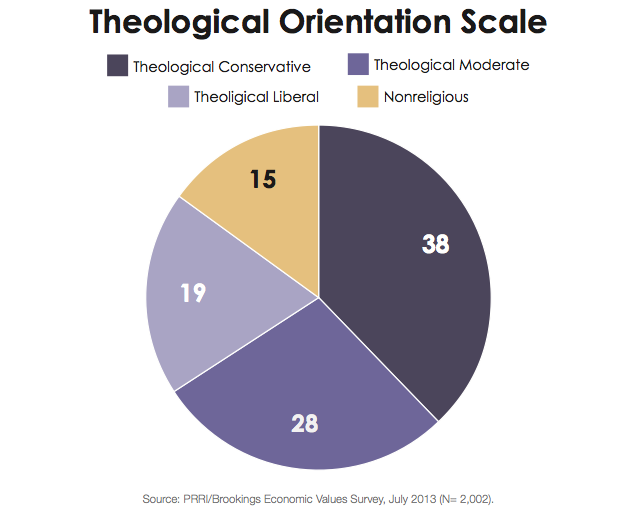
Source: PPRI/Brookings Economic Values Survey, 2013
The Public Religion Research Institute and the Brookings Institute have just released their 2013 Economic Values Survey, which includes a major section on religious orientation in the U.S. today.  The survey found that among Americans irrespective of religious affiliation, 38% are theologically conservative, 28% moderate, 19% progressive, and 15% are nonreligious.

There is, of course, a good deal of variation in these percentages among the various religious groups.  Evangelical whites are the most conservative (80%), as would be expected.  Among mainline white Protestants, conservatives number 36% and among white Catholics they are 29%.  Interestingly, some 28% of white Catholics are progressive.  Only one category among religious believers showed a plurality of theological liberals, that being "non-Christian" religious Americans of whom 43% are liberal and only 7% conservative.  This group includes Jews, Buddhists, Hindus, Muslims, and members of other "non-Christian" groups.

One other trend described in the report has to do with age.  Younger generations show a greater percentage of liberals and nonreligious while the older generations show higher proportions of conservatives and moderates.

There are no surprises here.  From a liberal-progressive perspective, there is hope in the figures for the Gen-X and Millennial generations.  Millennials in particular show just 17% being theologically conservative and 61% moderate or liberal.  One would hope that these figures foreshadow the decline of the Christian hard right and its influence in American politics as well as religion.  Along those same lines, the report shows one of the fastest growing ethnicities in the U.S., Hispanics, as already being markedly less theologically conservative (28%) and more liberal (23%) than other white Americans (40% and 18% respectively) or black Americans (49% and 14% respectively).  In terms of American theological orientations, the general trend is away from conservative and toward moderate and liberal.

However, as an editorial posting entitled, "Religious Progressives Predicted To Outnumber Conservatives, Survey Finds," notes, a significant part of this trend away from religious conservatism is toward "non-religion".  That posting also argues that progressive Christianity will never have the kind of unity and power that the Religious Right has exhibited in recent decades.  The religious left is too diverse and disinclined to exercise political power for that.  Honestly, that is not a bad thing.  A good deal of the hard right's power has been based on fear, and one would trust that a more moderate to left-leaning religiosity would be less fearful and more inclined to promoting a more Christ-like compassion for and acceptance of the Other.  Amen.