We should maintain that if an interpretation of any word in any religion leads to disharmony and does not positively further the welfare of the many, then such an interpretation is to be regarded as wrong; that is, against the will of God, or as the working of Satan or Mara.

Buddhadasa Bikkhu, a Thai Buddhist Monk


Showing posts with label Historical Jesus. Show all posts

Wednesday, August 28, 2013

Jesus the Post-Exilic Messiah

The Gospel of Matthew opens, famously, with a genealogy (1:2-17), which is divided into three sets of generations with 14 generations to a set.  The first set of generations runs from Abraham to David, the second from David to the Babylonian Exile, and the last set from the Exile to Jesus.  In the whole genealogy only one historical event named (other than births) is the Exile.  Jesus was, that is, a post-exilic Jew living in post-exilic times.  While biblical scholars may generally understand the power and importance that the Exile had in the history of the Jewish people right down to the New Testament, that understanding has not for the most part reached the churches.  Out here in the real world of the church, we tend to divorce Jesus and earliest church history from its Jewish post-exilic historical context.  We shouldn't.  Again, as we saw in yesterday's post on Matthew 1:1, "Jesus the Messiah," the first verses of the first book in the New Testament highlight the fact that Jesus was situated in a real time and place.  Our faith is that he is God With Us in a unique way, that is that God was incarnate in Jesus of Nazareth.  Matthew 1 drives home both the centrality and historicity of the Incarnation for us.

The text thus invites the historical investigation of the events recorded in the New Testament including most especially the life of Jesus himself.  That is to say that Matthew 1 and what follows in the gospels and the rest of the New Testament inspires both a theological and an academic response.  Theologically, it drives us in the direction of the Incarnation.  Academically, it invites us to engage in historiography.  In their own way, each of these intellectual responses to Matthew 1 and beyond are faithful to the text itself.  They each reflect the realities of the earliest church's faith in Jesus, namely that he was the "son of Abraham, the son of David" (Matthew 1:1) who was born fourteen generations after the Babylonian Captivity.  For Christian theologians, then, he was God's Son.  For the historians, he was a post-exilic rabbi and prophet.  From our pulpits and in our prayers, we need to pay attention to both of these faithful perspectives on Jesus of Nazareth.  Amen.

Thursday, October 4, 2012

Alleged 4th century fragment referring to Jesus' wife
In recent weeks, a fragment of an alleged fourth century document containing a reference to Jesus' wife has set the media all atwitter.  The Google search I just carried out on "Jesus wife" received "about 275,000,000 results," which is a lot of hits.  The case for the document and its possible implications is set out in a paper by Harvard Divinity School professor, Dr. Karen L. King, and is entitled, "“Jesus said to them, ‘My wife…’”A New Coptic Gospel Papyrus."  There have been so many doubts raised about the authenticity of the fragment, however, that it is not at all clear that it is genuine.  King herself says that the fragment doesn't really prove that Jesus had a wife, only that  some fourth century believed that he did.

Leaving aside the authenticity (or lack thereof) of the fragment, a couple of thoughts come to mind.  First, all of the media attention given to it gives further proof to how enamored American society is with Jesus of Nazareth.  He remains an iconic figure and a newsworthy one.  Second, it would apparently be a big deal if it could somehow be proven that Jesus did actually have a wife.  Certainly, the Catholic Church would find such an eventually awkward as the whole emphasis on priestly sexual abstinence would be called into question.  More largely, it would force all of us to rethink the doctrine of the incarnation of Christ.  That's not a bad thing.  Suppose Jesus did have a wife.  Would that not confirm the depth of God's presence in human history through Christ?  It would certainly have an impact on our gender politics, especially in the church, if it turned out that Jesus was married.  Thus, just the bare possibility that this fragment opens the door to the possibility that Jesus might have had a wife is highly newsworthy.

Daniel Burke and David Gibson, however, remind us (here) to be very cautious about all of this.  They raise the question, "But how many overhyped archaeological discoveries have proven less than world-changing under careful examination?"  They cite other examples of the uncovering  of supposedly ancient documents or artifacts that grabbed media attention for a moment but proved either insignificant in the long run and/or to be forgeries.

Still, it might be interesting to preach one or more sermons on the subject of, "What if Jesus had a wife."  There is no evidence that he did, but it is fun to speculate on what kind of husband (and father?) Jesus might have made.

Saturday, April 21, 2012

Forming the Jesus Circle (Mark 4:1-34)

A new posting in the Mark series at Rom Phra Khun Bible.  The series continues to look at the formation of the earliest church as described in the Gospel of Mark.

Monday, January 23, 2012

The Ideal Christian Life Re-examined - Mark 2:1 (xxii)

Lion of St. Mark, Piazza San Marco, Venice
This posting is the 22nd in a series (originally written in 1998) looking at the Gospel of Mark from the perspective of a historian. The first posting in this series is (here).

The idea that Jesus may have owned a home (see posting 21) and used it as a base for conducting his ministry is striking. It gives us an entirely different model for living the Christian life from that of Luke and Matthew, where Jesus is a classic wandering itinerant teacher and healer. The Jesus of Mark is a model much more reasonable and obtainable for the overwhelming majority of Christians who lead lives according to the ways of their society. The idea that Jesus had a home could also put the manner in which his earliest disciples just walked off to follow him in perspective (Mark 1:14-20). He called them to be his companions when he was on the road, not to leave their homes and families permanently.

New Testament historians point out that the early church included a class of wandering evangelists who dedicated their whole lives to their task. They were homeless. And their form of Christian ministry, as reflected in Matthew and Luke, became an important model for other Christians. There was, evidently, a certain amount of tension between the itinerants and the rest of the earlier church because the itinerants took themselves to be the "true followers' of Jesus. I'd like to offer the possibility that the author of Mark stood outside the itinerant tradition and used sources that reflected something more closely akin to the actual way in which Jesus worked. This is speculation. Only two things commend it: first, Mark points to it. Second, it's the way evangelists in Thailand conducted themselves, in conditions in the 19th century not entirely unlike those in which Jesus lived.

A couple of further thoughts. If Jesus had a house, he had to have an income of some sort for upkeep. Undoubtedly it was a small house and probably didn't cost much to maintain. (Utilities were really, really cheap in 1st century Galilee). Still, Jesus had to be involved in the everyday economic and social life of a neighborhood and a community. So, where did his income come from? It's also worth reflecting that a home-owning Jesus was more fully incarnate in his world than the no hole, no nest, and no home Jesus (Luke 9:58). It's fun to play with the idea that Jesus the Christ, the Fully God Second Person of the Trinity, owned a home. Finally, Mark changes our view of what it means to live a Christ-like life. If Jesus was a home owner, we are more (not less) challenged to live the Christian life within the every day structures of society. And living such a life can be an ideal Christian life, such as it can never be if we accept the homeless Jesus as our ideal.

Saturday, October 29, 2011

Leaning on the Historical Jesus (xi)

This is the eleventh posting in a series of postings reflecting on Thich Nhat Hanh's book, Living Buddha, Living Christ (Riverhead Books, 2007; originally published in 1995). The introductory posting, setting the stage for the series, is (here).

In posting number nine (here), we saw that Thich Nhat Hanh looks at Jesus in two ways, as the Son of God and the Son of Man, and I observed that he seems to prefer the "living Christ," the Son of God, over the historical person of Jesus, the Son of Man.  The "seems" is important because from a Christian theological perspective his understanding of Jesus is not  quite that simple or clear.  For one thing, as he goes along Thich Nhat Hanh comes back to the life and teachings of the historical Christ, observing that, "Jesus lived exactly as He taught."  He is thus a model for our own religious practice, which is based as much on his historical life as on his teachings and means that his life and teachings are more important that faith in him (page 36).  Whatever it is that makes Christ the "living Christ," thus is rooted in the actual life that Jesus of Nazareth lived and not in his eternal, timeless, and spaceless divine nature as the One through whom creation took place (John 1).

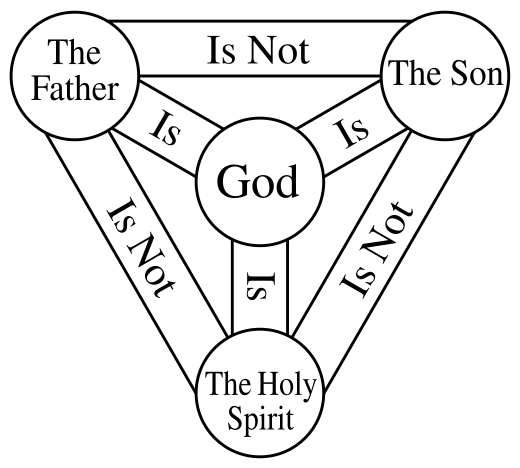
For another thing, Thich Nhat Hanh conflates the three persons of the Trinity in a way that most traditional or orthodox theologians will find unacceptable.  Jesus is the Son of God because he was "animated by the energy of the Holy Spirit."Jesus was also the Son of God because he had God the Father in him; he could not otherwise have been the Son.  Thich Nhat Hanh claims that all of this shows the "nature of nonduality in God."  (page 36) I take this to mean that in his view functionally God is not Three but rather One, which brushes aside the orthodox Christian insistence that each of the three persons of the Trinity is in fact distinct from the other two.  Historically, we have said that each person of the Trinity is not the other but all three are one in God.  Thich Nhat Hanh pretty much ignores the "is not" aspect of the Trinity—as do many Christians, in practice.

What seems to be happening here is that Thich Nhat Hanh tends (strongly) to understand God as being Present in reality while leaving aside our Christian perception that God is as much Beyond as Present.  Thus, the "living Christ" lives in us, and God the Father and God the Holy Spirit also live in us as they live in the "living Christ."  The God who, again, stands Beyond time and space and created all that is doesn't really come into the picture at all.  Let me pursue that thought in the next posting in this series.