We should maintain that if an interpretation of any word in any religion leads to disharmony and does not positively further the welfare of the many, then such an interpretation is to be regarded as wrong; that is, against the will of God, or as the working of Satan or Mara.

Buddhadasa Bikkhu, a Thai Buddhist Monk


Showing posts with label Incarnation. Show all posts

Monday, September 1, 2014

Avatar & Incarnation

Quite a bit has been written in the blogosphere about the theological implications and message of the 2009 movie, Avatar.  From a sample supplied for me by a Google search on the subject, "avatar and theology," there is obviously the usual range of responses from appreciation to deprecation.  A couple of the ones I looked at, however, caught my attention because they wrestle with the nature of Jake Sully's incarnation in a Na'vi avatar designed by human exobiologists.

One is a post entitled, "Scalp Locks, Gaia, and the Incarnation: History and Theology in James Cameron’s Avatar," by Wen Reagan, which comments on the manner in which a human is put into a Na'vi body. Reagan points out the obvious parallel between the movie's version of incarnation and the Christian understanding of the Incarnation of God in Christ.  He esp. highlights the way in which by the end of the movie the human Jake Sully has become a Na'vi, actually leaving his human body entirely.  Reagan observes, "But in the end, we don’t get a glimpse of Vishnu, safe to retreat from his current avatar and come again in another one. Instead, we get a glimpse of Christ, as Jake takes on the risk of fully embracing the Na’vi by becoming one of them, forever." Garrett East in a post entitled, "James Cameron's Avatar and the Critical Response: An Alternative Perspective," picks up on this same theme of the transformation of a human into another species by arguing that the central theme of the whole movie is the conversion of Jake Sully. He writes, "In essence, I think Avatar could be described as a conversion story," and goes on to observe that this conversion,
requires not only a change of mind and intellectual assent, but a whole new embodied way of life. It requires new eyes, new ears, a new language, and a new heart. It is a relearning of what is right and what is wrong. It is a transfer of allegiance from one people to another (the Na'vi), from one God to another (Eywa). It requires that Jake become nothing less than a new creature in a new creation...We are watching the story of a man who moves from despair, death, hate, and disbelief to hope, life, love, and even faith. When we watch Jake Sully’s story, we are watching a story about conversion.
All of which is to say a central dual theme of the story of Avatar is incarnation and conversion.

Most practicing Christians for most of the last two thousand years have held a view of incarnation not very different from that described in Avatar.  In Jesus of Nazareth, the essence of God was transferred into a human body.  God was in Christ just as Jake was in a Na'vi body.  Now, if we start to think about it, there are differences; but most of the time we don't think about it.  God was in Jesus; Jake was in a Na'vi body.  The movie makes a very important observation, however.  You can't place a person into another body and expect that there won't be any change.

One of the themes of the Book of Genesis is that God does indeed change.  In the story of the Flood, God set a rainbow in the sky as a promise that God would never again use violence against the human race and the rest of creation (Genesis 9:1-17).  Did, then, becoming incarnate in Jesus change God?  If so, how so?  If not, then how can we claim that Jesus was at one and the same time fully God and fully human?  Is it not change an essential element of our nature?

Tuesday, July 8, 2014

Somehow Present & Beyond

There lies in our understanding of One, Creator, Personal God a fundamental tension for us between the Creator and Personal faces of God.  How can this One God be both creator of the whole of the cosmos and all that is in it and yet also a presence that we can somehow sense in a personal way?  Our conception of the Incarnation of God in Jesus Christ mirrors that tension.  How could a man be at once human and divine?  How can God be somehow like us and yet completely and incomprehensibly unlike us?  And in our understanding of the Bible we are faced again with this fundamental tension.  How can a clearly fallible, human collection of words still somehow reveal to us the Word that connects us to the divine Beyond?  We call the church, the "body of Christ," and yet again how is it that this depressingly human institution can be a vessel somehow of the Spirit?

This tension between realities lies within us as well.  We discover it most painfully in the question of evil and good.  In our experience, these are not two separate categories that can be neatly divided from each other.  Out of one so often emerges the other.  Even in the darkest storm, we say, there is a silver lining.  We are at one and the same time good and not, evil and not.

How can God be both Beyond and Personal is a question that resonates across our human experience.  Maybe someday we will have an answer.  In the meantime, we live in faith.

Tuesday, June 17, 2014

Preaching and Local Theology


In a posting back in September 2012 entitled, "All Theology is Local," I suggested that our geographical and social locales play a role in how we understand God.  Different cultures also play a powerful role in our perception of the divine, as does the language we speak.  As a rule, preachers and local churches, however, devote little thought to the particular nature of their local theology and its spirituality.  The truth is, most preachers most of the time call on a mixture of personal experience, the Bible, personal theology, and pop culture to shape their preaching.  Some will draw on literature or the arts from time to time.  And preachers will more-or-less naturally draw on local images and stories for their sermons, especially if they have been in the same locale for a longer period of time.

There is less evidence of preachers consciously reflecting with the church they serve on the ways in which they experience God in their setting including their natural environment and local culture.  In Lewis County, New York, for example, many people continue to reside here because of its proximity to the northern wilderness.  Many hunt and/or fish.  Others are hikers or ride horses or engage in other outdoors activities.  Many live in the forest as a conscious choice, and in all of this there is often enough a spiritual component to their decision to live in or near the wilderness.  It is quite possible to speak of a "north country spirituality," which spirituality should inform the content of preaching in north country churches and from time to time be addressed directly.

In many locales, there would be a combination of local theologies and spiritualities, such as a farm country spirituality that combines with a Great Plains theology or a hillbilly theology.  An urban theology could well also encompass black theology or hispanic spirituality perhaps in tandem with a North Atlantic costal theology.  The larger point here is that we always experience God through our culture, local history, and natural environment and that fact should be incorporated into local preaching in a conscious way.  Amen.


Saturday, March 8, 2014

Jesus as a Vagrant: Two Views

"Homeless Jesus" by Timothy P. Schmalz
The website for WCNC, Charlotte, North Carolina, recently carried a news post entitled, "'Homeless Jesus' sculpture sparks controversy," which reports on reactions to a sculpture entitled, "Homeless Jesus,"by Timothy P. Schmalz.  As seen at left, the statue is a lifelike representation of a homeless person sleeping on a bench.  Only the feet of the person are showing, and a close up of the feet shows the wounds of crucifixion on them.  The statue was recently placed in front of St. Alban's Episcopal Church, Davidson, NC, and has evoked two basic responses—positive and negative.  Two other churches were originally approached to display the statue, and they both declined the opportunity.

The rector at St. Albans and two church members, as reported in the posting, all feel that the statue represents an important aspect of who Jesus was.  The rector is quoted as saying, ""It's Jesus representing the most marginalized of society... We're reminded of what our ultimate calling is as Christians, as people of faith, to do what we can individually and systematically to eliminate homelessness," Buck said, "Part of a faith commitment is to care or the needy."  A member of the community, however, is quoted as saying that the statue does not represent who Jesus really is. She said, ""I can't understand why anyone would want this," and argued according to the article that the statue is "an inappropriate message and wrong for the neighborhood." She would rather have a statue that shows Jesus "standing over the homeless protecting them." The article quotes her as saying in conclusion that "Jesus is not a vagrant, Jesus is not a helpless person who needs our help... We need someone who is capable of meeting our needs, not someone who is also needy."

This is a debate about Jesus that we have been having for two thousand years.  For some Christians, it was and is the power of Christ that is most important.  For others, it was and is his humility and his actual human weakness that is most significant.  The Christian tradition has insisted that he was both human and divine, but that still leaves us with the question of how we understand a human inhabited by divine power who was at the same time God embodied in human weakness.  In this case, however, I'm not sure we actually have to choose between the two.  Jesus can be for us both the one who is homeless and the one who is a patron for the homeless; he both sleeps on the bench and works through the Spirit to get others off of the benches where they must sleep.  He is weakness inhabited by power and power embodied in weakness.

And, personally, it would be quite a statement if "Homeless Jesus" was placed in the public triangle in front of First Presbyterian Church, Lowville, NY.  Placed there, it would be a still more powerful image of the vagrant Christ to have him sleeping on a snow encrusted bench in the midst of our winter snowscape—cold, alone, and bedded in the snow.  Of such things are our visions of the Incarnation made.  Amen.

Wednesday, August 28, 2013

Jesus the Post-Exilic Messiah

The Gospel of Matthew opens, famously, with a genealogy (1:2-17), which is divided into three sets of generations with 14 generations to a set.  The first set of generations runs from Abraham to David, the second from David to the Babylonian Exile, and the last set from the Exile to Jesus.  In the whole genealogy only one historical event named (other than births) is the Exile.  Jesus was, that is, a post-exilic Jew living in post-exilic times.  While biblical scholars may generally understand the power and importance that the Exile had in the history of the Jewish people right down to the New Testament, that understanding has not for the most part reached the churches.  Out here in the real world of the church, we tend to divorce Jesus and earliest church history from its Jewish post-exilic historical context.  We shouldn't.  Again, as we saw in yesterday's post on Matthew 1:1, "Jesus the Messiah," the first verses of the first book in the New Testament highlight the fact that Jesus was situated in a real time and place.  Our faith is that he is God With Us in a unique way, that is that God was incarnate in Jesus of Nazareth.  Matthew 1 drives home both the centrality and historicity of the Incarnation for us.

The text thus invites the historical investigation of the events recorded in the New Testament including most especially the life of Jesus himself.  That is to say that Matthew 1 and what follows in the gospels and the rest of the New Testament inspires both a theological and an academic response.  Theologically, it drives us in the direction of the Incarnation.  Academically, it invites us to engage in historiography.  In their own way, each of these intellectual responses to Matthew 1 and beyond are faithful to the text itself.  They each reflect the realities of the earliest church's faith in Jesus, namely that he was the "son of Abraham, the son of David" (Matthew 1:1) who was born fourteen generations after the Babylonian Captivity.  For Christian theologians, then, he was God's Son.  For the historians, he was a post-exilic rabbi and prophet.  From our pulpits and in our prayers, we need to pay attention to both of these faithful perspectives on Jesus of Nazareth.  Amen.

Tuesday, August 27, 2013

Jesus the Messiah

The first verse of the first book of the New Testament, Matthew 1:1, reads, "An account of the genealogy of Jesus the Messiah, the son of David, the son of Abraham." (NRSV)  We should not pass over the meaning of this passage as it takes it at once into the core of New Testament faith.  For the earliest generations of the faithful,  Jesus was the Jewish messiah, and this is the first spiritual "fact" asserted in the first verse of the New Testament.  Whatever else Jesus of Nazareth might have been, those who followed him were convinced that he was the one the Jewish people had long waited for—the one to lead them to safety.  The verse, furthermore, drives home the "fact" of Jesus' messiahship by noting that he was the "son of David, the son of Abraham."  He was, that is, heir to the royal power of King David and the powerful faith of Father Abraham, which meant that his messianic pedigree was legitimate and impressive.

In light of the Trinitarian faith that later developed, there are a couple of things worth noting here.  First, in these stage-setting, theme-setting first words in the New Testament there is no hint of the divine Son of God who is the Second Person of the Trinity.  If his generation had believed in these doctrines when Matthew was written, it seems likely that the author would have included something to indicate the divinity of Jesus, even something as simple as, "the son of David, the son of Abraham, the son of God."  At the heart of the New Testament message is Jesus the Messiah.  It took the church centuries to read his divinity back into the record.

Second and in light of the doctrine of the Trinity, this simple verse points decisively to the incarnational nature of the Christian faith.  The story of the divine Jesus begins with a genealogy tying him to a long list of what the people of Matthew's time took to be historical figures.  He was Jesus of Nazareth, son of David and of Abraham.  Historically down to the present, large segments of the church have virtually denied the Incarnation by their emphasis on the Perfect Son of God who shared and shares God's omnipotence and omniscience.  They have also denied the historical reality of Jesus the Messiah by turning him into "Sweet Jesus," the one who offends no one, never has an unkind word or thought.  The Jesus of Matthew 1:1 has long been buried under the weight of our philosophies and ideologies to the point that it has become impossible to see how God was actually in an actual person in the real world of the first century.

Tuesday, March 5, 2013

Incarnational Politics

Political commentator Steve Kornacki recently posted an interview he did with former Speaker of the House Newt Gingrich entitled, "In the real world we were kidding ourselves."  The focus of the interview, obviously, was the results of the 2012 election and what they mean for the Republican Party.  Unlike many Republicans who are not willing to contemplate more than a cosmetic touch-up of their party, Gingrich argues that it must undergo substantial change.  In the course of the interview, Kornacki asked Gingrich, "When you look at the Republican Party’s relationship with African Americans and Hispanics, what is the message you want to deliver to those voters?" Gingrich answered by calling for the Republican Party to undergo "a big rethinking," a "very large fundamental rethinking." He then stated,
The first thing you have to do with African Americans, Latinos, and Asian-Americans and Native Americans is go there. They don’t need to come to you; you need to go to them. And when you go there, listen. Phase one is not going there to tell about you. Why is it we can have entire cities that are disasters, that we can have 500 people getting killed in Chicago, we can have Detroit collapsing, we can have the highest black unemployment teenage in modern history, and no Republican politician can figure out that going there to say, “Gee, shouldn’t we do something to make this better”? And then talk about it jointly, so it becomes a joint product — that it’s not “Let me re-explain conservatism.” I don’t mean to walk away from conservatism, but we need to understand conservatism in the context of people who are talking with us.
This is almost stunning stuff.  In effect, Gingrich is proposing what in theological circles we can only call an incarnational approach to the practice of politics.  In order to become a party of all the people, the Republican Party has to go to the people and not talk at them about conservative principles but listen to them regarding their lives and needs.  Go to listen.  Then, Gingrich proposes, the party has to work collaboratively with the people to address real life problems, such as gun violence in Chicago or the collapse of Detroit.  Finally, he urges conservative Republicans to understand their conservatism in the context of "people who are talking with us."  In short, he is calling for a politics that is dialogical, collaborative, and contextual.  Theologically speaking, he is proposing a Christ-like, incarnational politics.

Two thoughts.  First, we would all benefit immensely if the Republican Party, by some miracle, embraced this path of political renewal.  Gingrich is proposing a set of attitudes and cognitive habits that would influence the whole way the party approached politics—including the way it related to Democrats, women, the LGBT community, and foreign nations.  Imagine a political culture in which both parties behaved according to the incarnational principles espoused by Gingrich!

Second, but back in the real world it is impossible to imagine that such a thing could come to pass as long as the tea party-ist radical right continues to dominate Republican discourse and behavior, such as it does today.  The recent flap over CPAC's failure to invite Gov. Chris Christie (R-NJ) to speak (see here) is but one reminder of where vocal American conservatism seems to be today.  The radical right's vocal indictment of less right wing Republicans as being RINO (see here) is another.  Only to the extent that the Republican Party can isolate and reduce the influence of its radical, dualistic, our way or the highway wing will it have the opportunity to become what Gingrich envisions for it.

Still, the vision is a noble one.


Thursday, November 29, 2012

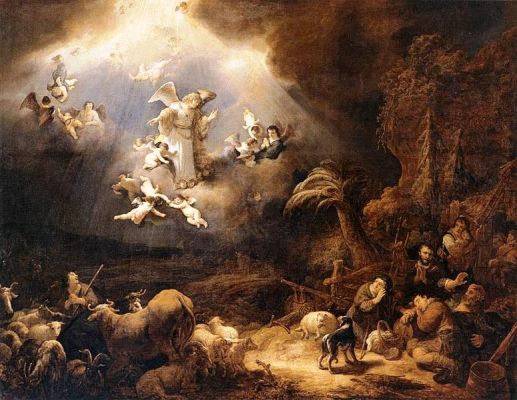
In That Region

"Angels Announcing the Birth of Christ..." (G. Flinck)
In that region there were shepherds living in the fields, keeping watch over their flock by night. (Luke 2:8 NRSV)

James L. Kugel in his book, How to Read the Bible (Free Press, 2007) describes three levels of biblical interpretation: (1) the original intent of the biblical contents; (2) the reinterpretation of that intent in ancient times, which came to be accepted as the "real meaning" of the Bible; and (3) modern scholarly attempts to get past #2 back to #1.

There is a fourth level, which in some ways is a return to level two in light of the contributions of level three.  In level four, we are most concerned to re-read scripture in light of the world we live in now while not ignoring the general findings of the scholars who reside in level three.  Level four readers often reject level two readings as being irrelevant and unpersuasive and seek to replace level two's "old-time religion" with interpretations more fitting to the early 21st century.

Reading at level four, then, our beginning point in the story of the shepherds encounter with God in their fields one night seems obvious.  The story opens with a group of working stiffs, probably relatively poor, who are working the night shift watching sheep.  Apparently, they actually lived in the fields, which may or may not suggest some kind of permanent residence.  The obvious point is that the first public announcement of the coming of the messiah is made to rural working class commoners who were actually at work at the time.  The point isn't subtle.  The very first proclamation of the Good News was not published in the Jerusalem Gazette nor did it make the 6:00 news.  It was announced away from the public eye and to an unassuming group of poorer folks.

As obvious as this initial point is, it warrants our attention because it sets the stage not just for the rest of the story but also for the whole Gospel of Luke.  The Incarnation took place in the real world.  It took place in the midst of the working poor who were literally the 99% in their day.  Impossibly long hours.  Smelly sheep.  Dangerous working conditions.  Lives that were short, hard, and sometimes brutal.  Jews living in Roman occupied territory where oppression touched every life.  This is where our story of the shepherds and angels opens and where the first proclamation of the good news of Christ took place—in the real world.

Thursday, October 4, 2012

Alleged 4th century fragment referring to Jesus' wife
In recent weeks, a fragment of an alleged fourth century document containing a reference to Jesus' wife has set the media all atwitter.  The Google search I just carried out on "Jesus wife" received "about 275,000,000 results," which is a lot of hits.  The case for the document and its possible implications is set out in a paper by Harvard Divinity School professor, Dr. Karen L. King, and is entitled, "“Jesus said to them, ‘My wife…’”A New Coptic Gospel Papyrus."  There have been so many doubts raised about the authenticity of the fragment, however, that it is not at all clear that it is genuine.  King herself says that the fragment doesn't really prove that Jesus had a wife, only that  some fourth century believed that he did.

Leaving aside the authenticity (or lack thereof) of the fragment, a couple of thoughts come to mind.  First, all of the media attention given to it gives further proof to how enamored American society is with Jesus of Nazareth.  He remains an iconic figure and a newsworthy one.  Second, it would apparently be a big deal if it could somehow be proven that Jesus did actually have a wife.  Certainly, the Catholic Church would find such an eventually awkward as the whole emphasis on priestly sexual abstinence would be called into question.  More largely, it would force all of us to rethink the doctrine of the incarnation of Christ.  That's not a bad thing.  Suppose Jesus did have a wife.  Would that not confirm the depth of God's presence in human history through Christ?  It would certainly have an impact on our gender politics, especially in the church, if it turned out that Jesus was married.  Thus, just the bare possibility that this fragment opens the door to the possibility that Jesus might have had a wife is highly newsworthy.

Daniel Burke and David Gibson, however, remind us (here) to be very cautious about all of this.  They raise the question, "But how many overhyped archaeological discoveries have proven less than world-changing under careful examination?"  They cite other examples of the uncovering  of supposedly ancient documents or artifacts that grabbed media attention for a moment but proved either insignificant in the long run and/or to be forgeries.

Still, it might be interesting to preach one or more sermons on the subject of, "What if Jesus had a wife."  There is no evidence that he did, but it is fun to speculate on what kind of husband (and father?) Jesus might have made.

Thursday, June 21, 2012

Revisiting Jesus & Dualism

A week or so ago, the Presbyterian news website, Church and World, picked up on a Rom Phra Khun posting entitled, "Jesus & Dualism," which generated  a spike in visits to this usually quiet, backwater blog.  Among the visitors was a sister Presbyterian blogger of a different theological persuasion, Viola Larson.  She did not like what she read and has posted a scathing critique of my blog entry (here).  She labels me, among other things, a heretic.  It's pretty blunt stuff.  One of her commenters even linked me to the notorious (on the Right) John Shuck of Shuck & Jive fame.

I only mention this because Viola's posting raises the important and fascinating question of the two natures of Christ, his humanity and divinity.  She accuses me of "rending" them apart.  This is an issue that has been debated intensely in Christian circles since the earliest days of the Jesus Movement.  Fairly early on, we settled on the formula "fully God, fully human" to express that affirmation.  But what does that mean?  Specifically, does it mean that the historical person of Jesus of Nazareth was all-knowing, all-seeing, and all-powerful in a divine sense, which seems to deny his humanity?  Humans are by definition limited, creaturely beings.  Does it mean that God somehow became limited, which seems to be a fundamental denial of divine nature?  God by definition is Beyond human or even cosmic limitations.  How do we put these two natures together in one physical body?

The truth is that faithful Christians frequently tend to lean one way or the other in their view of Christ.  Those on the "high Christology" side emphasize his divinity while struggling to contain that divinity in his humanity.  Those on the "low Christology" side are big on Christ's humanity while struggling to fit his divine nature into his humanity.  Viola holds to a high Christology, while I hold to a low one.  Were I so inclined, I suppose, I could accuse her of rending apart Jesus' two natures, too.  To do so would be to miss the point that the person of Jesus, human and divine, is important to both of us—profoundly meaningful and worthy of our life's commitment.

I accept the two natures of Christ formula, which for me means that God the Beyond was incredibly present in Jesus of Nazareth, but not in a way that was immediately obvious to those around him.  The gospels, particularly Mark, portray Jesus as a man who could grow tired, didn't know everything, could lose his cool, and shared some of the prejudices of his age.  The gospels clearly associate Jesus with God to such an extent that the early church soon enough worked out the two natures doctrine to explain that association, but it is worth noting that the struggle was not with Jesus' human nature.  That was always the easy part.  It was with figuring out how one man could also be God incarnate.

For myself, it makes most sense to see Jesus as being a real-time, actual human being with the full set of human qualities.  In fact, the point of the incarnation is that God humbled God's self, stooped down to our level, and became one of us.  "One of us" is not all-knowing and all-powerful.  "One of us" feels pain, grief, and struggles with human limitations.  If God the Beyond did not shed such divine attributes, the incarnation was not a risk and not truly a sacrifice.  Jesus was God With Us in his intense compassion and courage, a spiritual and moral Presence that I associate with the Holy Spirit.  The gospels seem to me to make that same association in their descriptions of Jesus' baptism.

It is helpful to remember the fact that those who knew Jesus the best in his own time did not come up with any clear formulation of his two natures.  Indeed, apparently, they seem to have thought of him primarily (again, esp. according to the oldest gospel, Mark) as the Messiah, which didn't at first mean he was divine.  Then, the dominant wing of the early church came to think of Jesus as a "super" Messiah, which belief eventually evolved into the two natures doctrine.  We should not forget that important segments of the early church saw Jesus either as "just" a man or as God who only appeared to be a man.  Both of these views were eventually deemed heretical.

So, I am in Viola's debt.  She has brought Rom Phra Khun increased attention, which can't be all bad.  She has taken my own thoughts on the person of Jesus very seriously, which also can't be all bad.  And she has afforded me the opportunity to slow down and think again about Jesus and our shared faith in him as Lord and Saviour, which is all to the good.

Thursday, October 27, 2011

Taking the Incarnation Seriously (x)

This is the tenth posting in a series of postings reflecting on Thich Nhat Hanh's book, Living Buddha, Living Christ (Riverhead Books, 2007; originally published in 1995). The introductory posting, setting the stage for the series, is (here).  Readers will want to read the previous (ninth) posting (here) before tackling this one.  It follows on nine.

In the interest of "full disclosure," I probably should say that my personal theology leans to the human Jesus rather than the divine Christ.  Given my training in history and the fact that I worked as a professional historian for many years (albeit in a church setting), it is hardly surprising that I find Jesus of Nazareth a fascinating and challenging historical figure.  Still, there was something go on in Jesus that doesn't go on in the rest of us.  That "something" lies deep within "the Christ event," and we should approach it with some trepidation and a realization that it defies human categories and easy dogmatic descriptions.  Indeed, it seems that the rush to embrace Jesus, the Son of God and sing high praises to Him, is always in danger of turning doctrines about the divine Jesus into idols that twist the actual person of Jesus, the Christ, into human renderings of what we think he should be.

The Asian theologian, Kosuke Koyama, has written a book entitled, No Handle on the Cross, in which he makes the point that we can't own the cross with our human ideas and doctrines about it.  It is not something we can "handle," manage, or control.  That goes for Jesus in general, and having to wrestle with the fact that he was just as human as the rest of us and bound by our human limitations should make us wary of over doing his divinity.  We should have to always be straining to glimpse the "living Christ."  He should remain slightly elusive, never quite in focus so that we can't envelope Him and thus turn Him into something of our own making.  The historical person of Jesus, thus, grounds us in the way God moves among us, which is itself elusively and obliquely—and patiently.  Amen.

Wednesday, October 26, 2011

Two Buddhas, Two Christs (ix)

This is the ninth posting in a series of postings reflecting on Thich Nhat Hanh's book, Living Buddha, Living Christ (Riverhead Books, 2007; originally published in 1995). The introductory posting, setting the stage for the series, is (here).


In Thich Nhat Hanh's view, there are two ways to understand the Buddha and Christ.  Each of them was, first, an historical person.  And each of them, second, is also today a living person: the living Buddha and the living Christ.  In the case of Jesus, he is both the Son of Man and the Son of God.  Thich Nhat Hanh shows little interest in the historical versions of the Buddha and Christ and focuses, instead, on the living ones.  He describes the living Buddha as being "the Buddha within ourselves who transcends space and time."  He is linked to ultimate reality, "transcends all ideas and notions and is available to us at any time."    In Jesus, we are able to "penetrate the reality of God," who is made known to us through Christ.  Jesus was "animated by the energy of the Holy Spirit." (pages 35-36)


It is interesting and, perhaps, instructive to watch a friend of the Christian faith seem to do the same thing we Christians do, which is to give lip service to the doctrines of the incarnation of God in Christ and the two natures of Christ, divine and human, and then to prefer one over the other.  And Thich Nhat Hanh even seems to prefer the one the vast majority of Christians prefer, namely the divine nature of God.  For much of our faith's history, Christians have put their trust in the Son of God, the Second Person of the Trinity, to such an extent that Jesus' humanity seems to be not much more than a formality.


Historically, however, it took decades stretching out into centuries to work out the divine nature of Christ.  The earliest church knew that Jesus of Nazareth was a real, historical person with the limitations of human nature.  They knew that the great majority of people who met him had no sense of his being in any way divine and that as Jews it was not possible that they would.  The very earliest Christians, the ones who knew Jesus personally, themselves did not see him as "fully man, fully God," and in fact it took time and thought for them to see that God was in Jesus in a way unlike the rest of humanity.  It was only in the long centuries after that faithful Christians increasingly emphasized the majesty of Christ at the expense of his humanity.  Like Thich Nhat Hanh, they preferred the living Christ to the historical Jesus.


Since the rise of science and modern historiography, the emphasis on the divine Christ at the expense of the historical Jesus has become problematic.  Let me pursue that thought in the next posting and here simply note that Thich Nhat Hanh seems to do what all Christians do, which is to prefer one Jesus or the other, the human one or the divine one.