We should maintain that if an interpretation of any word in any religion leads to disharmony and does not positively further the welfare of the many, then such an interpretation is to be regarded as wrong; that is, against the will of God, or as the working of Satan or Mara.

Buddhadasa Bikkhu, a Thai Buddhist Monk


Showing posts with label History. Show all posts

Thursday, June 26, 2014

Beyond the Newtonian Jesus

Christian orthodoxy across all denominations and traditions affirms the dual nature of Christ as both human and divine, man and God.  In the Age of Science, the European branches of the faith have largely treated the Doctrine of the Incarnation as if it is a fact on the order of scientific factuality.  Gravity attracts, Columbus discovered the Americas in 1492, and Jesus was human and is divine.  These three "facts," however, exist in three different realms of their own.  Gravity is an observable physical phenomenon.  It requires research to explain it, but explain it or not it is.  The discovery of the Americas is a historical fact, which itself is not observable.  It does not even exist because it lies in the past, which by definition no longer exists in the present.  It is over and done.  We require research to know that it even took place.

The doctrine of the incarnation takes us into a third realm.  All spiritual experiences do.  In and of itself the dual nature of Jesus of Nazareth was not observable, even after his resurrection.  It took the early church centuries of controversy and debate to develop the doctrine.  It cannot be established by observation or by research.  It is a matter of faith that is both experiential and philosophical.  It is philosophical in the sense that it had to be thought through using the powers of reflection and reason.  It is experiential in the sense that on reflection the earliest church saw in their experience of Jesus an experience with God and succeeding generations of Christians have affirmed that we too see in our experience with Christ an experience with God.  None of this fits the profile of a physical phenomenon or historical event.  Jesus did not have a special God organ.  According to the biblical accounts, he was observably human.  And while the doctrine of the incarnation and its development is historical as a doctrine, the purported divinity of Christ is not itself a historical fact.  All that historians can establish is that there was and is a belief in Christ's divinity, not the divinity itself.  Historians are not equipped to deal with spiritual events any more than carpenters are equipped to drill teeth.

For those of us living on the postmodern bridge between the Newtonian world (a.k.a. "modernity") and whatever is coming next, it is excruciatingly difficult to separate divinity from factuality.  For us, God is not a physical phenomenon.  There is no science that deals with God or has the tools to establish the factuality of God in any way that makes scientific sense.  I am personally convinced that one day future science (or whatever comes after science) will discover God, but I don't have a clue what that even means.  Future science will rely on technologies and ways of thinking that have yet to be developed.  In the meantime, we must rely on spiritual sensitivities and the insights we draw from them to discern the Beyondness and the Presence of God.  And we have to unlearn our worshipful respect for facts.  We have to move beyond the doctrine that only what is factual is real.  We have to stop thinking that science is the last stop in our cognitive evolution.

We have to live in faith.

This does not mean we stop thinking critically but precisely the opposite.  It means that when we sense the divine in a sunset and find peace in meditation we accept that we are participating in a different realm of reality—one where Christ is human and divine for those of us who put our faith in him and where the logic of science is flawed, open to criticism.

Thursday, May 15, 2014

Historically Reliable?

As reported in the Washington Post (here) and elsewhere online, Mr. Steve Green has developed a high school course for the study of the Bible, which will be tested next school year at a high school in Oklahoma.  In an editorial entitled, "Is the Hobby Lobby Bible elective objective?" commentator Stephen Prothero raises two objections to the curriculum.  First, he argues, it betrays a Christian bias; it is not secular and objective.  Second, in various, subtle ways the authors uncritically promote the idea that the Bible provides reliable historical data.  He particularly points to a summary box in the text that reads, “We can conclude that the Bible, especially when viewed alongside other historical information, is a reliable historical source.”

Understanding the point Prothero is making, still one can argue that the assertion in the summary box is a correct one if properly understood.  The condition that the Bible is a reliable historical source when viewed along other historical information is crucial depending on how we understand the meaning of "other historical information."  If it includes the mountains of research and commentary devoted to the Bible by reputable biblical scholars then I would have to agree that the Bible, read critically, is indeed a reliable historical sources.  This does not mean that every event asserted in its text happened as described in its pages.  It does mean that the text of the Bible opens important doors for our understanding of the past.  It beautifully describes an ancient cosmology.  It hints at the emergence of monotheism from polytheism.  It describes among other things political developments in Western Asia over many centuries.  It provides insights into the person of Jesus and of Paul as well as data useful for understanding the emergence of the Jesus Movement in the first century AD (or CE, take your pick).

One has to read the text critically, consult other sources, and immerse oneself in the relevant scholarly literature.  And one has to be circumspect in claiming what information is available through careful readings of the text.  Still, given these conditions, the Bible is a reliable historical source—recognizing that some biblical texts are more reliable than others.

Before I returned to pastoral ministry, I devoted 16 years to the study of church history in Thailand.  I have spent a good deal of time with Protestant missionary sources.  There are scholars who refuse to use those sources for the study of Thai history generally "because they are biased."  My response is, "Yes, of course, they are biased.  But they also contain a wealth of information on subjects other than Protestantism in Thailand if one read them critically and knowledgeably."  The bias is generally clear, indeed so obviously apparent that it is not that difficult to sift it out just as if one were panning for gold.

By the same token the biblical texts are important sources for the study of the ancient world.  Yes, the authors of the curriculum mean something different by the phrase "reliable historical source," but they are still right that it is reliable—even if for the wrong reason.

Saturday, November 2, 2013

Beyond Modernity

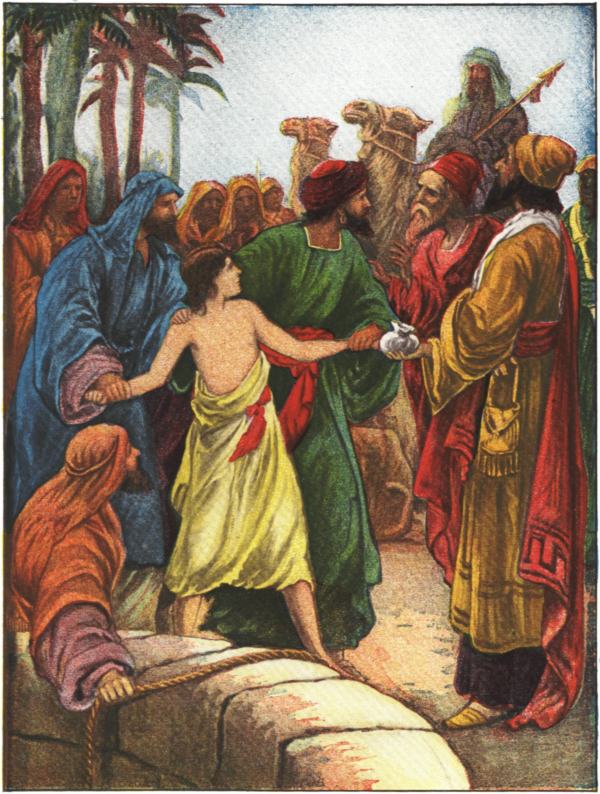
Joseph Sold into Captivity
In his commentary on Genesis (Genesis, John Knox, 1982), Walter Brueggemann argues that the final narrative of the book, the "Joseph Narrative" (Genesis 37-50), is fiction rather than history.  It is a story or composite of stories written as a bridge to carry the Israel's story over the gap between Abraham, Isaac, and Jacob and the Exodus.

By treating the Joseph Narrative as fiction rather than as history, Brueggemann does not lose the value of the stories in it.  He makes it possible, rather, to focus on the story itself rather than the actors.  The tendency otherwise is to give our attention to the actors and attempt to psychoanalyze them—figure them out.  The story, when treated as history, is not important in and of itself but for what it reveals about it characters.  If the story is fictional, however, our attention shifts to the author and the story itself.  It shifts to a deeper level of meaning in which the story becomes a witness to Israel's faith in the era of Exile when it was likely written.  And there is the added value of laying aside the need to defend the Bible's factuality at all points, which so often obscures its deeper meanings and spiritual value by forcing us to worry about superficial issues such as demonstrating that Jonah could survive for three days in the belly of a fish or proving that David really did write the psalms attributed to him in the Book of Psalms.

Equally to the point, the Joseph Narrative is just as historical whether it be treated as literature or as a factual account of actual events.  It gives witness to the faith of its author and its times and thus reflects the historical experience of the Jewish people.  It is as true spiritually and no less inspired.  Treating it as literature, in truth, helps to awake us from the dreamworld of modernity with its narrow understanding of reality and its obsession with factuality.

Tuesday, July 2, 2013

Telling the Truth About War

James Holland, The Battle of Britain (St. Martin's, 2010), poses a serious question concerning how we view war generally.  Drawing mostly on personal stories of those involved, especially pilots from both sides, Holland renders an almost intimate portrait of the Battle of Britain, which celebrates the courage of the pilots and the role the British played in turning the tide against Nazi Germany.  The larger elements of strategy and tactics and the ways and means of the war are included, but in a less prominent role than usual.  The book is about the people that fight wars as much as it is about war itself.

War is not good, the lesson seems to be, but there are things related to war that can be taken to be good.  Pilots were courageous, Britons and Germans sacrificial, and Britain's staying power and superior skills at waging modern war praiseworthy.  That's fine as far as it goes, but what do we do with it?  Do courage, heroism, grit, and fortitude tip the balance sheet of war, if even slightly?  Or, do they serve to highlight the evil of war by their contrasting goodness?  Is war itself a mixed bag of good and evil?  Or is it unmitigated evil to which people respond with good qualities?  For my money, it is the latter.  The human spirit does find ways to turn even the most evil aspects of human nature to a good that is not inherent in the evil.  We can create good out of the evil, just as we seem endlessly able to subvert good to evil ends.

Perhaps it is not necessary to come away from every book about war with a feeling of revulsion for the institution itself, but perhaps we should remain at least somewhat conscious of what lies behind the courage and heroism—the backdrop of war.  That is what I personally found understated in Holland's portrait of the Battle of Britain, the backdrop of pain and misery the whole world suffered because of World War II.  It is there, for example, in the deaths of individual pilots, but understated nonetheless.  Pain, death, suffering, and destruction are the main themes of any history of war, and where they are not sufficiently present in the historian's prose her or his history is less than adequate.  It is less than an accurate historical portrayal of war.

Thursday, February 14, 2013

Reality, Truth, & Scripture

Jacob Set Up a Pillar at Rachel's Grave (Gen. 35:20)
 Genesis 35:16-21 comes after the famous story of Jacob's dream of a ladder between heaven and earth and recounts the birth of Jacob's son, Benjamin, and the death of his wife Rachael.  The passage concludes in verse 21 with the statement that, "Israel [Jacob] journeyed on, and pitched his tent beyond the tower of Eder." (NRSV)   Of this verse and passage, Walter Brueggemann observes, "As though to stress the historical reality of this family, that it must face death and move on, the narrator ends with the brief report, 'Israel journeyed on...'" (Brueggemann, Genesis, 284).  As I understand it, Brueggemann himself is not claiming that there was a "historical Jacob" but that the narrator believed that to be the case and was highlighting that assumption with the words, "Israel journeyed on..."

The Wikipedia article on "Jacob" states, "Most biblical scholars and historians of ancient Israel today view the patriarchical narratives, including the life of Jacob, as late (6th and 5th centuries BCE) literary compositions that have ideological and theological purposes but are unreliable for historical reconstruction of the presettlement period of Israel’s past."

The average reader and some professional historians might conclude, thus, that the Genesis stories about Jacob (and more generally) are "not true" and have no historical value.  That is a wrong conclusion.  In a very important sense, whether or not there was a "historical Jacob," is neither here nor there.  The story is historically accurate and even factual—in the sense that it accurately reflects the real religious experience of ancient Israel and truly reflects the nature of the life of faith in a given historical period.  Now, that  period may not be the "presettlement period" before the Hebrews took possession of Palestine.  It may well be that it reflects the time of the Exile and post-exilic era, the time when scholars think these stories were stitched together into the Book of Genesis.  Nonetheless, the book of Genesis is a reliable document in the historical reconstruction of ancient Israel's life and faith.

Historians ask two kinds of factual questions.  First and more precisely, did the events recounted actually happen?  Second and more broadly, what does the account tell them about the past?  In this case, the historian has every reason to doubt whether the events recorded in Genesis actually too place.  Many of them seem improbable, and there is no corroborating evidence.  What the historian can safely assume, however, is that the form and content of the Book of Genesis story do reflect the real world of ancient Israel.  In this more general sense, Genesis is historical and a valuable historical document.

As scripture, then, we have confidence in the story of Jacob in at least two ways.  First, we know that it accurately reflects a moment in our faith tradition that remains important to us today because of its influence on the course of our history and because of what we can learn about our faith from it.  Second, scripture for us is inspired, that is the Spirit speaks through it to us.  For most Christians, it is important that the voice of the Spirit be grounded in historical reality.  Ours is an incarnational faith.  We know from the study of the past (history) that this portion of scripture is grounded in historical realities.  In faith, we trust in the spiritual fact that the Spirit thus speaks through these stories across the span of generations to us.

Monday, January 7, 2013

Forgetting the Past

We can forget the past, but the past, most assuredly, will not forget us.

Eric Foner,
Who Owns History? (New York: Hill & Wang, 2002), 108.

Tuesday, December 4, 2012

Charting the Future

We can chart our future clearly and wisely only when we know the path which has led to the present.

Adlai Stevenson
Speech, Richmond, Virginia (20 September 1952).
Source: Wikiquote

Tuesday, July 3, 2012

Did Jesus Walk on Water - or Ice?

One of the consequences of biblical historical literalism is a cottage industry devoted to explaining seemingly impossible biblical events.  Recently, the MSNBC website posted an article entitled, "Did Jesus Walk on Water?  Or Ice?", concerning an international team of climate researchers, which has found that in ancient times under certain conditions ice could possibly have formed on certain parts of the Sea of Galilee.  Their research findings are published (here), if you are interested.

There are three passages in the New Testament that tell the story of Jesus walking on water: Matthew 14:22-33, Mark 6:45-52, and John 6:16-21.  In Matthew's version, Peter also stepped out of the boat and momentarily walked on water until he realized what he was doing.  These passages tell an amazing story about the power of Christ over chaos, which has been partly ruined in these latter days by the skeptical question of whether or not he actually, historically, really and truly, on a given place & time walked on water.  The researchers themselves note that this ancient "spring ice" (water from springs flowing into the sea) would have been small in area, fooled people into thinking someone was walking on water only at a distance, and apt to happen only once every 30 to 60 years.

This latest explanation of how the story could  be "real" makes no sense at all.  Taking the story as the factual recounting of a historical event, the boat the disciples were in was apparently well out to sea, beyond where the ice could have formed.  And if the forming of ice was so freakish, requiring precise conditions, would it have been thick enough to walk on even close to the shore?  Then, there's the problem that Jesus walked all the way to the boat and got in.  So, if there was ice, the disciples would have known it and not been so entirely astonished at Jesus walking out to them.  And the weather was bad, the waves high according to the story.  How did the ice remain stable enough to be walked on?

Biblical-historical literalism demands that stories like Jesus walking on water must be true or false (we're back to the dualism thing).  Given that demand, either these stories describe a miracle or a natural phenomenon, and usually it is a stretch to explain them naturally—as in this case.  We are left with this story either being an account of a miracle or a lie.  And that is a false choice, one that obscures the true power of the story itself.

Monday, June 11, 2012

Jumping Jehoshaphat

History and societies do not crawl.  They make jumps.  They go from fracture to fracture, with a few vibrations in between.  Yet we (and historians) like to believe in the predictable, small incremental progression.

Nassim Nicholas Taleb,
The Black Swan (Random House, 2010), page 11

Saturday, May 19, 2012

Black Swan Events Revisited

Yesterday's posting introduced the idea of Black Swan Events, as being significant historical events that are unpredictable.  This concept, which originates with Nassim Nicholas Taleb, describes a phenomenon that historians have long been keenly aware of, which is that there is a randomness to history that defies all of their powers of explanation.  Even the most important of historical events "just happen," and all of our post-event explanations cannot fully account for them.  Historians are also aware of Black Swan Events that almost happened, such as the failed assassination attempt on president-elect Franklin Roosevelt in 1933.  There is a whole genre of alternative history fiction devoted to speculating what might have happened if a given Black Swan Event didn't happen, such as the accidental murder of Confederate General Stonewall Jackson during the Civil War.  Sci-fi author, Orson Scott Card, has written a fascinating book entitled, Pastwatch: The Redemption of Christopher Columbus, which describes a future where it becomes possible to manipulate past Black Swan Events—in this case, the discovery of the Americas, which has to stand as one of the great Black Swan Events of all time.

The point is that Black Swan Events are complex, and we have to be careful about how we use the term to understand the past.  Taleb claims, for example, that they are unpredictable and unlooked for.  The fact that we can't control them is part of their power over us.  If that is the case, was 9/11 a Black Swan Event?  According to the Wikipedia article, Rick Rescorla, "As the World Trade Center security chief for the financial services firm Morgan Stanley and Dean Witter, Rescorla anticipated both attacks on the towers and implemented evacuation procedures that are credited with saving many lives. He died in the attacks of September 11, 2001, while leading the evacuation efforts." Rescorla, obviously, did not predict the particular event of September 11, 2001, but he did anticipate the possibility of that event.  He took steps to anticipate that possibility and thus actually exercised a (small) measure of control over it that saved some lives.  So, was 9/11 truly a Black Swan Event?   Or, again, was the assassination of President Kennedy such an event?  The government had developed a whole set of personnel and procedures to deal with just such an eventuality, and while it is true that all of that preparation failed to prevent the assassination it was anticipated.  It was known to be a possibility.  Was it a Black Swan Event?

In determining what constitutes a Black Swan Event, more weight needs to be given to the idea that such events are unexpected rather than unpredicted.  Many Black Swan Events were predicted by someone, but those who had the power to respond to those predictions and prepared for their potential consequences either ignored the predictions or did not even know about them—or, took a few ineffective precautions.  We can know something about the future, but our knowledge is partial, uncertain, and easy to discount.  As we know from political punditry, it is also often just downright wrong.  And sometimes even when we anticipate them and take massive steps to counter-act them—such as is the case with presidential assassinations—we still fail to stop them.  On the other hand, sometimes we do prevent them, such as the foiled attempt to assassinate President Reagan.

In an excerpt from his book, The Black Swan: The Impact of the Highly Improbable (here), Taleb writes a Black Swan Event is, "an outlier, as it lies outside the realm of regular expectations, because nothing in the past can convincingly point to its possibility."  By this definition, Kennedy's assassination was not a Black Swan Event, however much impact it had on our world in 1963 and subsequently.   We know that a presidential assassination is always a possibility.  But Kennedy's death was a Black Swan Event.  We didn't expect it.  It had tremendous impact.  And since 1963, we've expended tremendous effort to trying to understand the event.  There was a presidential commission devoted to exactly that task.  That is, we can correctly argue either way on this one.  It both was and was not a Black Swan Event.

In sum, the actual nature of actual events in the real world are complex (even in our personal lives) and the concept of Black Swan Events does not do justice to that complexity.  It may be a useful term in some ways, but it needs to be treated and used circumspectly.  By the way, the term "black swan" goes back to ancient Roman times when everyone knew that all swans are white.  "Black swan" described something that was impossible.  Then, Europeans discovered Australia and learned that swans can be black, so the term eventually came to mean something unexpected.  The discovering of black swans was thus a smallish but significant black swan event.

Friday, May 18, 2012

Black Swan Events

Source: corporate-eye.com
Nassim Nicholas Taleb has developed the concept of Black Swan Events to describe a phenomenon already well-known among historians.   Basically, a Black Swan Event is any historical event that was unlooked for and had significant impact on subsequent events.  Once it has taken place, historians and society in general develops  explanations about why it happened so that it no longer seems to have been unpredictable.  According to Taleb, history is driven by Black Swan Events.  The unpredictable is far more powerful in our lives than we usually realize.  In an excerpt from his book, The Black Swan: The Impact of the Highly Improbable (here), Taleb writes, "Black Swan logic makes what you don't know far more relevant than what you do know."

While apparently Taleb has become something of a guru of unpredictability and yet another prophet alerting us to the fundamental ignorance of the human race, Black Swan Events is but a name for the way history unfolds.  War, for example, is a breeding ground of black swan events large and small, which are collectively termed "the fog of war."  And while historians struggle mightily to understand the origins of Black Swan Events, they realize that at the end of the day such events can't be fully accounted for.  Historians are also aware of the Black Swan Events that didn't take place, such as Winston Churchill being run over by a car in New York City well before World War II.  If he had been killed or more severely injured, the course of world history would surely have been significantly different.  Had the assassination attempt on Franklin Roosevelt in 1933 before he was inaugurated been successful, history also would have been greatly affected.

Taleb is wrong, I think, in claiming that humanity has gone through history ignorant of the importance of Black Swan Events.  In fact, the book of Genesis, written some 2,500 years ago, contains a vivid account of just such an event: the call of Abraham and the emergence of the Hebrew people.  Surely, the Exodus and Moses, also stands as a Black Swan Event.  The Old Testament explains these unlooked for events as being the work of God, which is one way to make sense of them.

Taleb contends that such explanations obscure the unpredictability of Black Swan Events and normalizes them in a sense,  which means that we fail to see their true nature as random events.  He may be correct, but only to a degree.  Historians of World War I realize that for all of their explanations about how that war happened, they cannot really explain the random events that led to it.  They can only describe them.  That is why history is not a science and more of a craft than anything else.  Science has not yet developed investigative tools and research methods for studying the past, and it is hard to see how it ever will—short of time travel!

Still, the concept of Black Swan Events names something that deserves being named, the randomness and unpredictability that is a key part of the human experience.  We are tremendously shaped by unexpected events.  I'd like to follow up tomorrow.

Sunday, August 21, 2011

HeRD #109: Power of the Past

Back in the day, when I worked as a research historian for the Church of Christ in Thailand, I used what was then the brand spanking new technology of the Web to send out almost daily research emails. I called them "HeRD," which stands for "Herb's Research Diary." The following note was sent out on January 4, 1996.  I keep it now on my personal website (here).

HeRD #109 - Power of the Past

It is often difficult for those of us living in the present to appreciate the vast diversity of the past. Early church history provides an example. Protestants have long looked at the early church as being a unified entity. We have engaged in a centuries' long struggle to "return" to the golden age of the early church. Koester in his History and Literature of Early Christianity, however, reminds us that such an understanding of the early church is entirely incorrect. In describing the rapid expansion of the early church, he writes, "However fragmentary the total picture may be, it is nevertheless obvious that the mission and expansion of Christianity in the first years and decades after the death of Jesus was a phenomenon that utterly lacked unity. On the contrary, great variety resulted from these early missions." (p. 94).

Images concerning the past are themselves powerful historical factors. These images frequently have little to do with what actually happened in that past, yet they profoundly influence later behavior. The Protestant attempts to recapture a mythical unified early church is one important example. How we understand the past matters---it matters a great deal.

Tuesday, July 19, 2011

The "Truthiness of Religion" (IV)

(Continued from "The 'Truthiness of Religion' (III)" below).

Shaun McGonigal's 2009 essay, "Truthiness of religion," also brings into focus for us the nature of religious thinking.  In what may be the key sentence in the essay, he writes, "Our creative powers which provide us with the transcendent, sublime emotions, and inspiring ideas are a great tool for the creative process, but not for attaining truth.  If we want to know what is real, we need to be critical, meticulous, and scientific."  The clear implication throughout his essay is that religious thinking fails the test of being critical, meticulous, and scientific.  Religious ideas do not help us to see reality because they are products of our minds, and thus while they may have their uses they cannot lead us to truth.

Let us put religion aside for a moment and turn to historiography, the study of the past.  In the past, a rather serious debate has raged over historiography's scientific bona fides.  In some ways, it is similar to the methods used by the hard sciences, but in other important ways it is not.  Where a physicist, ultimately, can't select her facts a historian very definitely can—and must.  Historians study something that, by definition, does not exist and cannot be recovered as it originally existed in the past.  All any historian can ever do is to select from a basket of facts, many of which are disputed, and do her best to paint a picture (caricature?) of what he thinks actually happened.  It is a slippery business at best.  The historian's own prejudices and perspectives get all tangled up with whatever bits of data from the past happen to have survived down to the present.  History is a craft more than a science.  And, therefore, by McGonigle's test, it does not lead to truth.

That doesn't work very well.  Historians, in actual fact, have a good deal to teach us about the reality of the past so long as we remember that what they teach us always provisional.  The truly great historians develop an instinct, a "sixth sense" for the truth embedded in the left overs of the past.  They practice a craft, an art.  And their work has a good deal to do with truth.

Theology is not that different.  As Christians, our central focus is on the person of Christ.  There are historical questions about him that we have to wrestle with, including what he actually taught and did as well as the nature of the gospels as historical documents.  These questions are only a beginning.  We must also critically and meticulously study what his words and actions—and those of the earliest generations of Christians—mean for us in our own context.  When Jesus taught that love of God and love of neighbor constitute the greatest commandments of the Law, we are constrained to discover what he meant in his time and what his words mean in our time.  We must think critically and meticulously.  Buddhism knows a great deal about all of this.  Buddhist thinkers tell us that they do not put their trust in faith or beliefs but rather in a critical, reflective method for discovering the truth about the self and about reality.  The truth is that "self" does not exist, that wants and desires are illusions that only create suffering.

Religious faith thus necessarily has its own standards of critical thinking.  In some ways, they parallel those of science.  In other ways, they are unique to their own faith.  For Christians, Christ lies at the heart of that critical thinking.  He is the measure by which we measure other truths.  Amen.