We should maintain that if an interpretation of any word in any religion leads to disharmony and does not positively further the welfare of the many, then such an interpretation is to be regarded as wrong; that is, against the will of God, or as the working of Satan or Mara.

Buddhadasa Bikkhu, a Thai Buddhist Monk


Showing posts with label Idolatry. Show all posts

Tuesday, June 18, 2013

The Bookends of Faith


Two verses in the Book of I John provide us with what might be called the "bookends of faith."  I John 1:5 gives one of the most succinct descriptions of God found in scripture: "This is the message we have heard from him and proclaim to you, that God is light and in him there is no darkness at all." (NRSV)  Our faith is in the One Who Is Light.  Whenever we are in the presence of The Light, we are in God's presence, and our search for God is a search for The Light.  Violence is dark, peace is Light.  Lust is dark, love is Light.

Hold that thought.

I John ends in 5:21 with a charge, which is the other bookend of our faith: "Little children, keep yourselves from idols." (NRSV)  An idol is anything that we put in place of God, be it a stone idol, a set of doctrines, or a search for success.  The author of I John warned his readers, that is, to beware of anything within themselves that would prevent them from "abiding in God" (I John 2:28).  Beware of our deeply planted human inclination to turn anything holy into something we own and have control over—and to turn those things what we desire into our vision of holiness.  The greatest danger to our abiding in The Light, that is, is our own tendency to want to own, control it, and have it be what we want it to be.

We are called upon to fill in the blank between 1:5 and 5:21, that is to discover what it means to abide in The Light, which has a good deal to do with loving one another (4:7).  Indeed, Love along with Light is another metaphor for God.  So: God is The Light.  God is Love. Abide in The Light.  Love one another.  And don't turn any of this into a process that we think we own and control.  At the end of the day, faith in God, who is Light and Love, is not something we have so much as something that has us.  And that's tough, because we don't like to be had.  We just plain don't, which is why 5:21 may be the most important single verse in the whole Book of I John.

Saturday, May 11, 2013

Tolerance: the Good, Bad, & Ugly

In a recent posting entitled, "Tolerance: The New American Religion," a Christian Post commentator takes to task Christians who believe in what he believes to be the secular, unfaithful new religion of tolerance.  He assigns their tolerant attitudes to ignorance of scripture, fear, and idolatry.  he concludes, "Tolerance is not love, the Cross is. I think it is time we let God define love and stop relying on Man’s worldly definition."

If anything, the author sounds like a liberal—in the sense that liberals criticize people of his persuasion in pretty much the same way he criticizes them.  Progressive Christians feel that fundamentalists in particular and evangelicals in general are ignorant of the true meaning of the gospel, practice a fear-based religiosity, and turn the Bible and faith into idols.  Liberal Christians have even coined the word, "bibliolatry," to make that last point.

There is no question.  The author of this posting has virtually no clue how those of us who advocate openness to others and a non-dualistic approach to faith understand our faith.  But, that's not my point here.  My point is that both of the warring camps among Christians today tend to treat those in the other camp the way this author treats people of a progressive faith.  Until that changes, postings like this one and any rebuttal of it are a waste of time and energy.  They change nothing.  They may serve to "gin up the base," but that only promotes the failure to understand each other within Christian circles, which brings us so much discredit in society at large.  All too often, we are our own worst enemies.  We are obstacles to the work of the Spirit rather than channels.

There is one point in the author's article on tolerance, however, that I would like to take exception to here.  He is incorrect in his statement that, "The problem with Tolerance is it doesn’t lead anyone to repentance." If we truly value a Christ-like tolerance we are led led precisely and exactly to repentance. Far too often, we fail to practice what we value and what we preach to others, and we do need to repent.  Amen.

Saturday, January 19, 2013

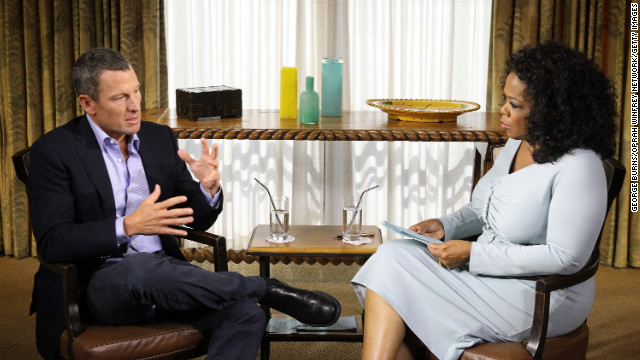
Chaos, Idolatry, & Sports

Armstrong confessing to Oprah Winfrey
Source: CNN
Disgraced professional cyclist, Lance Armstrong, is everywhere in the media right now.  His story is a classic rags to riches to disgrace story of a sports icon tarnished beyond recognition.  Not since Tiger Wood's fall from grace has the media had this much fun, clucking and wagging their collective heads—"for shame, for shame."  There are a couple of theological points, at least, to be made of it all.  They have to do with idolatry and chaos.

Chaos is the theological condition of anti-creation or un-creation.  It is that state where God's creative power is absent.  In our lives chaos manifests itself by "sin," but that old-fashioned word is so loaded with baggage that it is hard to use it seriously or even correctly.  Anyone trapped in addiction is living, to one degree or another, in chaos.  Lance Armstrong has been living in chaos, which in his case is composed of cheating, lying, bullying, and self-denial.  He admits as much himself (here).  His disgrace, the media attention, and the skepticism that has widely greeted his confession of sin are all integral elements of the chaotic storm blowing through his life.  The fallout, which has adversely affected so many lives and continues to do so is one of the surest effects of a life trapped in chaos.  There is almost always "collateral damage."

This is where the theological concept of idolatry comes in.  It is a concept that seems especially applicable to the world of sports.  Past Rom Phra Khun postings include reflections on the self-destroying worship of sports success by a South African swimmer, Cameron van der Burgh,who cheated his way to an Olympic gold medal (here) and the awful, hurtful events at Penn State (here).  Idolatry is intimately related to chaos.  It is a face of chaos, a consequence of chaos, and an immensely destructive (un-creative) cause of chaos. Idolatry is that state when we invest worship and trust in anything mundane before and above God.  In sports, success is the god of choice, the prefered spiritual poison of athletes who devote long hours of training often at serious personal sacrifice to be successful—the love of winning, of accolades, and sometimes of financial gain.  When one is willing to do almost anything to be successful, winning has become god.  And chaos ensues.

In our media-driven world, event the media is sucked into the chaos.  Its purveyors become endlessly fixated with failure stories, "rewarding" the disgraced athlete of the moment with still more of its attention and with momentary fame.  We like failure stories, obviously, and that too is part of the chaos that swirls around our stubborn inclination to worship those things that are not worthy of worship.  At the end of the day, we are not constructed to put our faith in mundane things but in The One That Is Beyond And Present—that is Creator, Savior, & Spirit.

Thursday, November 15, 2012

Ideolatry

A couple of years back, the blog Findings posted a brief article on the word "ideolatry" (here).  Now, neither dictionary.com nor wiktionary recognize"ideolatry" as a word (nor does this blog's spell check), so Finding's posting may be fanciful, but if so it still makes an important point.  In its analysis of "ideolatry" in relationship to idolatry and ideology, the posting concludes that ideolatry means that, "We give service to ideas, and they become our reasonable worship."  Ideolatry occurs when we turn an idea, doctrine, or ideology into something so sacrosanct that we virtually treat it as an object of veneration and worship.  If it isn't a "real" word, it should be.  Bibliolatry, one of the chief forms of Christian false worship, for example, is a close kin to and perhaps even a child of ideolatry.  We are seeing the full  power of ideolatry in the wake of the 2012 elections as so many of the losers twist in the winds of denial, unable to see their ideological idols for what they are.  (The political winners, of course, always stand in danger of transforming their own ideologies into idols and maybe some of them already are).

Tuesday, November 13, 2012

Theology & American Politics Today - a postscript

In the previous two postings, I've argued that a powerful wing of the Republican Party today is mired in ideological idolatry, which necessarily blinds them to the realities of early 21st century American politics.  Idolatry in all of its forms is self-defeating.  Theologically, it stands under divine judgment, which is here understood to mean that its failure is planted in the very nature of who we are as human beings.  Gravity causes things to drop.  Idolatry causes people and movements to fail.  To the extent that the Republican Party remains trapped in an ultra-right ideology, to just that extent it will inevitably dwindle into irrelevance.  False gods always bite the hands that worship them.

Writing for CNN, commentator Will Marshall has just written an article entitled, "The GOP's real problem is ideology."  Marshall points out the unmistakable consequences of putting ideology before reality, which ended with the Republicans' failure to capitalize on an economic environment in which they "could not lose" and lost.  Rendered majestically tone deaf by their ideology, they went out of their way to alienate African Americans, Latinos, and many women.  Marshall concludes, "A conservative governing philosophy centered on exploiting white voters' sense of cultural dispossession is a formula for political marginalization, if not demographic suicide. Any honest post-mortem of the 2012 election should lead Republican strategists to this inescapable conclusion: It's the ideology, stupid."

If, however, we visit the right wing websites, we hear very little of this kind of reflection.  There, the commentary is more largely (but by no means entirely) marked by finger pointing, denial, animosity directed at President Obama, and a protective insistence that "conservative principles" were not at fault in Republican losses (see here for one example).  A lot of the blame is falling on Governor Romney.  The word "scapegoat" comes to mind.

In sum, the theological doctrines of judgment and idolatry are important analytical tools that provide important insights into the real world of American politics.  One wishes it was otherwise.  But it isn't.

Monday, November 12, 2012

Theology & American Politics Today (ii)

Picking up from the last posting, the focus of much of the political commentary since last Tuesday has been on the Republican Party.  How will it respond to its losses, which were serious and totally unexpected by party leaders, pundits, and faithful?  There is the hope that it will learn its lesson and shift back to the center at least enough so that it can advocate a less abrasive and radical conservatism.  There is the fear that it can't and that we will continue to be plagued by asymmetrical politics.  Stated theologically, there is the hope that the party will learn the lessons of idolatry and will move away from the hardline ideology in which is has been mired for some years now.  The statement, "This is not your grandparents' Republican Party," reflects the reality of how far to the hard right the party has fallen. The predominant portion worships uncritically at the feet of Conservatism.  The religious fundamentalism of the Evangelical Right gives this idolatry a religious fervor, one of the key marks of idolatry being the worship of a false idol.  The racial fear of people of color, the Other so potently symbolized by President Obama, is an idol in itself and powerfully contributes to the Idol of Conservatism worshipped by the dominant wing of today's Republican Party.

Much of the Republican Party appears to live in a bubble because it does live in a bubble.  Its faithful live in an alternative reality where their hard right version of conservatism fed by religious fundamentalism and white racism is god-like, and the god their religious wing preaches is a piece of their idolatry.  The Republican Party was not like this in the past.  The Democratic Party, for all of its obvious flaws, is not like this today, although the possibility that it could be is always with us.  Inside the bubble of right wing idolatry, the president is an anti-christ figure.  He is not the legitimate president.  He is a Muslim born in Kenya.  He is a socialist who doesn't understand how the "real" America works.  He is incompetent and lazy (meaning, of course, he is a person of color).  His followers are ignoramuses or only interested in living off the government "teat"—"they" just want "stuff" (meaning, of course, they too are people of color).  Thus, the 2012 election's results are mind-boggling to the idolatrous hardcore Right that is so powerful in the Republican Party.  Its faithful are fervently convinced that the real America of their forefathers is dying.

Idolatry is always insidious and always carries its own judgment.  The political ideology that infects a powerful wing of the Republican Party cannot be sustained in the long run.  As a form of idolatry, it is self-defeating and self-destructive.  The thing that is not comforting is that idols fall hard and in the process cause significant collateral damage.  What could happen is that the hard right wing of the Republican Party will refuse to budge politically or practice compromise, and the demographic realities of 21st century America will inexorably squeeze it into a smaller and smaller space until eventually it will become irrelevant.  But the process will take time.  Each election cycle the Republican Party as it is today will shrivel a little more.  As some have already observed, Virginia, Florida, Nevada, Colorado, and Ohio will become solid blue states.  The new swing states will be places like Texas, Arizona, and Georgia.  The electoral college math suggests that it will become harder and harder for a Republican to win the presidency.  The Congress will eventually become lopsided with Democrats.  And the real debate in American politics will be between liberal and conservative blue dog Democrats with a rump Republican Party sometimes allying itself with the blue dogs.

Or, perhaps, the Republican Party can shake the party loose from its idolatry, and we can return to true, fruitful two party politics.  This could well happen.  Certainly, right now there is a sense that the Republicans could loosen up their doctrine of "new no taxes" and could accept some kind of meaningful immigration reform measure.  Some powerful Republicans, at least, heard the message that the public is tired of all the fighting and wants a Washington that works effectively and cooperatively.  This second scenario is preferable, but given where the party is today not certain.  Idols fall hard.  Their faithful will not, cannot live outside the bubble.  They cannot compromise their principles.  They honestly believe that their  political opponents are inherently evil.  And the realities of 21st century America will eventually bring their god crashing down, but it will take time and there will be a good deal of damage done to the very fabric of our nation.

The matter hangs in the balance.  Idols are powerful, and a wing of the Republican Party will not learn the lessons of defeat.  They will continue to live inside the bubble, and their intransigence threatens the whole party with decline and eventual irrelevance on the national scene.  There is another wing, however, that can live outside of the bubble and learn the hard lessons of last Tuesday.  The key is compromise and humility.  Real-world politics requires compromise and a pinch of humility.  If the Republican Party can shake itself free of doctrinaire politics ("no new taxes" politics), it can reverse the otherwise inevitable demographic decline that threatens it today—if.  But, we should never forget that idols fall hard.

Saturday, November 10, 2012

Theology & American Politics Today (i)

As the pundits and politicians assess the aftermath of last Tuesday's elections, the pieces of analysis that they will miss are theological.  They wouldn't be interested or impressed even if they had an inkling that such an analysis exists.  Still,  it is worth our time here to engage in a little theological reflection and prognostication regarding our nation's current situation and future prospects.

In doing so, a couple of theological principles are relevant.  The first is divine judgment.  From the perspective of evolutionary theology, God's judgment is built into the very fabric of what it means to be human.  One might even liken it, spiritually, to gravity.  It is what it is and cannot be challenged let alone abrogated.  Divine judgment dictates that actions have consequences that reflect the action itself.  Thus good actions breed good consequences and evil actions are their own "reward."  At the micro level, this law is very messy and involves a lot of "collateral damage" because others suffer for the wrongs we do, just as others benefit from the good we do.  The second theological principle at work is idolatry, which is closely allied with divine judgment.  Idolatry is the worship of anything that is not worthy of worship.  In our day and age, false ideologies are one of the most common forms of idolatry.  Idolatry is powerful, insidious, and ultimately destructive of the idolater, but again with "collateral damage" as others are adversely affected by the passion and failed actions of those engaged in false worship.  Addictions can be considered forms of idolatry, the false worship of pleasure.

 Judgement and idolatry are two key doctrines of the Christian faith.  They are also important tools for the analysis of the current state of American politics and the nation.  Let me save the hows, whys, and therefores for a second posting, probably tomorrow.


Tuesday, October 16, 2012

The Plank in Our Mainline Eye

Mary & Martha (Luke 10:38-42)
In Dynamics of Faith, theologian Paul Tillich argues that faith in an ultimate of one sort or another is a universal characteristic of the human race and that we are always prone to turn our ultimates into idols.  Thus, in some religions there are physical images, such as statues or pictures, which are meant to symbolize the ultimate but over time become themselves the ultimate.  Faith becomes idolatry.  All faith of every kind, every religion and secular faiths (such as humanism), are prone to idolatry.  One of the most common forms of Protestant idolatry is bibliolatry, the transformation of the Bible into an object of veneration and worship in place of God.

When our faith becomes idolatrous, it eventually leads to disappointment, disillusionment, and a dead spirituality.  It fails to nourish.  It no longer brings healing and well-being.  Tillich experienced how fearful the dangers of idolatry can become as he witnessed the rise of the false faith of nationalism embodied in European fascism.

Tillich's analysis is spot-on and very helpful—especially if we want to see the speck in someone else's eye.  Thus, from over here in the mainline we can see with painful clarity the way many evangelicals really do turn the Bible into an idol, one that forces them into denying the very nature of reality as discovered by science.  Other churches, also mostly evangelical, turn numerical growth into a god, the god of evangelism.  The Catholics tend to transform their hierarchy into a god—that's one reason we broke off from the Catholic Church in the first place.

What is more difficult for us to see is the plank(s) in our own mainline eye.  Historically, Presbyterian churches in the U.S. have been profoundly concerned to reform human society, and we have engaged in all manner of reform movements along with other mainline folks.  One of the most curious was the 19th century movement to "keep the Sabbath holy" by preventing the delivery of mail on Sundays.  We Presbyterians were deeply involved in that one.  The point here is that our search of a more righteous society, for the Kingdom of God on Earth if you will, has become a false faith for Presbyterian churches right down to the present.  The pursuit of social righteousness has become the goal for the great majority of us.  Ask us what it means to believe, and we will quickly answer that it means to do good to others.  We believe in the Golden Rule, and it has become an idol for us.  We are driven, thus, to be busy with the work of the Kingdom—endless meetings, programs, projects, and a multitude of tasks and activities.  We have lost spiritual balance and lost sight of the Christ who commended the "idle" Mary and, by implication, criticized the always busy Martha (Luke 10:38-42).

The question is, how do we regain our balance?  In and of itself, working for the Kingdom is a good thing so long as it does not become the thing.  How do we de-sacralize our constant doing?  That is the question.

Monday, August 20, 2012

Idolatry, or the Art of Turning Gold into Tin

Cameron van der Burgh
Last month, I reflected in two postings (here and here) on the value of the theological concept of idolatry as a real-world analytical tool.  Reports out of the 2012 Olympics provide, sadly, further insights into the power of idolatry in modern life.  In a perceptive article aptly titled, "Shades of Gray on Way to Podium," New York Times reporter, Karen Crouse, points out that various degrees of cheating and manipulating the rules is widespread in Olympic competition.  The badminton players who were disqualified for purposely trying to throw their games were evidently only the tip of the iceberg, according to Crouse. South African gold-medal swimmer, Cameron van der Burgh, who cheated in his pursuit of the gold medal in the 100 meter breaststroke, provided one of the most powerful examples.  The Sydney Morning Herald reported (here) that van der Burgh admitted to using an illegal stroke during the gold medal heat in order to win.  It quoted him as saying, ‘‘If you’re not doing it [cheating], you’re falling behind. It’s not obviously - shall we say - the moral thing to do, but I’m not willing to sacrifice my personal performance and four years of hard work for someone that is willing to do it and get away with it,’’  He was, obviously, willing to sacrifice his moral standards—and in the process break the Olympic oath to follow and respect the rules of the game taken by a representative of the athletes at the opening of the games.

That being said van der Burgh deserves credit as well.  Crouse quotes American swimmer,Brendan Hansen, who finished third behind van der Burgh as saying, “I give him credit for actually having the guts to come out and say something and be honest because maybe that’s what it’s going to take for the organizations running swimming to use the technology at their disposal to enforce the rules.”  There is evidently some risk that van der Burgh could lose his medal because he spoke out.  Hansen himself stated that he did not cheat even though he knew it would cost him the gold medal. He told reporters, “I wasn’t raised to cheat. It’s not something I practice.”

The Olympic gold medal is a potential idol, awaiting the worship of those who seek it.  Crouse treated it as such, worshipped it, and the inevitable result was his worship of the idol cheapened him.  He does not deserve what he won, and he clearly knows it.  Whatever pride or satisfaction he might take in it is tainted.  Hansen, on the other hand, can take pride not only in his bronze medal, but also in the fact that he overcame not only other competitors to achieve it.  He also overcame temptation.  His bronze medal is golden.  Van der Burgh's gold medal is worth less than tin.  His honesty does deserve credit, but his gold is still worth much less than Hansens' bronze.

That is what false worship of human-made idols does to us.  Idolatry cheapens us and taints us.  There is only one "object" worthy of our worship, God.  We approach God and engage in worship only as we are able to put away our own agendas.  That is hard to do, damnably hard.  Fortunately, we aren't called to be perfect at it.  We are called to keep trying.


Thursday, July 26, 2012

Penn State & Idolatry Revisited

Israel worships the golden calf (Exodus 32)
It turns out that the football scandal at Penn State involving Sandusky's repeated abuse of young boys over many years has sparked serious and healthy reflection on the nature of idolatry and how best to deal with it—and this among sports writers!  A previous RPK posting (here), noted the emergence of what amounts to the theological analysis of how Joe Paterno in particular and the Penn State football program more generally became false gods.  What seems to be happening is that the sports application of the idea of idolatry and theological-like reflections on it have become increasingly widespread.  Witness an op-ed piece by sports writer Tim Keown entitled, "NCAA offers losing solution," which criticizes the way in which the NCAA imposed sanctions on Penn State that only serve to perpetuate obeisance to the false idol of winning & losing.  In the posting, Keown refers to Joe Paterno as a "false god" and Penn State's football program as an idol.  He argues that the sanctions are an act of retribution that punish Penn State merely by turning its winning program into a losing one.  The emphasis is still on winning and losing.  The idolatrous culture that enabled Sandusky remains in place.  Keown feels that it would have been better to shut down the program for a year and let it deal with its deeper problems out of the glare of the public eye—and away from the necessities of winning & losing.  Suspending the football program for a year would have sent the message that more is at stake than winning or losing.

Keown may be correct in his analysis—or maybe not.  The matter is debatable.  The point here, however, is that as a sports writer he is looking for a way to deal with idolatry, that is to bring it to an end.  He writes, "You can't tell us the problem is with the idolatry that comes from winning and then make decisions that are based solely on the importance of wins and losses."  He is taking the concept of idolatry seriously and using it to deal with a real-world issue that has important social implications.

In the church, we make one additional critical observation that does not appear in the sports analysis of idolatry.  That is, idolatry is essentially a spiritual issue.  It happens whenever we elevate the mundane to the status of God.  And, ultimately, the only effective antidote is faith in God, Creator & Lord of the universe.  The worship of anything else—Joe Pa, for example—will one sooner or later collapse in on itself, sometimes with devastating repercussions.

(For another thoughtful piece on the Sandusky scandal see the Christian Science Monitor editorial, "NCAA sanctions on Penn State football: Why only penalties?" Although it doesn't use the theological language of idolatry, it is similar to Keown's analysis in calling for fundamental cultural changes in college football.)

Monday, July 23, 2012

Idolatry in the "Real World"

Penn State campus statue of Joe Paterno
(AP photo)
By and large, the "secular" world is not much interested in theology  and looks on it as largely specious speculation about things we only think we know about.  It is not a field of knowledge most academics and scientists would consider a candidate for critical thinking.  They are wrong. Theology, in practice, engages in critical reflection at least as much as supposedly more empirical fields, and one of the most powerful tools for critical theological reflection is one we've highlighted before here: the concept of idolatry.  Idolatry is false worship, the worship of the created as if it were the Creator.

Once-in-awhile, however, the world "out there" unwittingly discovers the value of this critical theological concept and appropriates it for its own analysis of contemporary events.  Sports analyst Evan Barnes in a posting entitled, "Penn State Scandal: What We Can Learn from Joe Paterno, Penn State's Failings," thus repeatedly charges Penn State football fans with practicing idolatry in their (false) worship of the late Nittany Lion football coach, Joe Paterno.

Commenting on Paterno's complicity in the tragic and reprehensible Sandusky child abuse case, Barnes opens with this theological observation, "College football has long created gods who tower over the sport."  He then analyzes the consequences of turning sports into a religion and sports heroes into idols.  He speaks of the danger of turning "ordinary men into gods," which leads to a fall from grace that is a consequence of the worship given them by their fans.  He observes that Paterno was elevated to the status of a deity and writes, "The danger in creating an idol isn’t in adoring it. It’s how far we go to protect it." (Theologically, Barnes is not correct here. You can't separate the adoration from the desire to protect the idol, hence the adoration is part of the danger.)  The worship of these false sports gods involves people's feelings, passions, and identity, which morph into a lust for victory and a moral failure to hold to what is right.  In places like "Happy Valley," Centre County, PA, a culture arose that mixed hero worship with an unwillingness to hear fair-minded criticism of the hero.  (I lived in Happy Valley for three years in the 1970s, and even forty years ago local folks laughingly referred to Joe Paterno as a member of the Trinity.  It was a joke, but pointed even then to a growing feeling that Joe could do no evil.)

At the heart of our dark side as human beings lies our deeply ingrained inclination to worship things that are not worthy of worship.  Almost anything can become an idol, including our heroes and our sports.  Were that not the case, Jerry Sandusky could not have continued to abuse young boys year after year protected by an idolatrous system that put the vaunted Penn State football program above child abuse.  That, friends, is how powerful idolatry can be and why it is roundly condemned time and again in scripture.  One wishes that "the world" would take the reality of idolatry more seriously and that bibliolatrous Christians would see it as a danger especially to the Christian faith itself.  That's a prayer.  Amen.

By the way, in case you missed it, Joe's statue has been taken down.

(While the author doesn't use language that is all but theology as Barnes did, interested RPK readers would do well to look at the posting entitled, "Let's Talk a Bit About the Penn State-Paterno Debacle," at the Daily Gopher blog.)

Thursday, July 12, 2012

Some Things Never Change

Fourth Century Christian art
According to Alister McGrath, Christian Theology: An Introduction (pp. 16-19), one of the hot button issues of the ancient church was the relationship of culture and classical learning to the church and its faith.  In the second century, Justin Martyr took what we would call today a liberal position on the question.  He was willing to draw widely and deeply from culture, writing "Whatever all people have said well belongs to us Christians."  He wrote that, "those who lived reasonably are Christians, even though they have been thought atheists." (First Apology, 46)  In the third century, Tertullian articulated the opposite position, namely that the church must divorce itself from "pagan" culture and learning.  These things only lead the church into error.  Eventually, St. Augustine (354-430) arrived at a formulation that became the default western Christian approach to culture, which McGrath describes as a "critical appropriation of classical culture."  Augustine's perspective was that, "whatever was good, true, or beautiful could be used in the service of the gospel." (McGrath, p. 19)  Augustine also believed, however, that these good, true, and beautiful elements of pagan culture had to be freed from that culture and grafted onto the tree of the Christian faith.  In modern terms, Augustine leaned toward a conservative position but mixed a bit of a more liberal approach in with it.

The ancient fathers of the church, thus, staked out three alternatives to the relationship between faith and culture;  One could largely embrace culture and use it to express faith.  One could largely reject culture and see it as an enemy of faith.  Or, one could pick and choose elements of culture useful to the faith.

These three choices are still with us today.  In fact, they stand at the heart of the ongoing controversy among Christians concerning culture in general and science in particular.  However, in early 21st century America the matter is slightly more complicated.  In fact, evangelicals in some ways are closer to Justin Martyr, the ancient "liberal," than either Tertullian or Augustine.  They tend to equate certain American values with the Bible and their faith and to conflate patriotism with their Christian faith.  We have even coined recently a new name for some of these folks; they are "teavangelicals."  In the U.S., on the other hand, progressive Christians tend to be critical of social and patriotic values while open to more liberal aspects of culture including science.  In fact, Tertullian's option hardly comes into play these days.  Augustine seems to have won the day for Christian conservatives while Christian progressives tend toward Justin's position that "anything said well" is Christian.

From a liberal perspective, however, we do well to be more precise about what we mean by anything being said well being Christian.  It doesn't mean that we take over or claim as our own all that is good, true, and beautiful.  Where we find value in the teachings of other faiths, for example, we recognize that we do not "own" those teachings just because we find them helpful for our own Christian faith.  Thich Nhat Hanh can speak powerfully to Christians, but he is not a Christian.  His writings are not Christian.  We insist on that for the sake of his integrity as much as our own.

At the end of the day, Christians of all stripes are still called upon to evaluate contemporary culture and make critical choices about what is good, true, and beautiful in light of Christ.  He remains the measure of culture.  Our failure across the theological spectrum is that we too often confuse him with culture and chain him to ways of thinking and behaving that aren't Christ-like.  Idolatry remains a threat, although today it more often takes the form of ideology rather than images.  In any event, some things never change.  The challenge of Christ and culture is one of those things.

Sunday, June 10, 2012

The Case for Relativism

"Relativism" has a bad name in many U.S. Christian circles.  In a recent posting entitled, "Evangelicals: We Must Stand Firm on Biblical Authority, Exclusivity of Christ," Dr. R. C. Sproul referred to "relativism" as being the idea "that says it doesn't matter what you believe as long as you're sincere."  In other words, relativism amounts to a lack of standards, commitment, and serious faith.  It is nonchalant, blithely saying that when it comes to beliefs "it doesn't matter."  In that posting, relativism is associated with contemporary social values inimical to the Christian faith, ones that have to be overcome with a determined stand for an exclusive gospel that preaches a salvation limited to Christianity.

Relativism as such has nothing to do with indifference to or a nonchalant attitude about beliefs.  Relativism doesn't say that beliefs don't matter. It says, rather, that beliefs have a context and the believer should be keenly, carefully aware of that context.  How and what we believe depends in part on the context in which we hold our beliefs.  Culture shapes how we believe.  History shapes how we believe.  Our personal experiences powerfully impact how we believe.  Our inherent (perhaps partly biological) tendency to be liberal or conservative in our thinking shapes how we believe.  Interestingly enough, philosophy has a particularly strong impact on our beliefs.  In an American Protestant context, the early church's experience with Greek philosophy continues to powerfully shape our understanding of God.

The choice we have to make about our contexts is the degree to which we ignore or acknowledge their influence over the ways we believe.  Many American Christians choose to ignore that influence and reject the idea that human beliefs are relative.  They seek to absolutize their beliefs.  Fewer, but still a significant number of believers, embrace the fact that faith is dependent on many factors and is not absolute.  Each choice is dangerous.  The "true believers" are seriously in danger of confusing what they believe about God with God.  The "relativists" are seriously in danger of losing sight of the importance of sharing their faith with others.  The relativists are apt to put their candle under a bushel.  The absolutists are liable to put their candle at the feet of something that is not God.

The middle way (via media) is to hold one's faith firmly, share it where appropriate, and understand that others can choose other faithful paths, which are spiritually viable but not our own.  What we believe matters.  Realizing that we are fallible in what we believe and that all human belief systems are relative also matters.  Otherwise, we tend to confuse our beliefs with the One we believe in.

Saturday, May 26, 2012

The Power of Idolatry in Our Times

When I was a grad student at the University of Maryland in the 1980s, I presented a paper in one of my classes on the missionary role in the modernization of 19th century northern Thailand.  Another student quizzed me on the motivations of the missionaries and rejected out of hand my claim that the missionaries were primarily motivated by their religious beliefs.  He argued that they went to the mission field in search of economic gain, and that fact explained their behavior.  Their beliefs were just a ruse.  Now, any fair reading of the missionary record does not substantiate that argument nor does the fact of the risks missionaries faced living in one of the most isolated places (from North America) in the world—especially health risks but also the risks attending living in a kind of social exile from their homeland.  I still remember, however, the scorn of my fellow student as I tried to make the case that faith was the primary motivation for most of the missionaries most of the time.  I knew from my own experience that faith is a powerful source of motivation.  And I knew for having spent years working with missionary documents and publications that their faith was the primary reason for their being missionaries, but my classmate rejected the whole idea out of hand.  He denied reality.

Previous to that experience in the classroom, I worked as a church-based archivist in Chiang Mai, Thailand, and the archives I managed contained a fair amount of missionary records going well back into the 19th century.  I remember a conversation with an American doctoral student working on his dissertation in the field of anthropology during which I observed that there was a wealth of material on his subject in the missionary records at the archives.  This grad student said with clear disdain in his voice, "I would never use missionary materials."  When I asked why, he replied, "Because they are biased."  Talk about the kettle complaining about the soot on the pot!  Yes, of course, missionaries wrote with a bias, which a reputable scholar will learn to read through and make allowances for.  On the other hand, they were the first Westerners to live for extended periods of time in northern Thailand, and their records contain a wealth of historical anthropological data obtainable from no other source.  This grad student rejected learning from that source because it was tainted by the religious nature of the record.

My point is that religious conservatives do not have a monopoly on self-righteous arrogance based on ignorant prejudice.  Those of us who are various degrees of liberal decry the denial of evolution and the findings of science by folks on the right while we engage in our own forms of prejudice and denial based on our own ideologies.  Ideological idolatry is no respecter of persons or philosophies or theologies.  It is a danger to us all.  For those of us who seek to live the Christian life, this is why doubt is so important.  Doubt can help us refrain from turning faith (which is a humble trust in God) into certainty (which can become an arrogant ownership of God).

Tuesday, May 1, 2012

In a Different World

Castellano & Maddow on "Meet the Press"
This past Sunday, April 29th, speaking together on the news program "Meet the Press,"  Rachel Maddow of MSNBC exchanged words with Republican strategist Alex Castellanos on the subject of equal pay for men and women in the workforce.  Maddow made the point that women on average make substantially less than men doing comparable work with comparable qualifications and experience.  Castellanos immediately denied the truth of the statement.  It is a liberal myth based on a misunderstanding of the facts.  Last night, Maddow invested a considerable amount of time laying out the data in detail, all of which shows beyond any reasonable doubt that across virtually all major occupations women do not receive comparable compensation for comparable work done with comparable skills and experience.  The data comes from multiple sources, mostly federal government labor and commerce statistics.  The case is air-tight so far as the data goes.

It is clearly not air-tight, however, once ideology is factored in.  Castellanos approached the whole question as a matter of belief.  He does not believe the slant given the data by "liberals".  In his universe, women don't receive equal pay because they don't do comparable work.  Now, the hard data analyzed statistically does not allow that conclusion, and this is not a matter of belief.  But, he turned it into one.   To hear Maddow go through this, it seems that she is stunned by the discovery that she and Castellanos are not living in the same world of fact.  Since she is 39 year's old, we have to assume that she actually did already know that, but maybe she was surprised to have the fact reaffirmed with such painful clarity.

I mention this in Rom Phra Khun because Maddow has bumped up against a reality that we live with in the church constantly.  People chose to believe things that are simply not true.  At the top of the list is the denial of evolution and the findings of the whole science of modern biology.  We evolve.  Life evolves.  This is not a matter of belief but of simple fact.  As I've pointed out here many times before, the science is overwhelming and the mountain of data is so incredibly huge that no reasonable person should be able to reject it.  Yet, tens of millions of American Christians do reject the data as being merely "bogus".  They maintain their rejection, indeed bolster it, by living in a world of people, institutions, and beliefs that all reinforce their denial—make that denial plausible and sustainable.  They are not crazy, and they are not dumb.  They live in a different world, one in which the age of the world is a mere 6,000-plus years.  In their world, any so-called fact that contradicts that conclusion is bogus and, more to the point, a denial of God and God's "Word," the Bible.  There is no arguing with the truths they know to be true because they exist in a different universe and living in that universe they demonstrate one of the most important insights of modern sociology.  We socially construct reality.  We establish truths together and together uphold the truth of those truths even when they are not true.

One of our failures in American politics today and in the church today is that we are not able to dialogue across our ideologies.  That failure is poisoning our politics and it leads Christians to treat each other in ways that are far from Christ-like.  Our ideological differences are a threat to church, nation, and the globe.

Friday, January 20, 2012

Religion Can Be Dangerous

There is a pastor in Arizona who openly preaches his personal hatred of President Obama.  He claims that his hatred is righteous and uses passages from the Bible to prove it.  You can hear some of his venom from the Youtube clip, below.  It is no wonder that some claim religion is the greatest evil in our world today and no wonder many others are cynical about faith and the Bible.  What is paradoxical, however, is that a man who considers himself "pro-life," is so bent on visiting death on someone who doesn't agree with him.  There is nothing of Christ in this preacher's words, except maybe in the protests they have sparked as even neighboring businessmen challenge his loveless message.


And that is, perhaps, the importance of this kind of false prophet.  He and others like him remind us of what Christian faith is actually all about and what it means to follow Christ, the Prince of Peace.  "Whatever Christian faith is," he affords us the opportunity to say, "this is what it most definitely is not."

Friday, January 13, 2012

Most Pastors Reject Evolution

In a report entitled, "Protestant Pastors’ Views on Creation," LifeWay Research reports its findings on the attitudes of Protestant pastors concerning evolution. LifeWay researchers interviewed over 1,000 pastors across several denominations and found that 64% strongly disagreed with the statement that, "God used evolution to create people." Conversely, some 74% strongly agreed that, "Adam and Eve were literal people."  These figures varied by region of the nation with pastors in the Northeast more likely to agree that the human race is a product of evolution and disagree with the idea that there was a literal Adam and Eve.  Mainline pastors also were more likely to hold a positive view of evolution as were pastors who had a postgraduate education, but in all cases the majority of pastors across all regions, levels of education, and whether evangelical or mainline affirmed anti-evolution beliefs.  For a good summary of the report, see Ed Stetzer's LifeWay blog (here).

Now, evolution is what they call "settled science," which means that denying its reality is precisely the same as "not believing" in gravity or the "theory" of a heliocentric solar system.  The root cause of the rejection of evolution is, of course, the desire to preserve the "truth" of Genesis 1-2.  In any event, it is discouraging to see such larger numbers of Protestant pastors rejecting evolution—assuming of course that LifeWay's findings accurately represent the views of Protestant pastors.  Without accusing the report of being inaccurate, we might still wonder just a tad since LifeWay Research is an arm of the Southern Baptist Church, a strongly anti-evolutionary denomination.

Regular readers of Rom Phra Khun will have heard much of this from me before, but these statistics are worrisome for a number of reasons.  First, in their rejection of evolution the participants in the study reject the reality of Creation.  God creates the universe and life on Earth by means of evolution.  Evolution is God's plan for Creation.  Second, in rejecting the findings of settled science, the participants only serve to drive a wedge between the faith of the church and contemporary worldviews, the worldviews we must be able to speak to if we want to bring Christ to those who hold them.  In our age, the scientific view of the world is already dominate and will grow only more so.  The same pastors who reject evolution regularly avail themselves of the benefits of medical science, which is built on evolutionary principles.  They ignore the mountains upon mountains upon mountains beyond counting of scientific data confirming evolution, which could not possibly provide the coherent picture of the reality of evolution it does if it were built on a false foundation.  Third, in their zeal to affirm the Bible as the Word of God, these pastors stand always in danger of bibliolatry, the worship of the Bible in place of God.  The great modern form of idolatry is ideology, and bibliolatry is what we might call a "stealth-idolatry," a form of idolatry posing as theology.  The Bible is God's word written, which has been preserved for us from ancient times.  It's inspiration is in the manner in which it cogently tells the Story of God's gracious, holy history with humanity.  It is a story told through the medium of ancient worldviews and values many of which simply do not make sense in 2012, but the Story itself remains powerful.  Indeed, by clinging ideologically to some of those ancient worldviews we only manage to obscure the meaning of the Story for the 21st century and make it harder to tell it to the world today.

I'm shouting down a deep dark well.  I know.  But, from time to time it is important to shout down the well, if only to remember that there are many different paths to faith in Christ.  One need not reject settled science in order to be his follower.  In fact, we can affirm settled science as a repository of clues into the nature of God's plan for humanity and Creation, if only we have the wit and wisdom to read what our forbearers in the faith called, "The Book of Nature."  Amen.

Thursday, October 27, 2011

Taking the Incarnation Seriously (x)

This is the tenth posting in a series of postings reflecting on Thich Nhat Hanh's book, Living Buddha, Living Christ (Riverhead Books, 2007; originally published in 1995). The introductory posting, setting the stage for the series, is (here).  Readers will want to read the previous (ninth) posting (here) before tackling this one.  It follows on nine.

In the interest of "full disclosure," I probably should say that my personal theology leans to the human Jesus rather than the divine Christ.  Given my training in history and the fact that I worked as a professional historian for many years (albeit in a church setting), it is hardly surprising that I find Jesus of Nazareth a fascinating and challenging historical figure.  Still, there was something go on in Jesus that doesn't go on in the rest of us.  That "something" lies deep within "the Christ event," and we should approach it with some trepidation and a realization that it defies human categories and easy dogmatic descriptions.  Indeed, it seems that the rush to embrace Jesus, the Son of God and sing high praises to Him, is always in danger of turning doctrines about the divine Jesus into idols that twist the actual person of Jesus, the Christ, into human renderings of what we think he should be.

The Asian theologian, Kosuke Koyama, has written a book entitled, No Handle on the Cross, in which he makes the point that we can't own the cross with our human ideas and doctrines about it.  It is not something we can "handle," manage, or control.  That goes for Jesus in general, and having to wrestle with the fact that he was just as human as the rest of us and bound by our human limitations should make us wary of over doing his divinity.  We should have to always be straining to glimpse the "living Christ."  He should remain slightly elusive, never quite in focus so that we can't envelope Him and thus turn Him into something of our own making.  The historical person of Jesus, thus, grounds us in the way God moves among us, which is itself elusively and obliquely—and patiently.  Amen.

Tuesday, October 18, 2011

Le Panatalon Rouge

In 1912, on the eve of World War I, the French Minister of War, Adolphe Messimy, attempted to modernize the French army's uniforms, which since before 1830 had been a combination of bright reds and blues set off by flashy red trousers. The British and the German armies had already switched to uniforms of browns and grays more fitting to the necessities of modern warfare with its rifles that could shoot accurately over many hundreds of yards. The French military, however, bitterly resisted Messimy's attempted reform. It felt that the army's prestige and honor were at stake. One witness at the parliamentary hearings on the matter, a former Minister of War himself, exclaimed, "Eliminate the red trousers? Never! Le pantalon rouge c'est la France!" Some years later Messimy observed, "That blind and imbecile attachment to the most visible of all colors was to have cruel consequences." (See Barbara Tuchman, The Guns of August, 55.)

One hundred years later, it is easy to smile at this "quaint" story taken from an era when war and honor were still synonymous terms, but one cannot help but observe how frequently churches and their leaders adhere to the outmoded ways of thinking and behaving, crying out with fervor, "Le pantalon rouge c'est la France!" "True believers" of all stripes, indeed, are particularly prone to a "blind and imbecile" attachment to the past because they assign eternal consequences to every word they utter and belief they cherish.

Thursday, October 6, 2011

"Abandoning Self" to Ideology & Power

There is a simple rule of thumb when it comes to spiritual matters.  When an individual publicly proclaims her own spiritual righteousness, we can be sure she is not righteous.  When an individual publicly proclaims her spiritual right-ness in the context of a national political campaign for the presidency in order to cement her political base with one wing of the American Christian movement, we can be sure that she is using her religion for personal gain.  In a recent address to students at Liberty University, Lynchburg, Virginia, presidential contender Michelle Bachmann said, ""Even though I hadn't been a drinker, even though I never did drugs ... even though I hadn't been chasing around, it didn't matter. I was a sinner." She went on to say, "I radically abandoned myself to Jesus Christ."  She went on to place a series of hard core right-wing ideological positions in the context of her radical abandonment of herself to Christ including opposition to abortion, opposition to "Obamacare," and unquestioning support of Israel.  The evidently unstated assumption and assertion was that in abandoning herself to Christ she has become God's warrior or champion in the American political arena.  Her religion, that is, validates her candidacy and, by extension, God does as well.

In the realm of the Spirit, if ya got it, ya don't flaunt it.  That is basic, fundamental to spirituality across the major religions including most especially Christianity.  We are painfully aware of Jesus' struggle against self-proclaimed righteousness in his own day.  Religious establishment types in his day would stand in the temple in Jerusalem and loudly proclaim their righteousness in self-serving prayers (Matthew 6:5).  Jesus criticized them for it.  One cannot judge Bachmann's personal faith when she's not on the stump, but when she uses that faith as a political tool then the public use of it becomes fair game for analysis, and in that context it is clear that publicly she has not abandoned herself to Christ but to a religious ideology and the quest for power.  In her public expression of her ideology, we hear little spirituality.  She is, instead, bombastic, aggressive, and impressively self-righteous.  The fact that she is trailing badly in the polls only seems to bring out these traits in her all the more clearly.  Michelle Bachmann's public behavior is that of a person who is hungry for power and using religion as an avenue to gain power.

In the long history of the Christian faith, those who have radically given themselves to Christ display marks of a deep humility that is aware of how impossible it is for any person to radically abandon themselves to God.  On their knees in  prayer and meditation, they seek to give self over to God.  Let me be clear.  Any politician on the national public stage in our super-heated ideological age who claims to have given herself (or himself) to Christ is simply not to be trusted.  The words do not reflect the reality especially when they are used to "gin up the base."