We should maintain that if an interpretation of any word in any religion leads to disharmony and does not positively further the welfare of the many, then such an interpretation is to be regarded as wrong; that is, against the will of God, or as the working of Satan or Mara.

Buddhadasa Bikkhu, a Thai Buddhist Monk


Showing posts with label United States. Show all posts

Sunday, September 1, 2013

What Say?

The Huffington Post has a posting entitled, "The Most Efficient Health Care Systems in the World," which makes the point that of 46 nations surveyed the United States ranked 45th in "life expectancy (weighted 60%), relative per capita cost of health care (30%); and absolute per capita cost of health care (10%)."  The posting cites a Bloomberg table (here) as its source, and what is particularly noteworthy to me as a former resident of Thailand is that Thailand is ranked 22nd among the nations surveyed in the effectiveness of its health care system.  Thailand ranks 1st in terms of the absolute cost of health care per person ($202/person compared to $8,608/person in the U.S.) and third in health-care cost as a percentage of GDP per capita (3.7% of GDP compared to 17.2% for the U.S., by far the highest percentage of the countries surveyed).

Thailand is a great place to live, but it is not noted for governmental efficiency.  It has a national government that many here would consider to be the very essence of "big government."  Corruption remains a serious problem.  Still, in the past the Thai government has taken steps to see that all of its citizens receive affordable health care, perhaps not always of top quality but still available.  Those efforts have apparently paid off, and it should give Americans pause.  Our health care system is incredibly expensive and hard to access for lower income folks, which facts have negative repercussions for all of us.  If Thailand and numerous other countries around the world can figure this out, why can't we?

Monday, April 1, 2013

Empty of Any Reality

In a news posting entitled, "Gay rights opponents' last argument," Paul Waldman notes that the opponents of full civil rights for the LGBT community have seen argument after argument punctured.  All they, except for hard core fringe types,  can really say now is that they are against gay rights because gays make them uncomfortable.  Waldman points out that this argument means LGBT Americans are supposed to be deprived of their full civil rights because of the personal feelings of one certain segment of the population—this in spite of the clear mandate of the Constitution, which protects the civil rights of all citizens in all cases except treason and terrorism.

Opponents of gay rights cannot say what they actually mean.  They cannot say, "We are prejudice, and we demand that the civil rights of others are abrogated so that we can maintain our prejudice.  We don't 'like' them, and so they should not be accorded the rights we enjoy."  Waldman concludes,"At this point, that's about all opponents of gay rights have left. They don't want to sound like bigots, so they've almost stopped talking about gay people entirely. It's not you, they say, it's us. Well, they're right about that. Just maybe not in the way they think."

Waldman also notes that the whole argument sounds ridiculous, which it is because prejudice is what the word says it is, a pre-judgment not based on reality.  Holders of this prejudice hope that if they repeat it often enough, forcefully enough, and act upon it often enough, the prejudice will create the reality.  And they have been successful in the past in turning their prejudice into a reality of sorts.  Their prejudice has branded homosexuals as "immoral," driven them underground, and thrown obstacles into the forming of stable homosexual relationships, which in the fashion of circular thinking "proves" to the prejudiced that gays are immoral.  Americans have used this same kind of circular thinking against people of color, women, people with physical disabilities, people of other ethnicities, and even people living in certain locations ("hicks" comes to mind) or under certain conditions.  The problem is, of course, that real people don't fit the stereotypes of prejudice—well, sometimes they do, but not nearly often enough and not with enough consistency to give substance to the prejudice.

In addition, American holders of prejudice face another obstacle to their prejudices, which is that one sentence in the Declaration of Independence that states, "We hold these truths to be self-evident, that all men are created equal, that they are endowed by their Creator with certain unalienable Rights, that among these are Life, Liberty and the pursuit of Happiness."  We have been too often too slow in fulfilling the vision this sentence offers us of a citizenry that is truly equal and equally enjoys the rights of life, liberty, and the pursuit of happiness.  But, for all of that, we are working our way out of the land of prejudice and into the land our nation's founders envisioned—slowly, painfully, and inconsistently, but still headed in the right direction.

It takes serious effort, in sum, to maintain the prejudice against LGBT Americans.  It has to be held in the face of reality and in the face of our national ideals.  Prejudice is powerful, to be sure, but it is ultimately built on the shifting sands of its own inconsistency and injustice.  Amen.

Friday, January 25, 2013

The Party of Christian America

The trend is deeply troubling and bodes ill for the future of the republic.  In Republican controlled states, we see a trend that attempts to effectively limit voting by minorities, gerrymander districts to maximize the vote of non-minorities, and now to manipulate the electoral vote to reduce the chances a Democrat can be elected by the new Democratic coalition of minorities and women.  All of this is being done quite openly and with one goal in mind: preserve, protect, and expand the power of the right wing of the Republican Party in the face of a fundamental demographic shift taking place in the U.S.

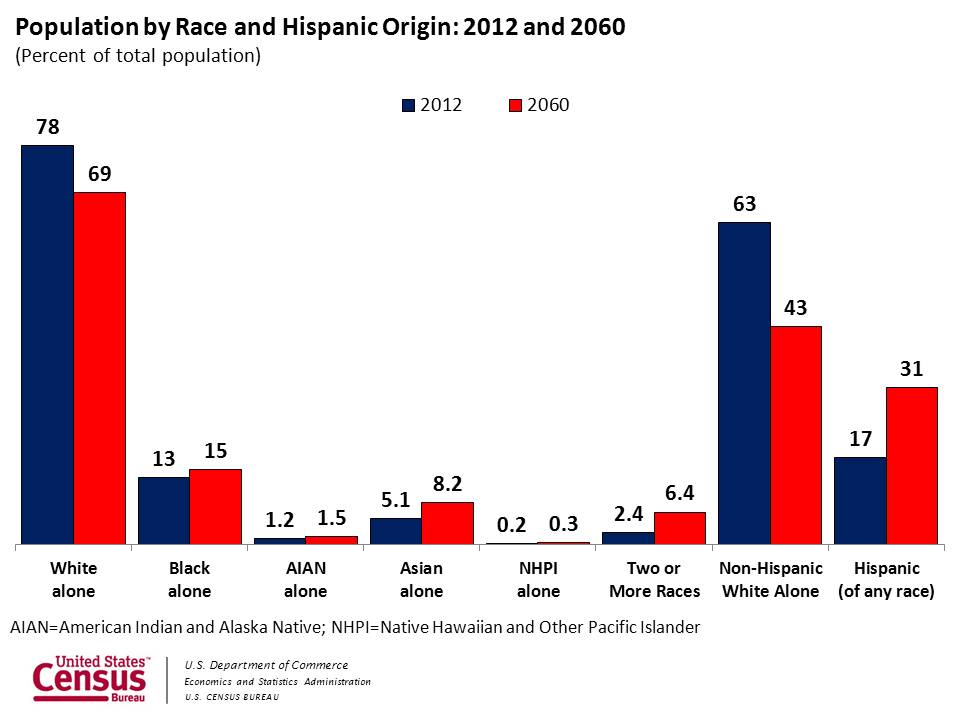
Within roughly 30 years, give or take, the U.S. will be a "majority minority" nation where "people of color" along with Hispanic Americans will comprise the majority of the nation.  The 2012 election has already demonstrated the growing political clout of the emerging minority majority, and it will only grow.  The U.S. Census Bureau observes (here) that, "The U.S. is projected to become a majority-minority nation for the first time in 2043. While the non-Hispanic white population will remain the largest single group, no group will make up a majority." It states that, "All in all, minorities, now 37 percent of the U.S. population, are projected to comprise 57 percent of the population in 2060. (Minorities consist of all but the single-race, non-Hispanic white population.) The total minority population would more than double, from 116.2 million to 241.3 million over the period."  White Americans will lose their status as the majority race in America but remain the largest single minority.  We will also be much less of a Christian nation than now.

In a nation where race still matters, this is scary stuff for a powerful segment of white society.  In effect, that fear has taken over the Republican Party, defining those who do not share in it as RINOs.  We could well rename this new, radical party of the right the "Christian America Party," although not all of its adherents are religious.

It seems inevitable that we are headed for a rocky ride over the next few decades as we collectively navigate the rapids of demographic change in a nation where demographic change matters.  It is to be hoped that our democratic institutions and sensibilities will weather the storms of this change and that we will find our way beyond the Christian America Party's desperate grab for permanent power.

As things stand now, it may succeed in stealing elections, but in the long run it is sealing its own fate.  Generations of Latinos, Asian Americans, and other ethnic-racial minorities will continue to learn what the overwhelming majority of black voters learned two generations ago, namely to vote Democratic as a matter of heritage and habit.  Unless CAP is able to totally corrupt our democratic system, the majority will win out, and the Democratic Party will come to dominant our political landscape in a way neither party does today.  This is not something that any of us should desire.  We desperately need a vigorous but reasonable conservative voice in American politics.  CAP is not that voice.

Wednesday, November 14, 2012

Statistical State of the Nation

For a fascinating statistical portrait of American politics in November 2012, see CNN's exit polls data (here), gathered from 26,565 respondents.  The data not only describes who voted for whom but also the views of the respondents on a variety of current political topics.  For example, 26% of the respondents agreed that they are white born again Christians, 74% disagreed.  Some 21% agreed that they support the tea party movement while 30% disagreed.  The same data is available for each state.  In New York, thus, only 8% of the respondents agreed that they are white born again Christians, and only 16% agreed that they support the tea party while 39% disagreed.  The data reveals the relative balance between liberal, moderates, and conservatives, income distributions, and so forth through a truck load of categories.  It's worth a look.

Monday, November 12, 2012

Theology & American Politics Today (ii)

Picking up from the last posting, the focus of much of the political commentary since last Tuesday has been on the Republican Party.  How will it respond to its losses, which were serious and totally unexpected by party leaders, pundits, and faithful?  There is the hope that it will learn its lesson and shift back to the center at least enough so that it can advocate a less abrasive and radical conservatism.  There is the fear that it can't and that we will continue to be plagued by asymmetrical politics.  Stated theologically, there is the hope that the party will learn the lessons of idolatry and will move away from the hardline ideology in which is has been mired for some years now.  The statement, "This is not your grandparents' Republican Party," reflects the reality of how far to the hard right the party has fallen. The predominant portion worships uncritically at the feet of Conservatism.  The religious fundamentalism of the Evangelical Right gives this idolatry a religious fervor, one of the key marks of idolatry being the worship of a false idol.  The racial fear of people of color, the Other so potently symbolized by President Obama, is an idol in itself and powerfully contributes to the Idol of Conservatism worshipped by the dominant wing of today's Republican Party.

Much of the Republican Party appears to live in a bubble because it does live in a bubble.  Its faithful live in an alternative reality where their hard right version of conservatism fed by religious fundamentalism and white racism is god-like, and the god their religious wing preaches is a piece of their idolatry.  The Republican Party was not like this in the past.  The Democratic Party, for all of its obvious flaws, is not like this today, although the possibility that it could be is always with us.  Inside the bubble of right wing idolatry, the president is an anti-christ figure.  He is not the legitimate president.  He is a Muslim born in Kenya.  He is a socialist who doesn't understand how the "real" America works.  He is incompetent and lazy (meaning, of course, he is a person of color).  His followers are ignoramuses or only interested in living off the government "teat"—"they" just want "stuff" (meaning, of course, they too are people of color).  Thus, the 2012 election's results are mind-boggling to the idolatrous hardcore Right that is so powerful in the Republican Party.  Its faithful are fervently convinced that the real America of their forefathers is dying.

Idolatry is always insidious and always carries its own judgment.  The political ideology that infects a powerful wing of the Republican Party cannot be sustained in the long run.  As a form of idolatry, it is self-defeating and self-destructive.  The thing that is not comforting is that idols fall hard and in the process cause significant collateral damage.  What could happen is that the hard right wing of the Republican Party will refuse to budge politically or practice compromise, and the demographic realities of 21st century America will inexorably squeeze it into a smaller and smaller space until eventually it will become irrelevant.  But the process will take time.  Each election cycle the Republican Party as it is today will shrivel a little more.  As some have already observed, Virginia, Florida, Nevada, Colorado, and Ohio will become solid blue states.  The new swing states will be places like Texas, Arizona, and Georgia.  The electoral college math suggests that it will become harder and harder for a Republican to win the presidency.  The Congress will eventually become lopsided with Democrats.  And the real debate in American politics will be between liberal and conservative blue dog Democrats with a rump Republican Party sometimes allying itself with the blue dogs.

Or, perhaps, the Republican Party can shake the party loose from its idolatry, and we can return to true, fruitful two party politics.  This could well happen.  Certainly, right now there is a sense that the Republicans could loosen up their doctrine of "new no taxes" and could accept some kind of meaningful immigration reform measure.  Some powerful Republicans, at least, heard the message that the public is tired of all the fighting and wants a Washington that works effectively and cooperatively.  This second scenario is preferable, but given where the party is today not certain.  Idols fall hard.  Their faithful will not, cannot live outside the bubble.  They cannot compromise their principles.  They honestly believe that their  political opponents are inherently evil.  And the realities of 21st century America will eventually bring their god crashing down, but it will take time and there will be a good deal of damage done to the very fabric of our nation.

The matter hangs in the balance.  Idols are powerful, and a wing of the Republican Party will not learn the lessons of defeat.  They will continue to live inside the bubble, and their intransigence threatens the whole party with decline and eventual irrelevance on the national scene.  There is another wing, however, that can live outside of the bubble and learn the hard lessons of last Tuesday.  The key is compromise and humility.  Real-world politics requires compromise and a pinch of humility.  If the Republican Party can shake itself free of doctrinaire politics ("no new taxes" politics), it can reverse the otherwise inevitable demographic decline that threatens it today—if.  But, we should never forget that idols fall hard.

Saturday, November 10, 2012

Theology & American Politics Today (i)

As the pundits and politicians assess the aftermath of last Tuesday's elections, the pieces of analysis that they will miss are theological.  They wouldn't be interested or impressed even if they had an inkling that such an analysis exists.  Still,  it is worth our time here to engage in a little theological reflection and prognostication regarding our nation's current situation and future prospects.

In doing so, a couple of theological principles are relevant.  The first is divine judgment.  From the perspective of evolutionary theology, God's judgment is built into the very fabric of what it means to be human.  One might even liken it, spiritually, to gravity.  It is what it is and cannot be challenged let alone abrogated.  Divine judgment dictates that actions have consequences that reflect the action itself.  Thus good actions breed good consequences and evil actions are their own "reward."  At the micro level, this law is very messy and involves a lot of "collateral damage" because others suffer for the wrongs we do, just as others benefit from the good we do.  The second theological principle at work is idolatry, which is closely allied with divine judgment.  Idolatry is the worship of anything that is not worthy of worship.  In our day and age, false ideologies are one of the most common forms of idolatry.  Idolatry is powerful, insidious, and ultimately destructive of the idolater, but again with "collateral damage" as others are adversely affected by the passion and failed actions of those engaged in false worship.  Addictions can be considered forms of idolatry, the false worship of pleasure.

 Judgement and idolatry are two key doctrines of the Christian faith.  They are also important tools for the analysis of the current state of American politics and the nation.  Let me save the hows, whys, and therefores for a second posting, probably tomorrow.


Saturday, November 3, 2012

How Our System Actually Works

Source: Wikimedia
We're a federal government; we're not a national government.  Disasters are local.  Through state constitutions, the governors are the primary incident commanders for the entire state response in support of that.  And the role of the federal government is to support the states when the disaster exceeds their capabilities.  And when it's this bad, we work as one team. But we are in support of the governors, as they are in support of the local officials.  It's a federal system of government.

FEMA Administrator Craig Fugate, quoted (here)
In response to the idea that the Federal Emergency Management Agency (FEMA) should be abolished & its tasks "returned" to the states

Friday, July 13, 2012

Out of Sight, Out of Mind

It is already hard to remember that the United States ever engaged in a decade long armed conflict in Iraq.  Our troops have left.  And so have most of the reporters and news agencies that kept us informed of events in that nation.  We really have no sense of what has been happening in Iraq recently—no sense that unrest continues and terrorist violence is increasing once again.  The truth is we shouldn't be allowed to forget so easily.  Each time we make the mistake of  involving ourselves militarily in the affairs of nations like Vietnam and Iraq, our own nation pays a heavy price in lives lost, lives ruined, and treasure wasted.  Violence always begets violence and not just physical violence.  If we forget the pain we caused in the Middle East and in North America by our second war with Iraq, we only increase the chances that sooner or later we will make the same mistake again...and again...and again.  Robert Deryfuss' news posting, "Remember Iraq? Still A Mess, but the US Needs to Stay Out," reminds us of the importance of remembering Iraq and knowing what is going on there now, lest we forget.

Sunday, June 17, 2012

God

Source: texaswiseman.com
Why should anyone believe in God today?  What might compel us to believe that there is an objective reality that we can appropriately call God?  This is not a question about whether there is or is not a God.  In any objective sense, we cannot answer that question knowing what we know now or with the research tools at hand.  God as God is objectively beyond our ken.

So, why believe there is a God if we cannot know with any reasonable degree of certainty that there is one?  That is the question.

There are reasons to believe.  Some find them compelling.  Some don't.  One of the least valued and most overlooked is the sheer fact that in American society most of us have been raised to believe that there is a God.  Even today, many long decades after Darwin, the vast majority of Americans believe there is a God.  The vast majority of Americans, even those who are not Christians, value the person of Jesus of Nazareth.  He is, as more than one scholar has pointed out, an American icon.  For those not inclined to engage in doubtful reflection, the very fact that they were raised to believe in God is a compelling reason for doing so.

There is another consideration.  Our socially-based belief in God is not "merely" heedless and superficial.  While that belief says nothing about whether or not an objective reality called God does exist, it suggests a good deal of social reflection and, perhaps, even some wisdom.  Our socially bred belief in God, for example, is rooted in the immigrant experience of several peoples and groups fleeing religious persecution.  Belief was important enough to them for them to remove themselves to North America rather than give up that belief.  Our belief in God is also rooted in the revivalist movements of colonial times, which eventually bred liberal social justice movements as well as conservative evangelistic movements.

The point is that our American social commitment to theism cuts both ways.  Yes, it does suggest a superficiality and a herd mentality.  It also embodies, however, the experiences, deep thoughts, and even wisdom of our society as well.  For tens of millions of Americans, those experiences, thoughts, and that wisdom is compelling.  They believe, whether deeply or superficially, that there is a God.

Friday, April 20, 2012

A Failure to Communicate

President Obama signing the Affordable Care Act
The Obama Administration is generally criticized for failing to communicate adequately to the American public the benefits of the Affordable Care Act, also known as "Obamacare."  For that reason, supposedly, the public largely disapproves of it.  Perhaps.  Perhaps the administration has failed to publicize the good points of the act sufficiently, but this thesis about why so many reject the new healthcare law forgets an important fact about communication.  Effective communication requires listening as much as it does speaking, and the public is notably short on listening skills.  It is a fundamental weakness of not just our political culture that the public does not listen well.  That's why politicians have learned that they can best communicate their message in brief, blaring sound bites that turn complex issues into distorted caricatures of themselves.  My personal sense is that, whatever the failings of the administration, a large segment of the American public was not, is not, and will not be willing to listen.  They don't know how and are not inclined to learn how.

There is a crying need in our nation today for dialogue, for the spiritual discipline of listening humbly and speaking quietly—for sharing—with others who likely do not share our attitudes and perspectives.  And the ones who most need to learn the spiritual discipline of dialogue are the those who consider themselves the most religious.  As a rule in today's political culture, the more overtly religious a person is the less likely it is that she or he can listen.

Saturday, February 25, 2012

A New Posting at Rom Phra Khun Reviews

There is a new posting at Rom Phra Khun Reviews entitled, "Reflections on Rick Santorum"s View of Faith," which describes and then critically evaluates presidential candidate Rick Santorum's understanding of faith. The purpose of the posting is to discern the impact of his faith on a Santorum presidency.  Theologically, Santorum advocates a form of moral dualism that has serious implications for the way in which he would govern as president.  Readers might find the posting worth a look see.

Wednesday, January 25, 2012

Anger in America

It was a moment not to be taken lightly when presidential candidate Newt Gingrich angrily turned on the moderator of the last Republican debate before the South Carolina primary for bringing up an interview with Newt's ex-wife.  Newt was at his best—at once professorial, accusatory, self-righteous, vibrating with palpable emotion, and pandering to a cheering, equally angry audience.  Newt the giant slayer faced down the evil dragon of the left-wing, elitist media.  This was high political theatre, which mirrored a reality of our nation in 2012: there are a lot of angry people in America today and not just on the Right.

The sources of anger are many, and to a degree they reflect hard economic times.  In the political arena, there seem to be two major currents of anger and angst.  The tea party movement represents the right wing of our anger, and the occupy movement the left wing, although they are not mutually exclusive and both express the deep-seated feeling that things are not right with America.  At the heart of the occupy movement is the fact that income disparity is growing and has become a serious social ill.  We have a system where the rich are really, really raking in the dough while more and more families are falling into the dark well of poverty.  The tea party movement is a reaction to another fact, namely the "browning of America."  The social commentators love to  point out that we are rapidly becoming a majority of minorities and that soon enough white Americans will be but one more minority in a nation that used to be theirs.  Economic disparity and rapid social change create anger.

As a member of a gloriously "brown" family, my sympathies do not lie with the tea party nor do I share their fears.  That being said, we should all be painfully aware of the fact that anger and fear are not just emotions.  They are spiritual states as well, ones that have a profound impact on behavior and well-being—mostly a negative impact.  Angry people do angry things.  They cannot listen.  They find it impossible to compromise.  They provoke angry responses.  Demagogues pander to their fears in order to gain power.  Their anger thus poisons the political landscape in a way that makes it all but impossible to address the root causes of anger.  Their anger creates dangers that don't exist and enemies where there are none.

And when movements and politicians build their base on anger, they are doing exactly that thing that Jesus warned us not to do.  They are building their house on sand (Matthew 7:24-27), and as Jesus said, "The rain fell, and the floods came, and the winds blew and beat against that house, and it fell—and great was its fall!" (7:27).  Whether it be the tea party folks or the occupiers, if they cannot move beyond their anger to something positive and creative, their movements are doomed to failure, a failure that could have ugly ramifications for the whole nation.  Angry people habitually destroy the very things that matter most to them because anger, even if originally justified, always and rapidly turns destructive if not transformed into something positive.

Monday, July 11, 2011

America’s Children: Key National Indicators of Well-Being 2011

The Federal Interagency Forum on Child and Family Statistics has recently issued a report on the state of America's children entitled, America’s Children: Key National Indicators of Well-Being 2011.  RPK readers who work with children or are interested in the state of childhood in the U.S. today will find the report, which contains tons of statistical data, interesting and helpful.

See the CNN news posting on the report (here).
See the online version of the report (here).
Download the full report as a pdf (here).

Saying it Slightly Differently

"The Prayer at Valley Forge"
by Arnold Friberg
Presidential contender Rep. Michele Bachmann (R - MN) recently visited Iowa and spoke on a Sunday morning at the independent megachurch, Point of Grace Church in the Des Moines suburb of Waukee.  According to the Des Moines Register news posting reporting the event, Bachmann did not deliver a typical stump speech but, rather, shared a message of hope appropriate to Sunday morning worship.  At one point, commenting on a painting hanging in the church of George Washington at prayer during the hard winter at Valley Forge, she stated:
“We too are at a crucial time today. And I think it is for us to remember, that if we do as Chronicles tells us, if we humble ourselves, and pray and confess our sins, and turn away from our wicked ways, and ask an almighty God to come and protect us and fight the battle for us, we know from his word, his promise is sure. He will come. He will heal our land. And we will have a new day.”
Bachmann's statement rings with some of the greatest themes of the Christian faith: humility, reliance on prayer, repentance, faith, divine healing, and salvation.  Those of us coming from a very different theological perspective still say, "amen," to the whole of the paragraph—and, yet,  maybe we wouldn't put it quite the way she does.  Instead, we might say:
"We too are at a crucial time today when we do well to remember the things Chronicles tells us.  These are times that require us to humbly see good in those with whom we disagree.  They are times for prayer, confession, and seeking to walk the path Christ walked.  In these times, we will do well to pray that God's presence gives us wisdom us, reconciliation with our enemies, and teaches us peace.  In Christ, we trust that God's Spirit is working for healing in our nation calling us to a new day."
As disciples of the Prince of Peace, we would like to see a little less emphasis on battle and perhaps just a slightly less triumphalist tone—maybe less reliance on the God who is on-my-side and a little more faith in God who calls us to work for the good of others.

One wonders, could we sit down with Rep. Bachmann and come up with a common paragraph?  It would be an interesting, possibly fruitful exercise.  In any event, we trust that she would be able to say, "amen" to this paragraph as we do to hers, even if she put it slightly differently.