We should maintain that if an interpretation of any word in any religion leads to disharmony and does not positively further the welfare of the many, then such an interpretation is to be regarded as wrong; that is, against the will of God, or as the working of Satan or Mara.

Buddhadasa Bikkhu, a Thai Buddhist Monk


Showing posts with label Protestantism. Show all posts

Tuesday, August 26, 2014

Religion and Power

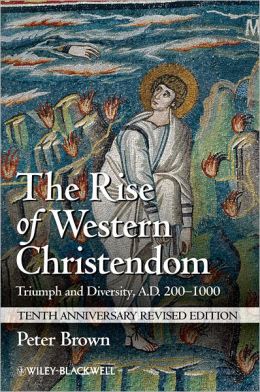
In his preface to the "Tenth Anniversary Revised Edition" of The Rise of Western Christendom, Princeton historian Peter Brown observes that the actual physical and cultural boundary between the Roman Empire and the "barbarians" of northern Europe was not nearly as absolute as the Romans themselves claimed.  The world on either side of the boundary, that is, was strikingly similar in many significant ways.  Drawing on the work of another historian, John Drinkwater, Brown argues that, "the emperor, military, and civilian populations alike needed the idea of a 'barbarian threat' to justify their own existence." (p. xiv)  He goes on to state that, "Altogether the Roman government had a way of rendering absolute boundaries that were, in reality, extremely permeable." He refers to those boundaries as "an ideological Iron Curtain." (p. xv)  The boundaries we draw on a map, in sum, are about power and control, which are fundamental factors in human social organization.  Boundaries are artifacts of our minds that are "socially constructed realities."

And many of the boundaries that we "draw" have nothing to do with maps at all.  They invariably do have a great deal to do with power and control.  Religious doctrines comprise often function as boundary markers.  Believers in a particular set of doctrines stand on one side of a boundary and unbelievers and doubters on the other side.  The Presbyterian Church (USA) has been suffering through a prolonged debate over the boundaries between those who consider homosexuality a sin and those who do not.  We have fought other fights, notably over the nature of the Bible.  In these battles, we engage a very human practice, the describing of boundaries between us, which boundaries are as much about power and control as anything else.  If that were not the case, the constant ecclesiastical splits that have taken place among Protestants since the earliest days of the Reformation make no sense at all.  Once we reach a crucial boundary such as the redefinition of marriage, we refuse to be bound by the authority of those on the other side of the boundary.  We migrate to new institutions and loyalties.

This is all well and good.  It is the way we humans do things.  What is worth noting, however, is the ways in which all of us seek to fit God into our boundaries and make Jesus the lord of our territory alone.  All of us do this.  And it is right here that our human instinct for social control and power fails us for what we call "God" is rendered merely a god of our own making, and we turn our search for the ultimate into a debate over who is right, who is wrong, and who has power and authority.  We erect Roman boundaries to divide a territory that actually isn't all that different on either side of the line however much we convince ourselves otherwise.  It's worth a thought.


Wednesday, April 3, 2013

Pope Francis and Protestant "Ecclesial Communities"

Francis I kissing feet of male & female prisoners
Source: CBC News
A recent AP article carries the headline, "Pope's Foot-Washing a Final Straw for Traditionalists" and provides a laundry list of the various things Pope Francis I has done that conservative and high church liturgical Catholics find "disturbing."  Benedict XVI restored some of the pomp of the papacy including the use of rich vestments and Latin in the mass, which gave the traditionalists hope of a 21st century counter-reformation of the reforms carried out in previous papacies.  The traditionalists attribute the decline of the Catholic Church in various regions of the world to the loss of traditional practices.  Francis evidently is bringing the traditionalist counter-reformation to an end.

From a liberal, low church Protestant perspective, thus, Pope Francis has made a good start.  He wears simpler garb and deports himself in a humbler manner.  On Maundy Thursday, he kissed the feet of two women, one of whom is Muslim.  He seems interested in reaching out to Islam, which evidently is especially worrisome for the traditionalists who fear that it suggests religious "relativism."  So, this is all to the good.

One can't help but continue to wonder, however, what the new pope's simple and humble approach means in other areas of church life.  In an earlier posting (here), I raised the question of his views on homosexuality, which are evidently less enlightened.  Protestants may well wonder, moreover, if he is going to affirm or change the Catholic Church's demeaning attitude toward Protestant local congregations, which in Catholic nomenclature are "ecclesial communities."  At present the official Catholic position is that Protestant congregations are not churches because Protestants have forfeited Apostolic succession and the sacraments as understood by the Catholic Church.  Pope Benedict reaffirmed this judgment on Protestant churches in 2007 (here).  If Francis does intend to open new avenues of dialogue with Islam, will he also bring a less demeaning attitude toward other Christians as well?  One wonders.

The point is not that we Protestants attain some kind of new status by having the pope recognize our churches as churches.  Our churches are churches in any event.  The point is that by changing the Catholic stance on the status of other sisters and brothers in Christ, he would further signal his intention to use every means at his disposal to reach the world with the good news of Christ.  He would open the door to greater ecumenical cooperation in facing the challenges facing our faith in the 21st century.  He would promote greater peace, understanding, and fellowship in intra-faith relations among Christians, which can only be a good thing.  But will he?  One wonders.


Tuesday, November 20, 2012

Coming to Christ Gently

"Christianity," as an identifiable separate religion, doesn't actually have a birthday in spite of the fact that we usually celebrate Pentecost as the birthday of the church.  In fact, the Spirit-filled followers of Jesus remained an identifiable sect of Judaism for many decades.  Most of the them were Jewish, and one powerful wing of the "Way," as it was called, believed that only Jews could be his followers.  Over time, however, the rest of Judaism found the Way less and less acceptable while more and more of Jesus' followers weren't Jewish; and eventually the Way became a separate religion, Christianity.  This took time.  It is not correct, for example, to call the Apostle Paul a Christian.  Christianity as an identifiable religion didn't exist yet, and it is clear from the New Testament that Paul considered himself to be a practicing Jew who believed that Jesus was the messiah (Christ).  The point here is that the church evolved from being a Jewish religious group with peculiar (but still Jewish) beliefs about Jesus of Nazareth into an identifiably separate religion with Jewish roots.  It took time for us to go through this process of separation.

Conversely, the 19th century western Protestant missionary movement preached a message that called on people of other faiths and cultures to convert to Christianity and become, virtually, a part of the western church.  Converts were expected to reject their previous religion and join churches that were like western churches.  They sang western hymns translated into the local language.  They sat on pews.  Nothing in the church was borrowed from their former faith.  Unlike the early church, which only gradually separated itself from Judaism, convert churches formed by the Protestant missionary movement were expected to make a swift and clean break with their past, and they were ex that there had been anything good in that past.  In many nations, the consequence was that most people refused to make such a break even if they were otherwise attracted to faith in Jesus.  Leaving their former religion so abruptly created tensions with neighbors and other family members, and it meant giving up much in life that was comforting and familiar.

In the past, Protestant missionaries simply insisted that a hard break had to be made, many still do.  But, in various parts of the world there is a movement of sorts to create churches that do not make a hard and fast break with their original faith and its culture.  Although not stated as such, the goal is to replicate more nearly the experience of the early church by making a gradual separation from one's previous faith and to dispense with hard and fast boundaries between religions that have to be crossed in a single leap.  The Hindu religious movement,Yeshu Satsang, is one such attempt to come to Christ more gently, less abruptly, and with less conflict.  In a posting entitled, "Following Jesus Yet Still Hindu or Sikh? Mission Leaders Weigh In on New Communities," reporter Michelle A. Vu describes how Yeshu Satsang communities have emerged as a way for Hindu and Sikh followers of Jesus to remain fully Hindu or Sikh as they explore and develop their faith in Christ.  They worship in ways that make sense within their own culture.  They've adapted the sacraments to fit that culture.  They sing songs that are Hindu and Sikh, and the members of Yeshu Satsang "churches" will sometimes insist that they are not Christians (i.e. members of a foreign religion) but remain Hindu or Sikh.  It's just that they follow Jesus.

That's worth thinking about—being a follower of Jesus but not a Christian.  That's what Paul was.  Peter and the other disciples all died before there was a Christian religion.  They followed Jesus while remaining devout, practicing Jews.  One of the things that seems to be happening in our increasingly secular society is that small groups of followers of Jesus are reinventing the church in ways that make more sense in the 21st century than do traditional churches.  Maybe something we should be aiming for is to be more Christ-like and less Christian.  Worth a thought.

Wednesday, October 17, 2012

Finding a Balance

"Be Still & Know that I Am God"
Photo:  Xanetia, Creative Commons
In the last Rom Phra Khun posting, I raised the question of how mainline churches might find a better spiritual balance.  For many, the problem is that we so emphasize being active, doing things, and accomplishing tasks (a multitude of tasks) that a balance has been lost.  Faith is not only about doing and accomplishing, even when the Kingdom of God is the goal of our doing and achieving.  Faith is also about listening quietly, praying gently, meditating with no goal other than to be still.  Faith is about singing for the joy of it, reading for the meaning of it, and reshaping life so that time is not a thing we fill with being busy—even the busy-ness of the Kingdom.

One of my treasured little possession from the long-ago past is a little plaque, not even the size of my hand, which reads, "Take time to be holy."  The psalmist enjoins us to be still so that we can know God (Psalm 46:10).  It is difficult for the average active Presbyterian church member to simply be still.  There's a million things to do.

I am personally convinced that one of the things we need to do in Presbyterian churches is to regain our spiritual balance, which means slowing down, maybe even doing less, or at least programming quiet into all of the activity—making non-activity an activity.  In that day, opening a committee meeting with two minutes of silence will be greeted with thanks and relief rather than impatience.  In that day, members will spend more time sharing their faith with each other and less on the business of the church.  In that day, we will balance our impatient quest for the Kingdom with a patient appreciation for the way it is already here.  Amen.

Tuesday, October 16, 2012

The Plank in Our Mainline Eye

Mary & Martha (Luke 10:38-42)
In Dynamics of Faith, theologian Paul Tillich argues that faith in an ultimate of one sort or another is a universal characteristic of the human race and that we are always prone to turn our ultimates into idols.  Thus, in some religions there are physical images, such as statues or pictures, which are meant to symbolize the ultimate but over time become themselves the ultimate.  Faith becomes idolatry.  All faith of every kind, every religion and secular faiths (such as humanism), are prone to idolatry.  One of the most common forms of Protestant idolatry is bibliolatry, the transformation of the Bible into an object of veneration and worship in place of God.

When our faith becomes idolatrous, it eventually leads to disappointment, disillusionment, and a dead spirituality.  It fails to nourish.  It no longer brings healing and well-being.  Tillich experienced how fearful the dangers of idolatry can become as he witnessed the rise of the false faith of nationalism embodied in European fascism.

Tillich's analysis is spot-on and very helpful—especially if we want to see the speck in someone else's eye.  Thus, from over here in the mainline we can see with painful clarity the way many evangelicals really do turn the Bible into an idol, one that forces them into denying the very nature of reality as discovered by science.  Other churches, also mostly evangelical, turn numerical growth into a god, the god of evangelism.  The Catholics tend to transform their hierarchy into a god—that's one reason we broke off from the Catholic Church in the first place.

What is more difficult for us to see is the plank(s) in our own mainline eye.  Historically, Presbyterian churches in the U.S. have been profoundly concerned to reform human society, and we have engaged in all manner of reform movements along with other mainline folks.  One of the most curious was the 19th century movement to "keep the Sabbath holy" by preventing the delivery of mail on Sundays.  We Presbyterians were deeply involved in that one.  The point here is that our search of a more righteous society, for the Kingdom of God on Earth if you will, has become a false faith for Presbyterian churches right down to the present.  The pursuit of social righteousness has become the goal for the great majority of us.  Ask us what it means to believe, and we will quickly answer that it means to do good to others.  We believe in the Golden Rule, and it has become an idol for us.  We are driven, thus, to be busy with the work of the Kingdom—endless meetings, programs, projects, and a multitude of tasks and activities.  We have lost spiritual balance and lost sight of the Christ who commended the "idle" Mary and, by implication, criticized the always busy Martha (Luke 10:38-42).

The question is, how do we regain our balance?  In and of itself, working for the Kingdom is a good thing so long as it does not become the thing.  How do we de-sacralize our constant doing?  That is the question.

Monday, September 12, 2011

Preaching & Worship (vi)

FPC, Lowville, NY
This is the sixth posting in a series working on what it means to be a church, based on eight criteria the Mars Hill Church uses to define its branch congregations as churches, which are listed in the first posting of this series (here).

The third criterion on the Mars Hill list is, "The church regularly gathers to hear God’s Word rightly preached and to respond in worshipful ways."  The fourth criterion reads, "The church is where the biblical sacraments of baptism and Communion are performed regularly."  Both of these criteria focus on worship, and while the order and wording may not have been intended to be important, it is worth noting that in this Protestant description of the role of worship preaching comes first, worship generally second, and the sacraments are third (although they do warrant their own separate criterion).  In Protestant worship, we emphasize preaching.  In my own preparation time for worship, I devote much more time to sermon preparation than to the overall "performance" of the worship service.  Whether for good or for ill, I'm not sure.

So, let's start with preaching.  Why do we put it at the center of Protestant worship?  Historically, I suppose, the early Protestants partly reacted to the high church "ritualism" of Roman Catholicism.  We didn't want to "be like them."  But, going back in time, early Protestant clergy faced congregations that generally had little or no Christian education background, no knowledge of the Bible, and hardly any sense that they were responsible for developing their own understanding of their faith.  They desperately needed teaching, and the reality was that the best time to do that teaching was during worship.  Protestant sermons became long, learned discourses aimed at teaching the rudiments of Christian faith to the ignorant.  We Presbyterians, in the good old days, even called our pastors "teaching elders," a term that the recent revision of the Presbyterian Church (USA) Form of Government has revived.

In a sense then, preaching is in our Protestant blood.  It defines who we are, at least in part.

In terms of the third criterion, there is one point that needs to be made about its wording, which says that one mark of the church is that it regularly gathers to hear preaching and "to respond in worshipful ways."  This is not a good choice of words.  It implies that the worship service doesn't begin until after the sermon and that it is the sermon that inspires worship.  I am sure the authors of these criteria did not mean to imply such, but the wording carries us to that conclusion.  Take it as further evidence of how deeply the centrality of preaching has seeped into Protestant worship.  Preaching, of course, is but one element in worship, and what congregants experience on a Sunday morning is not just the sermon but the whole worship package.

Sunday, August 21, 2011

HeRD #109: Power of the Past

Back in the day, when I worked as a research historian for the Church of Christ in Thailand, I used what was then the brand spanking new technology of the Web to send out almost daily research emails. I called them "HeRD," which stands for "Herb's Research Diary." The following note was sent out on January 4, 1996.  I keep it now on my personal website (here).

HeRD #109 - Power of the Past

It is often difficult for those of us living in the present to appreciate the vast diversity of the past. Early church history provides an example. Protestants have long looked at the early church as being a unified entity. We have engaged in a centuries' long struggle to "return" to the golden age of the early church. Koester in his History and Literature of Early Christianity, however, reminds us that such an understanding of the early church is entirely incorrect. In describing the rapid expansion of the early church, he writes, "However fragmentary the total picture may be, it is nevertheless obvious that the mission and expansion of Christianity in the first years and decades after the death of Jesus was a phenomenon that utterly lacked unity. On the contrary, great variety resulted from these early missions." (p. 94).

Images concerning the past are themselves powerful historical factors. These images frequently have little to do with what actually happened in that past, yet they profoundly influence later behavior. The Protestant attempts to recapture a mythical unified early church is one important example. How we understand the past matters---it matters a great deal.