We should maintain that if an interpretation of any word in any religion leads to disharmony and does not positively further the welfare of the many, then such an interpretation is to be regarded as wrong; that is, against the will of God, or as the working of Satan or Mara.

Buddhadasa Bikkhu, a Thai Buddhist Monk


Showing posts with label Belief. Show all posts

Wednesday, April 2, 2014

Boundaries, Imagined and Real

In his outstanding book, Siam Mapped (Hawaii, 1997), Thai historian Thongchai Winichakul observes that traditionally boundaries between nation-states in Southeast Asia were ill-defined regions between power centers that melded into each other at their outer peripheries.  One did not cross a boundary but rather travelled through it, gradually leaving one power sphere and just as gradually entering another.  At the peripheries, local rulers and people often gave shifting allegiance to two or more centers of power.  When the Europeans showed began to take control of most of the region in the 19th century, however, they introduced carefully surveyed, sharply drawn boundaries.  They wanted to know the precise extent of their authority for purposes of control and taxation.  The "mapping of Siam," thus, was not just about cartography.  It was about power.

We in the West continue to think of boundaries in this sharp-edged, almost rigid way.  A recent posting entitled, "Facebook Data Creates Incredible MLB Fan Map That Proves That Yankees Fans Are Everywhere," provides a striking example of how such mapping of realty is both useful and deceiving at the same time.  Illustrating the posting is this map:
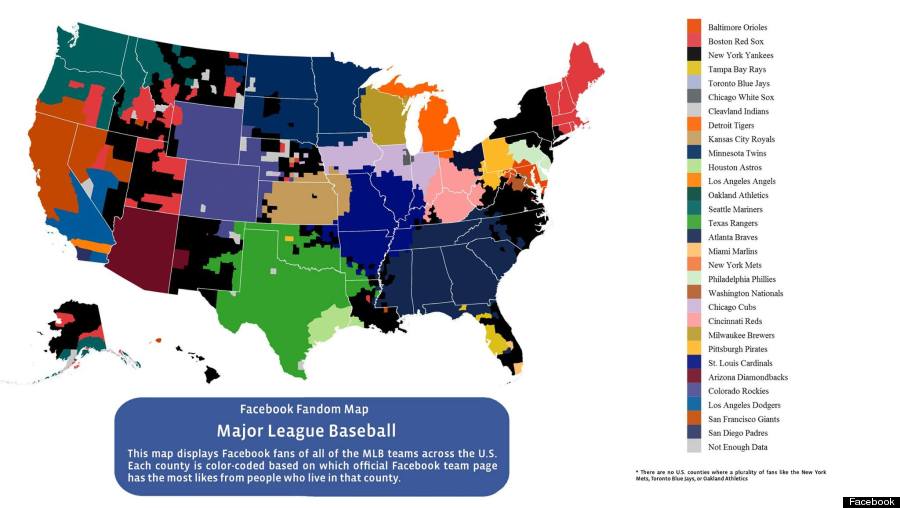
The point of the posting is that Yankee fans are everywhere.  Its assumption is that sports cartographers are able to draw fine-lined boundaries between geographical areas "occupied" by each major league baseball team.  Thus, Minnesota Twins support all but ends at the Minnesota-Wisconsin state line and the Milwaukee Brewers take over.

In truth, it isn't like that.  The boundaries of support for each team are far more porous, less well-defined, and more like traditional Southeast Asia than the above map suggests.  The actual point of the article, that there are Yankee fans in large numbers all across the nation, itself suggests that sports boundaries are more amorphous that the map suggests.  The map evidently uses counties for its basic unit, so that a county that has a bare plurality of Yankee fans is colored Yankee black, while another one that almost has a plurality of support is not Yankee black.  Twins support does not abruptly end one county into Wisconsin or Iowa, but it does dribble off so that there are more Brewers fans or Cubs fans east or south of the state line.

The point here is that people who habitually draw maps with sharp-edged boundaries tend to perceive such boundaries in other areas of life.  Such boundaries promote rigid identities in all facets of life, and those who think in terms of pencil-thin boundaries tend to draw them when it comes to religion as well.  One must be either a believer or an unbeliever, an atheist or a religionist.  In reality, even in our hearts the boundaries between faith and unfaith are just not that clear.  We have, in fact, a word for those who eschew amorphous shifting boundaries of the heart: "fanatics".


Tuesday, December 11, 2012

There Never Was A Brontosaurus

Brontosaurus - the critter that never was
According to an NPR posting entitled, "Forget Extinct: The Brontosaurus Never Even Existed," there never was such a thing as a brontosaurus. The belief that there was turns out to be the product of a "Bones War" between two over-zealous, fame-hungry nineteenth-century paleontologists. The thing is scientists have known since 1903, one hundred and nine (almost ten!) years ago, that there never was a creature that we have called by the name, "brontosaurus".  Weird.  Up until this morning, I believed in the brontosaurus and would have answered, "Yes, of course," had I been asked if I did.

Now, one could head off in a couple of directions from the fact that the brontosaurus was invented by bad science rather than discovered by good science.  We could explore the boundaries between belief and fact, which are not nearly as sharply drawn as we might think.  Or, it would be fun to rag a bit on science, which is a whole lot more fallible and human than some of its devotees like to pretend.  But, why ruin a perfectly good story?  If you have the time, I'd suggest you follow the above link to the story about how and why there never was such a thing as a brontosaurus.  And, if that isn't enough, check out this posting, entitled, "The Great Brontosaurus Hoax." It points out that scientists continued to use the name brontosaurus until 1974, which may help explain why we the public didn't know it was a name without a thing to be named.  The picture accompanying this posting is from yet another source, "Brontosauruses Never Existed," which has still more facts on the matter.

All of this makes one wonder what else there might be that we know is true that isn't true.

Sunday, June 17, 2012

God

Source: texaswiseman.com
Why should anyone believe in God today?  What might compel us to believe that there is an objective reality that we can appropriately call God?  This is not a question about whether there is or is not a God.  In any objective sense, we cannot answer that question knowing what we know now or with the research tools at hand.  God as God is objectively beyond our ken.

So, why believe there is a God if we cannot know with any reasonable degree of certainty that there is one?  That is the question.

There are reasons to believe.  Some find them compelling.  Some don't.  One of the least valued and most overlooked is the sheer fact that in American society most of us have been raised to believe that there is a God.  Even today, many long decades after Darwin, the vast majority of Americans believe there is a God.  The vast majority of Americans, even those who are not Christians, value the person of Jesus of Nazareth.  He is, as more than one scholar has pointed out, an American icon.  For those not inclined to engage in doubtful reflection, the very fact that they were raised to believe in God is a compelling reason for doing so.

There is another consideration.  Our socially-based belief in God is not "merely" heedless and superficial.  While that belief says nothing about whether or not an objective reality called God does exist, it suggests a good deal of social reflection and, perhaps, even some wisdom.  Our socially bred belief in God, for example, is rooted in the immigrant experience of several peoples and groups fleeing religious persecution.  Belief was important enough to them for them to remove themselves to North America rather than give up that belief.  Our belief in God is also rooted in the revivalist movements of colonial times, which eventually bred liberal social justice movements as well as conservative evangelistic movements.

The point is that our American social commitment to theism cuts both ways.  Yes, it does suggest a superficiality and a herd mentality.  It also embodies, however, the experiences, deep thoughts, and even wisdom of our society as well.  For tens of millions of Americans, those experiences, thoughts, and that wisdom is compelling.  They believe, whether deeply or superficially, that there is a God.

Wednesday, October 19, 2011

Boundaries East & West (iv)

This is the fourth posting in a series of postings reflecting on Thich Nhat Hanh's book, Living Buddha, Living Christ (Riverhead Books, 2007; originally published in 1995). The introductory posting, setting the stage for the series, is (here).  As we've seen in the previous two postings, Thich Nhat Hanh opens Living Buddha, Living Christ with a provocative challenge to our socially-inherited ways of thinking about our beliefs, secular as well as religious.  He wants us to discard the notion that our set of beliefs are truer han those of people who believe differently than we do.


Some years ago Thongchai Winichakul, a Thai scholar, published a fascinating book entitled, Siam Mapped: The History of the Geo-body of a Nation (University of Hawaii, 1997).  One of its key points is that people in Southeast Asia used to think about national boundaries in ways very different from the West.  Boundaries were porous and ill-defined.  There was a national center, which was more-or-less under the authority of the central government, and there were the peripheries that were less fully under the control of the central rulers.  Cities and territories on the periphery frequently gave loyalty to two different kings or princes.  It was the Western colonial powers who in the 19th century introduced distinct, razor sharp boundaries and the notion that every territory had to have one allegiance, clearly defined by its boundaries.


Thich Nhat Hanh is asking us to think about our religious and ideological boundaries the way Southeast Asians used to think about political boundaries.  He wants us to see the boundaries of our beliefs (and unbeliefs) as porous and ill-defined.  There is a center, which for him, is the practices of our faith, and then there are neighboring faiths, from which we can learn a good deal.  Christians, thus, remain Christians because they centrally seek to practice the precepts of Jesus, to walk his Way.  But, Christians can learn from Buddhists, Muslims, Jews, Hindus, skeptics, and "non-believers" if only we will hold our boundaries with less rigidity and seriousness.  All of this separates believing in Christ from following Christ.  For the sake of our inner peace and world peace, Thich Nhat Hanh wants us to follow Christ utterly and fully, but he calls on us to be less assertive and rigid in our beliefs about Christ.  He wants us to be "true practitioners" rather than "true believers"—again, for the sake of inner and international harmony, true peace.


In sum, Thich Nhat Hanh advises us to put our faith, that is our trust, in Christ and his Way while taking our beliefs about Jesus less seriously—to the end that we don't treat each other violently or disdainfully.


Tongchai makes the point that the Western colonial powers introduced razor thin, clearly mapped boundaries into Southeast Asia as a matter of power and control.  Britain, thus, needed to know precisely what the boundaries of Burma were so that British colonial authorities could exercise their power over the people and territory falling within those boundaries.  Ideological and religious boundaries, when sharply drawn, are also about power and control.  They are about who is 'in" and who is "out," who exercises authority, power, and control—and who doesn't.  In the church, in particular, the insistence that we believe certain things about Christ is not really about following or even trusting in Jesus at all.  It is about maintaining institutional control and exercising ecclesiastical authority.  Thich Nhat Hanh is correct.  We would do better to give ourselves utterly to following Christ, trusting that his Way is best for us, and not put so much store in what we believe about him.

Monday, October 17, 2011

Letting Go of Views (iii)

This is the third posting in a series of postings reflecting on Thich Nhat Hanh's book, Living Buddha, Living Christ (Riverhead Books, 2007; originally published in 1995). The introductory posting, setting the stage for the series, is (here).

Following up on the second posting regarding Thich Nhat Hanh's openness to other faiths, we turn to his fundamental premise regarding the relationship of one religion to another: "People kill and are killed because they cling too tightly to their own beliefs and ideologies.  When we believe that ours is the only faith that contains the truth, violence and suffering will surely be the result."  He insists that we must put aside the idea that our religion possesses "changeless, absolute truth" and calls on us to cultivate an attitude of nonattachment to our beliefs and an openness to those of other religions.  He concludes, "To me, this is the most essential practice of peace." (p. 2)

Thich Nhat Hanh is asking Western and Muslim people of faith to cultivate a more East Asian attitude toward religion, which takes beliefs less seriously and the practice of religion more seriously.  He wants us to think of religion as many Buddhists do in places like Thailand, where the common wisdom of Thai society endlessly repeated on the streets is that, "All religions teach the same thing, namely to make people better."

And he's not just calling on people of faith in the West and the Arab world to think about truth and religion in new ways.  He is challenging one of the fundamental characteristics of our societies, which is to take what we think about things with utter seriousness.  He is challenging political ideologues and activist atheists to change their attitudes about the truths they think they know and their opponents supposedly don't know.  He is telling us all that we need to chill, to back off, and to learn to hold our religious, political, and even anti-religious beliefs more gracefully and peacefully.  He may be too gracious to come out and say it in so many words, but he must see in our beliefs and ideologies a major source of global violence and unrest.  If he doesn't, he should, because they are.  For us to see the dangers of being "true believers," however, requires that we think outside of our inherited social box and to see those dangers in our own beliefs.  The point I want to emphasize here is that this is not just about religion.  It is about the way we think and value what we believe generally in Western and Muslim societies.  More in the next posting.

Friday, August 5, 2011

Belief & Faith Revisited

In what amounted almost to an aside, a few days ago I described how I found a book on the history of doubt shelved in the atheism section of a  major bookstore in New Haven, Connecticut (here).  Not long after, I came across a posting entitled, "How abandoning belief rocked my world," by John Ptacek, which is about the value of doubt for discovering the limits of belief. He begins the posting by writing,
What I believe isn’t important. The fact that I can put order to my thoughts, sort them into opinions and fan them into beliefs is hardly impressive. In fact, such thinking is unavoidable. It’s what our highly evolved human brains do. They compare and contrast and judge in an endless attempt to make sense of the world around us. Believing is as automatic as walking or talking or sneezing, and about as noteworthy.
Pracek goes on to describe how he attempted to use a variety of beliefs to rise above his "animal nature," and claims that the rest of humanity is engaged in the same desperate attempt to save themselves with beliefs.  Eventually, he realized that clinging to his belief systems actually kept him from asking truly difficult questions such as, "If a clash of beliefs can be found at the root of all the violence in the world, then shouldn’t we question their validity – not the validity of any particular belief, but belief itself?"  Having then discarded all of his beliefs, he felt a sense of liberation, and he concludes,
However sacred or profound, a belief is nothing more than a thought, and thought is never the thing it describes. It can only hint at the wonders it attempts to touch. Sermons about love garble love’s ineffable beauty. Speeches about unity clank after the first syllable. Courting belief is a prescription for a virtual, not a virtuous life.
Ptacek, working from another angle, is getting at something similar to what I was working on in my recent posting,  "When Faith Becomes Ideology."  Beliefs are something we must always keep an eye on because we have a nasty inclination to transform them into idols, that is human-made "things" that we give our reverence to in place of God.  Buddhist thinkers, such as Thich Nhat Han, regularly warn about the dangers of beliefs.  They insist that Buddhism is not a way of believing but a way of practicing that leads to liberation from suffering and self.  Beliefs are a hinderance to that practice.  The Judeo-Christian tradition is also painfully aware of the dangers of ideological idolatry.  As best we can, we subordinate our beliefs to our faith, putting our trust in God in Christ rather than trusting what we believe about God in Christ.  It's an admittedly difficult distinction but one we must wrestle with continually, and doubt plays an important role in helping us find a balance between what we believe and who we trust.

Those well-meaning preachers and churches that condemn doubt do our faith a disservice.  Doubt is important and when exercised reasonably is an important aid to faith.  Amen.