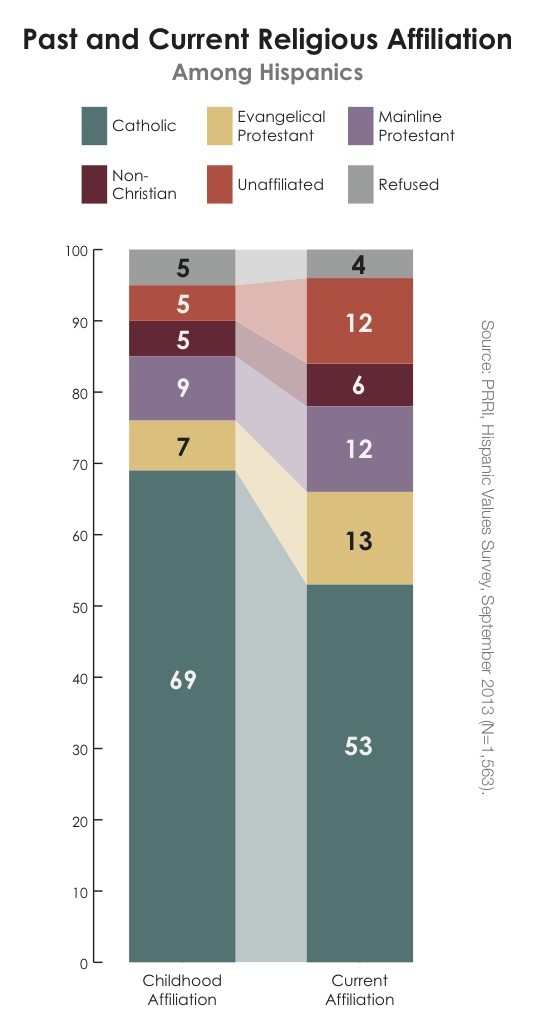
We have become so used to the story of mainline decline and the failure of mainline churches to attract significant numbers of new members that even a modest success comes as a surprise. The PPRI's 2013 Hispanic Values Survey, however, provides us with just such a surprise. According to the findings of the survey, a measurable number of Hispanics who were born Catholic have become mainline Protestants. While only 9% of American Hispanics were born mainline Protestants, 12% of the survey's sample reported themselves to belong (as adults) to mainline churches. That rate of conversion lags behind evangelicals, who went from 7% of Hispanics born evangelical to 13% of Hispanic adults being evangelicals. Those who considered themselves "unaffiliated" rose from 5% to 12%.
It is not unusual for mainline churches to have at least some members who were formerly Catholics, but it is a little surprising to find quite a number of Hispanics moving from Catholicism into mainline churches. Our general image is of a mass migration from Catholicism into evangelicalism, and that appears to be a misapprehension of what is actually taking place. The "nones" are increasing more rapidly than the evangelicals, and for once even the mainliners are attracting adherents from a segment of the American population—an unexpected segment at that.
We can't make too much of these figures. The mainline continues to decline in all of the key measures of viability. But if the PPRI survey is accurate, that story is not the only story. It is worth noting also that the "nones" are growing as rapidly among Hispanic Americans as they are among the population at large—and that the evangelicals are not making as great an inroad into Hispanic-American Catholicism as we might have thought.
We should maintain that if an interpretation of any word in any religion leads to disharmony and does not positively further the welfare of the many, then such an interpretation is to be regarded as wrong; that is, against the will of God, or as the working of Satan or Mara.
Buddhadasa Bikkhu, a Thai Buddhist Monk
Showing posts with label Roman Catholic Church. Show all posts
Monday, October 7, 2013
Saturday, May 25, 2013
Culture of Encounter
| The pope speaking on May 22nd
Source: Vatican Radio
|
"The Lord has redeemed all of us, all of us, with the Blood of Christ: all of us, not just Catholics. Everyone! ‘Father, the atheists?’ Even the atheists. Everyone! And this Blood makes us children of God of the first class! We are created children in the likeness of God and the Blood of Christ has redeemed us all! And we all have a duty to do good. And this commandment for everyone to do good, I think, is a beautiful path towards peace. If we, each doing our own part, if we do good to others, if we meet there, doing good, and we go slowly, gently, little by little, we will make that culture of encounter: we need that so much. We must meet one another doing good. ‘But I don’t believe, Father, I am an atheist!’ But do good: we will meet one another there.” (emphasis added)On first reading, many media commentators assumed that the pope was asserting the possibility that atheists can be saved without having to become Christians let alone Catholics. More circumspect readings generally agree that he was not making such a blanket statement. And the next day, Thursday the 23rd, a Vatican spokesman clarified the pope's position on salvation by saying that anyone who is aware of the Catholic Church and doesn't become a Catholic “cannot be saved” if they “refuse to enter her or remain in her.” (Quoted here)
What is worth noting in his speech, however, is the pope's concept of creating a "culture of encounter" between peoples of faiths and no faith. He seems to be suggesting that we have the drive to do good created in us as part of our God-given natures. We should nurture that drive in each other and use it as a point of contact for mutual understanding—for dialogue, that is. It is not clear what his ultimate goal is in encouraging a culture of encounter grounded in good works. The Thursday clarification would suggest that he still desires the incorporation of the whole of humanity into "the Church," which apparently means the Catholic Church. The hope is that he is encouraging something else, which is a culture of pluralism based on understanding growing out of dialogue with each other. Dialogue in this sense is more than discussions. It is a process of listening, learning, and reflection leading to reductions in conflict and a growth in peace.
If Pope Francis' goal is to develop a "culture of encounter" as a subtle form of Catholic evangelism, he will fail. It will become evident over time that his real agenda is aggrandizement rather than dialogue. If, however, he seeks such a culture as a way to embrace pluralism to the end that ours might be a less conflicted, more peaceful world, he could well play an important role in fostering a more dialogical international atmosphere. Time will tell.
Labels:
Atheism,
Dialogue,
Peace,
Pope Francis I,
Roman Catholic Church
Wednesday, April 3, 2013
Pope Francis and Protestant "Ecclesial Communities"
| Francis I kissing feet of male & female prisoners
Source: CBC News
|
From a liberal, low church Protestant perspective, thus, Pope Francis has made a good start. He wears simpler garb and deports himself in a humbler manner. On Maundy Thursday, he kissed the feet of two women, one of whom is Muslim. He seems interested in reaching out to Islam, which evidently is especially worrisome for the traditionalists who fear that it suggests religious "relativism." So, this is all to the good.
One can't help but continue to wonder, however, what the new pope's simple and humble approach means in other areas of church life. In an earlier posting (here), I raised the question of his views on homosexuality, which are evidently less enlightened. Protestants may well wonder, moreover, if he is going to affirm or change the Catholic Church's demeaning attitude toward Protestant local congregations, which in Catholic nomenclature are "ecclesial communities." At present the official Catholic position is that Protestant congregations are not churches because Protestants have forfeited Apostolic succession and the sacraments as understood by the Catholic Church. Pope Benedict reaffirmed this judgment on Protestant churches in 2007 (here). If Francis does intend to open new avenues of dialogue with Islam, will he also bring a less demeaning attitude toward other Christians as well? One wonders.
The point is not that we Protestants attain some kind of new status by having the pope recognize our churches as churches. Our churches are churches in any event. The point is that by changing the Catholic stance on the status of other sisters and brothers in Christ, he would further signal his intention to use every means at his disposal to reach the world with the good news of Christ. He would open the door to greater ecumenical cooperation in facing the challenges facing our faith in the 21st century. He would promote greater peace, understanding, and fellowship in intra-faith relations among Christians, which can only be a good thing. But will he? One wonders.
Thursday, March 14, 2013
Acknowledging the Shift
| Jorge Mario Bergoglio, Pope Francis I |
The latest evidence of how even the United States, which remains significantly more religious that western Europe, is involved in this shift comes from data collected by sociologists from the University of California, Berkeley, and Duke University, which according to a news posting in the Huffington Post (here) shows that in the U.S., "the number of people who do not consider themselves part of an organized religion has jumped dramatically in recent years." This is not even news anymore, but the election of Pope Francis I does provide further evidence concerning just how far the demographic shift southward has gone. For Americans, his election also requires a reorienting of our usual social-political categories of liberal and conservative. From what's been published thus far, it appears that Francis I is very liberal on social justice issues having to do with capitalism and the poor and painfully conservative on the question of homosexuality. Catholicism frequently has a deep concern for social justice, and we can only wonder how long it will be until the Catholic Church finally learns to extend that heart to all of God's children.
Thursday, March 1, 2012
Another Voice on Contraception
North Country Public Radio recently interviewed the Rev. Laurena Will, pastor of First Presbyterian Church of Ogdensburg, NY, concerning her views on the current debate over Planned Parenthood, abortion, contraception, and religious freedom. The posting, entitled, "Pastor sees personal choice threatened in health coverage debate," presents an alternative view to that of the Catholic Church and various evangelical Protestant denominations and groups. The posting includes both the audio interview and a transcript, and I recommend RPK readers check it out.
Subscribe to:
Posts (Atom)