We should maintain that if an interpretation of any word in any religion leads to disharmony and does not positively further the welfare of the many, then such an interpretation is to be regarded as wrong; that is, against the will of God, or as the working of Satan or Mara.

Buddhadasa Bikkhu, a Thai Buddhist Monk


Showing posts with label Power. Show all posts

Tuesday, August 26, 2014

Religion and Power

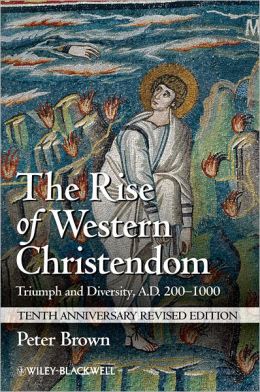
In his preface to the "Tenth Anniversary Revised Edition" of The Rise of Western Christendom, Princeton historian Peter Brown observes that the actual physical and cultural boundary between the Roman Empire and the "barbarians" of northern Europe was not nearly as absolute as the Romans themselves claimed.  The world on either side of the boundary, that is, was strikingly similar in many significant ways.  Drawing on the work of another historian, John Drinkwater, Brown argues that, "the emperor, military, and civilian populations alike needed the idea of a 'barbarian threat' to justify their own existence." (p. xiv)  He goes on to state that, "Altogether the Roman government had a way of rendering absolute boundaries that were, in reality, extremely permeable." He refers to those boundaries as "an ideological Iron Curtain." (p. xv)  The boundaries we draw on a map, in sum, are about power and control, which are fundamental factors in human social organization.  Boundaries are artifacts of our minds that are "socially constructed realities."

And many of the boundaries that we "draw" have nothing to do with maps at all.  They invariably do have a great deal to do with power and control.  Religious doctrines comprise often function as boundary markers.  Believers in a particular set of doctrines stand on one side of a boundary and unbelievers and doubters on the other side.  The Presbyterian Church (USA) has been suffering through a prolonged debate over the boundaries between those who consider homosexuality a sin and those who do not.  We have fought other fights, notably over the nature of the Bible.  In these battles, we engage a very human practice, the describing of boundaries between us, which boundaries are as much about power and control as anything else.  If that were not the case, the constant ecclesiastical splits that have taken place among Protestants since the earliest days of the Reformation make no sense at all.  Once we reach a crucial boundary such as the redefinition of marriage, we refuse to be bound by the authority of those on the other side of the boundary.  We migrate to new institutions and loyalties.

This is all well and good.  It is the way we humans do things.  What is worth noting, however, is the ways in which all of us seek to fit God into our boundaries and make Jesus the lord of our territory alone.  All of us do this.  And it is right here that our human instinct for social control and power fails us for what we call "God" is rendered merely a god of our own making, and we turn our search for the ultimate into a debate over who is right, who is wrong, and who has power and authority.  We erect Roman boundaries to divide a territory that actually isn't all that different on either side of the line however much we convince ourselves otherwise.  It's worth a thought.


Friday, July 4, 2014

Reflections on Competition

The creation stories contained in Genesis 1-2 affirm a number of things including the goodness of creation including humanity and the idea that the Earth was created to be a garden in which we live in peace with all of life and each other.  The story of Adam and Eve's expulsion from the Garden in Genesis 3 affirms a less happy fact: it was humanity's competitive spirit, its desire to be equal with God that led to expulsion.  Humanity "had it all" and wanted more.  The story of Cain and Abel (Genesis 4:1-16) confirms this ancient analysis of the human condition: our desire to be better than someone else, to have more than they have lies at the root of our tragic failings as a race.

If we weren't so competitive, we would still be in the Garden.  Jesus made much the same point when it came to the Kingdom of God: those who want to be "first" there must be slaves and servants who are not interested in what they attain but in how they serve (see Mark 10:35-45).  The lesson of the Bible is that we cannot go home to the Kingdom, which is the Garden, until we stop being destructively, greedily competitive.

As an evolutionary tool, competition is important to our race.  We determine leadership through competition.  Our very survival required that we compete with our species and with other human groups for scarce resources.  We obtain and keep territory through competition.  Our young learned the skills they needed to survive (and even thrive) through competitive play, and we continue to take great pleasure in competition.  Placed in this context, the biblical message can be understood to make at least two important points: first, the problem is not competition itself.  We obviously were created with a competitive spirit in the Garden as a part of God's good creation of us.  The problem in Genesis is that we started competing in ways that are counterproductive.  Second, the road back to the Garden (the Kingdom, if you will) takes us away from competition.  It means unlearning the competitive spirit that gets us into so much trouble, causes so much pain.

Just as we abuse God's good gift of a loving spirit by turning it into lust, so we abuse the good gift of competition by turning it into greed.  The antidote for love gone bad is asking and giving forgiveness; the antidote for competition gone bad is seeking to serve.  We are created to be competitive.  The issue is how we compete, which takes us ultimately into the realm of the uses and abuses of power.

Monday, September 30, 2013

The Paradoxical Meeting of Wisdom and Power

In an earlier posting, entitled "The Element of Surprise," I observed how the birth stories in the Gospel of Matthew begins in chapter one with a series of surprises including, for example, Mary's surprising pregnancy and Joseph's surprising willingness to stick with her in the face of the inevitable scandal.  By the opening of chapter two (verses 1-6), surprise has morphed into paradox.  These verses introduce, of course, the story of the wise men of Sunday school pageant fame.

What the pageants miss is the deeper drama of the wisdom of the East seeking the royal power of the Jews and finding that power in an infant, one born to an otherwise inconsequential couple who were not even legally married.  Wisdom found the king, but the king was a kid.  Now, there was no question that this infant was indeed the messiah, the savior king of the Jews.  The star confirmed it.  His residence in Bethlehem just as "it has been written by the prophet" also confirmed it.  And in wisdom's discovery of power in an infant lies the central theological paradox and insight of the Christian faith, which is that God does not come to us in a Solomon, a figure of obvious power and supposed wisdom, but in a child of no particular significance otherwise.

Now, in a formal theological sense, we already know all of this, but there is always a tendency among Christians to forget the scandal and the paradox involved.  We have traditionally tended to prefer the "birth narrative" of John 1:1-18, which clothes Jesus, the Word (often seen as a veiled reference to Sophia, wisdom), in the majesty of creation.  And the story of wisdom seeking power in an infant has been consigned to a more sentimental, Christmas-y purpose, one that carefully never reads on as far is the massacre of the children in Matthew 2:16-18.  The paradox of the baby messiah, however, looms over the whole of the Gospel of Matthew, and in that paradox we see the shadow of the cross and the promise of resurrection.

Saturday, June 16, 2012

Herod vs. Jesus

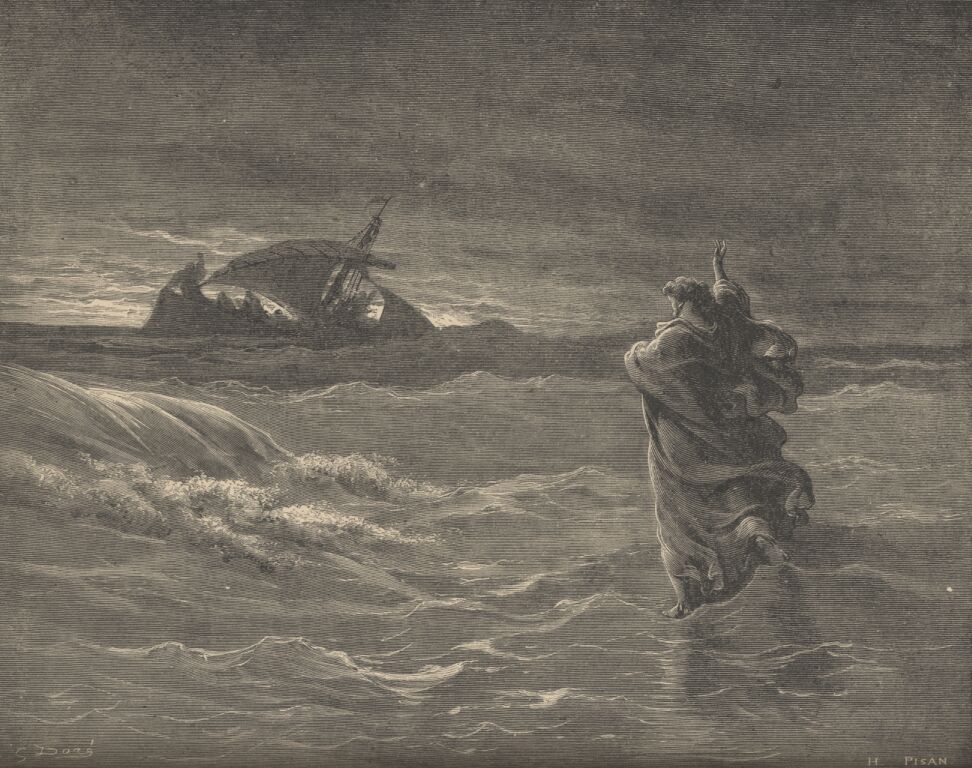
Dore, "Jesus Walking on Water"
Source: Gutenberg.org
Matthew chapter 14 tells three stories.  The first story is about the death of John the Baptist, who was beheaded at Herod's order to please a dancing girl he favored.  When Jesus heard that John was dead, he went away to be by himself, but a crowd followed him, and he fed the crowd with five loaves and two fish.  Then, Jesus again went off to be alone while his disciples climbed into a boat to cross the Sea of Galilee. In the dead of night, Jesus walked on the sea in high winds.  Peter started to walk on water, too, but then lost faith and nearly drowned.  At the end of this third story, "The people in the boat worshipped Jesus," and they avowed that he was truly God's son.

The three stories can be seen in different ways, and they can be read separately to communicate several different meanings.  Taken together, however, they contrast the way in which empires and rulers exercise power with Jesus' use of power.  The first story portrays Herod as lustful, vindictive, power-hungry, capricious, unjust, and violent.  He took John's head on a whim.  By way of contrast, Jesus fed 5000 hungry people, and "everybody ate and was satisfied" (Wright, The Kingdom New Testament, 29).  Then, Jesus walked across a stormy sea, symbolic of chaos, invited Peter to overcome the chaos as well, and saved him when he failed.  In the process, he told the people in the boat to not be afraid.  They worshipped him as they would God.

Herod was the agent of chaos.  Jesus was the master of that same chaos.  Herod behaved unjustly while Jesus showed compassion.  Each exercised power, but they did so to different ends.  The contrast between the power of empire and of God is stark, and early Christians listening to readings of Matthew's gospel surely heard a contrast between the power of Rome and that of Jesus looming in the shadows of these stories.  God, they heard, was greater than Rome.  Jesus used power to different ends than Rome.  Amen.