We should maintain that if an interpretation of any word in any religion leads to disharmony and does not positively further the welfare of the many, then such an interpretation is to be regarded as wrong; that is, against the will of God, or as the working of Satan or Mara.

Buddhadasa Bikkhu, a Thai Buddhist Monk


Monday, September 1, 2014

Avatar & Incarnation

Quite a bit has been written in the blogosphere about the theological implications and message of the 2009 movie, Avatar.  From a sample supplied for me by a Google search on the subject, "avatar and theology," there is obviously the usual range of responses from appreciation to deprecation.  A couple of the ones I looked at, however, caught my attention because they wrestle with the nature of Jake Sully's incarnation in a Na'vi avatar designed by human exobiologists.

One is a post entitled, "Scalp Locks, Gaia, and the Incarnation: History and Theology in James Cameron’s Avatar," by Wen Reagan, which comments on the manner in which a human is put into a Na'vi body. Reagan points out the obvious parallel between the movie's version of incarnation and the Christian understanding of the Incarnation of God in Christ.  He esp. highlights the way in which by the end of the movie the human Jake Sully has become a Na'vi, actually leaving his human body entirely.  Reagan observes, "But in the end, we don’t get a glimpse of Vishnu, safe to retreat from his current avatar and come again in another one. Instead, we get a glimpse of Christ, as Jake takes on the risk of fully embracing the Na’vi by becoming one of them, forever." Garrett East in a post entitled, "James Cameron's Avatar and the Critical Response: An Alternative Perspective," picks up on this same theme of the transformation of a human into another species by arguing that the central theme of the whole movie is the conversion of Jake Sully. He writes, "In essence, I think Avatar could be described as a conversion story," and goes on to observe that this conversion,
requires not only a change of mind and intellectual assent, but a whole new embodied way of life. It requires new eyes, new ears, a new language, and a new heart. It is a relearning of what is right and what is wrong. It is a transfer of allegiance from one people to another (the Na'vi), from one God to another (Eywa). It requires that Jake become nothing less than a new creature in a new creation...We are watching the story of a man who moves from despair, death, hate, and disbelief to hope, life, love, and even faith. When we watch Jake Sully’s story, we are watching a story about conversion.
All of which is to say a central dual theme of the story of Avatar is incarnation and conversion.

Most practicing Christians for most of the last two thousand years have held a view of incarnation not very different from that described in Avatar.  In Jesus of Nazareth, the essence of God was transferred into a human body.  God was in Christ just as Jake was in a Na'vi body.  Now, if we start to think about it, there are differences; but most of the time we don't think about it.  God was in Jesus; Jake was in a Na'vi body.  The movie makes a very important observation, however.  You can't place a person into another body and expect that there won't be any change.

One of the themes of the Book of Genesis is that God does indeed change.  In the story of the Flood, God set a rainbow in the sky as a promise that God would never again use violence against the human race and the rest of creation (Genesis 9:1-17).  Did, then, becoming incarnate in Jesus change God?  If so, how so?  If not, then how can we claim that Jesus was at one and the same time fully God and fully human?  Is it not change an essential element of our nature?

Wednesday, August 27, 2014

Cane Toads & God

Source: animals.nationalgeographic.com
Cane toads are a large, poisonous species of toad that originates in South America that has spread widely throughout northeastern Australia.  A recent ABC Science article entitled, "Toad personalities key to territorial takeover," cites scientific evidence that suggests that the key to the cane toads ability to expand its territory in Australia has to do with "personality".  Some toads are more adventerous than others—bolder, more likely to head off into new feeding territory on their own.  Other toads are more timid and unlikely to go into new feeding territory.  The article concludes that the mix of bold and timid toads is a factor in the cane toads success in Australia.

Who would have thought that cane toads even have personality, let alone that it is apparently important to the species ability to adapt?  Such a possibility causes one to consider the potential role that personality plays in the larger, evolutionary scheme of things.  We know from experience that many other species have personality and that personality is of crucial importance in human social interactions.

The concept of personality is also important theologically.  Christian theology across the board assumes and asserts that God is a person and has the marks of personality (loving, compassionate, cares about justice, is "slow to anger") exemplified for us in Christ.  Trinitarian Christians believe that God is actually three persons (persona), Father, Son, and Holy Ghost.  While professional theologians understand that the Latin term persona does not mean "person" in our English sense, the vast majority of English-speaking Christians translate the "personhood of God" as meaning God has personality.  It can be argued that this idea that God is a person who has personality is but another case of us creating God in our own image, which has pretty much been my own personal view for a long time.  It seems ludicrous on the face of it that the Divine Creator Beyond could in any sense have something as human and mundane as personality.

Still, it is worth considering that personality as a tool of our evolutionary development reflects a predisposition of the Creator, perhaps even an aspect of divine reality.  It remains entirely speculative to assert the personality of God, but it is less speculative to claim that personality is somehow within the "providence of God" and again somehow compatible with "God's will for humanity."  At the very least, it would seem that our having personalities is not a barrier that stand between us and God as such.  Certainly, the way we express personality can be a barrier, but it is not inherently so.

If, then, we apply the English-language conception of person to God as a metaphor we are not asserting something necessarily illogical or out of sorts with modern science—so long as we remember that we are using personhood metaphorically.  It functions thus as a helpful "mask" (the original Latin meaning of persona) of the Divine Beyond, which remains unknown to us directly.  It is not wrong to think of God in personal terms including the ides of having a personal relationship with God.  Whether or not God is a person or has personality, we can legitimately experience God in these terms—and think of God in this way.  It is, we might say, in our God-given nature to do so.

Tuesday, August 26, 2014

Religion and Power

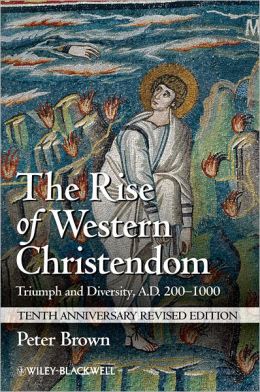
In his preface to the "Tenth Anniversary Revised Edition" of The Rise of Western Christendom, Princeton historian Peter Brown observes that the actual physical and cultural boundary between the Roman Empire and the "barbarians" of northern Europe was not nearly as absolute as the Romans themselves claimed.  The world on either side of the boundary, that is, was strikingly similar in many significant ways.  Drawing on the work of another historian, John Drinkwater, Brown argues that, "the emperor, military, and civilian populations alike needed the idea of a 'barbarian threat' to justify their own existence." (p. xiv)  He goes on to state that, "Altogether the Roman government had a way of rendering absolute boundaries that were, in reality, extremely permeable." He refers to those boundaries as "an ideological Iron Curtain." (p. xv)  The boundaries we draw on a map, in sum, are about power and control, which are fundamental factors in human social organization.  Boundaries are artifacts of our minds that are "socially constructed realities."

And many of the boundaries that we "draw" have nothing to do with maps at all.  They invariably do have a great deal to do with power and control.  Religious doctrines comprise often function as boundary markers.  Believers in a particular set of doctrines stand on one side of a boundary and unbelievers and doubters on the other side.  The Presbyterian Church (USA) has been suffering through a prolonged debate over the boundaries between those who consider homosexuality a sin and those who do not.  We have fought other fights, notably over the nature of the Bible.  In these battles, we engage a very human practice, the describing of boundaries between us, which boundaries are as much about power and control as anything else.  If that were not the case, the constant ecclesiastical splits that have taken place among Protestants since the earliest days of the Reformation make no sense at all.  Once we reach a crucial boundary such as the redefinition of marriage, we refuse to be bound by the authority of those on the other side of the boundary.  We migrate to new institutions and loyalties.

This is all well and good.  It is the way we humans do things.  What is worth noting, however, is the ways in which all of us seek to fit God into our boundaries and make Jesus the lord of our territory alone.  All of us do this.  And it is right here that our human instinct for social control and power fails us for what we call "God" is rendered merely a god of our own making, and we turn our search for the ultimate into a debate over who is right, who is wrong, and who has power and authority.  We erect Roman boundaries to divide a territory that actually isn't all that different on either side of the line however much we convince ourselves otherwise.  It's worth a thought.


Tuesday, July 8, 2014

Somehow Present & Beyond

There lies in our understanding of One, Creator, Personal God a fundamental tension for us between the Creator and Personal faces of God.  How can this One God be both creator of the whole of the cosmos and all that is in it and yet also a presence that we can somehow sense in a personal way?  Our conception of the Incarnation of God in Jesus Christ mirrors that tension.  How could a man be at once human and divine?  How can God be somehow like us and yet completely and incomprehensibly unlike us?  And in our understanding of the Bible we are faced again with this fundamental tension.  How can a clearly fallible, human collection of words still somehow reveal to us the Word that connects us to the divine Beyond?  We call the church, the "body of Christ," and yet again how is it that this depressingly human institution can be a vessel somehow of the Spirit?

This tension between realities lies within us as well.  We discover it most painfully in the question of evil and good.  In our experience, these are not two separate categories that can be neatly divided from each other.  Out of one so often emerges the other.  Even in the darkest storm, we say, there is a silver lining.  We are at one and the same time good and not, evil and not.

How can God be both Beyond and Personal is a question that resonates across our human experience.  Maybe someday we will have an answer.  In the meantime, we live in faith.

Monday, July 7, 2014

"Yankee Doodle Dandy" & the "Historical Jesus"

Among the classic patriotic films shown over this Fourth of July weekend, the broadcast on TCM of "Yankee Doodle Dandy,"the movie biography of George M. Cohen staring James Cagney, caught my eye.  In his comments on the film, Robert Osborne noted that the movie took "liberties" with Cohen's life such as having him married only once to a woman named Mary.  In real life, he had two wives neither of them named Mary.  Osborne concluded, however, that if the details were sometimes wrong the overall portrait given by the movie is accurate.

Suppose for a moment that the screenplay for "Yankee Doodle Dandy" survives for a thousand years, long after Cohen is forgotten, and future historians have only it to work with in recapturing his life.  How would they treat the script?  How much of the actual life of the real Cohen would they be able to reconstruct?  Would they be able to figure out that he had two wives instead of one?  Would they be skeptical of the rosy portrayal of his personality?  How many nuances obvious to us would they miss completely?  How accurate would their portrayal of the "ancient" world be if based on this lone screenplay?

If we turn to the long "quest for the historical Jesus" with all of this in mind, we get some sense of how difficult it is to reconstruct the real Jesus from the biblical screenplay, which was never intended to be a history of Jesus in the first place—even less so than YDD was supposed to be a biography of Cohen.  Indeed, the gospels were intended to be tributes to Jesus the Messiah in a way somewhat similar to the musical, which is a tribute to Cohen.  YDD is not biography anymore than the gospels are.  As a tribute, however, YDD still approximates "the truth" about George M. Cohen (in Osborne's view, at least) even if it plays footloose with the biographical details of his life.  Can we say the same about the gospels?  Are they faithful to the truth about Jesus of Nazareth if not the biographical details?  That is our impression—our faith, actually.  Amen.

Friday, July 4, 2014

Reflections on Competition

The creation stories contained in Genesis 1-2 affirm a number of things including the goodness of creation including humanity and the idea that the Earth was created to be a garden in which we live in peace with all of life and each other.  The story of Adam and Eve's expulsion from the Garden in Genesis 3 affirms a less happy fact: it was humanity's competitive spirit, its desire to be equal with God that led to expulsion.  Humanity "had it all" and wanted more.  The story of Cain and Abel (Genesis 4:1-16) confirms this ancient analysis of the human condition: our desire to be better than someone else, to have more than they have lies at the root of our tragic failings as a race.

If we weren't so competitive, we would still be in the Garden.  Jesus made much the same point when it came to the Kingdom of God: those who want to be "first" there must be slaves and servants who are not interested in what they attain but in how they serve (see Mark 10:35-45).  The lesson of the Bible is that we cannot go home to the Kingdom, which is the Garden, until we stop being destructively, greedily competitive.

As an evolutionary tool, competition is important to our race.  We determine leadership through competition.  Our very survival required that we compete with our species and with other human groups for scarce resources.  We obtain and keep territory through competition.  Our young learned the skills they needed to survive (and even thrive) through competitive play, and we continue to take great pleasure in competition.  Placed in this context, the biblical message can be understood to make at least two important points: first, the problem is not competition itself.  We obviously were created with a competitive spirit in the Garden as a part of God's good creation of us.  The problem in Genesis is that we started competing in ways that are counterproductive.  Second, the road back to the Garden (the Kingdom, if you will) takes us away from competition.  It means unlearning the competitive spirit that gets us into so much trouble, causes so much pain.

Just as we abuse God's good gift of a loving spirit by turning it into lust, so we abuse the good gift of competition by turning it into greed.  The antidote for love gone bad is asking and giving forgiveness; the antidote for competition gone bad is seeking to serve.  We are created to be competitive.  The issue is how we compete, which takes us ultimately into the realm of the uses and abuses of power.

Thursday, July 3, 2014

Intolerance

Intolerance is its own reward.

Monday, June 30, 2014

On the Boundaries of the Spirit

We are not only living in the postmodern age, but we are also entering the post-religion age as well, which is to say that spirituality and religion are still generally identified with each other.  Christianity and Islam still provide the standard models for what it means to be spiritual.  But, as we dip our toe into a new era where spirituality is expressed in different, less classically religious ways, we are finding that the boundaries between what is spiritual and what is not are shifting.  The Spirit is encountering us in unexpected places and non-traditional ways.

A sports news posting entitled, "Strike a pose: Gophers embrace yoga" provides a striking case in point.  It reports that University of Minnesota Golden Gophers football head coach Jerry Kill and Gopher strength coach Eric Klein have introduced a regular course of yoga exercises into the football team's training program.  The rationale is that yoga restores the players physically and mentally, helping them to recuperate from the stresses of playing big time, Big Ten football.  It also helps them became more flexible, which will reduce injuries.  Gopher yoga instructor, Christine Ojala, explains that she is teaching the players to, "access the breath in a more informed and intelligent way." She observes that, "Yoga is one of the best methods for restoring the mind, body and spirit to their essential, balanced and strong states of being."

In Protestant Christian circles, prayer is generally understood to be talking to God. It is, to quote the website All About Prayer, "our direct line with heaven. Prayer is a communication process that allows us to talk to God!...To many people, prayer seems complicated, but it is simply talking to God." Asian spirituality, an increasingly important post-religious spiritual tool, is more about listening than it is about talking.  It often invites practitioners to learn to be still, to allow healing to take place.  In Western prayer we speak to God; in Asian meditation technologies the Spirit talks back.  Even when said before football games, prayer is mostly about religion and church.  For most westerners, yoga and other forms of meditation are spiritual practices that do not carry those same associations.  In them, the Spirit crosses the traditional boundaries, makes new connections, and finds new ways to entice us forward toward the full bloom of the Kingdom.  Amen.

Friday, June 27, 2014

Pastoral Visitation

By all accounts, most American Protestant pastors do little home visitation any more even in smaller congregations.  What was once widely seen as one of the basic tasks of pastoral ministry has largely fallen by the wayside.  It is a shame that this is the case, and it is likely one cause of why so many pastorates end sooner rather than later and badly rather than well.  Home visitation of parishioners by their pastor, if done in a friendly and caring manner, contributes to the over all health of a pastor's relationship with her congregation in several ways.

Regular visitation is in and of itself a statement by the pastor that he cares.  The word gets out quickly that she devotes time each week reaching out to members of the church.  It is not just those who receive visits that appreciate the gesture of care embodied in regular calling.  Pastors will use different standards to determine who requires regular visitation (e.g. everyone over the age of 80 as  one criterion) and different churches will have their own unique set of considerations.  The important thing is that pastoral calling visibly, regularly takes place.

Visitation provides a foundation for pastoral care in times of crisis and need.  The time spent socializing with parishioners in their homes, which often enough involves real sharing of each other's lives and concerns, helps a pastor to know how to minister to her parishioners more effectively when they have a real need for pastoral help.

Visitation also sets a tone for the whole congregation.  It communicates the importance of fellowship and mutual care in a church.  It is better to practice the mutual love we expect of the people of God than preach it.

In general, regular visitation provides a pastor with insights into the relationships of people within the church—who are friendly with each other, who are not.  When a pastor visits the people on a regular basis, he plain and simply knows them better.  Visitation has a positive influence on preaching, worship, and administration.  It helps a pastor better navigate the politics of a congregation.

For pastors themselves calling on parishioners sets a tone that becomes a habit.  The pastor has to work at relationships and always remember that the health of the church-pastor relationship (and thus of the church itself) depends on that work.  Visitation also encourages a pastor to find other ways to care for those relationships including having lunch at the local diner with some and inviting others to dinner in the pastor's home.

In the course of a pastorate, there will be times (for months sometimes) when a pastor genuinely has little time for calling; but the fact that it has been done and will again get done is not lost on her parishioners.  Their appreciation of a pastor who goes out of his way to minster to them in this way remains—as long as the visits are friendly, kindly, and obviously caring.  And I should add that most of the time visitation is one of the more enjoyable aspects of pastoral ministry.  In how many jobs, are people paid "just" to sit and chat with friends?


Thursday, June 26, 2014

Beyond the Newtonian Jesus

Christian orthodoxy across all denominations and traditions affirms the dual nature of Christ as both human and divine, man and God.  In the Age of Science, the European branches of the faith have largely treated the Doctrine of the Incarnation as if it is a fact on the order of scientific factuality.  Gravity attracts, Columbus discovered the Americas in 1492, and Jesus was human and is divine.  These three "facts," however, exist in three different realms of their own.  Gravity is an observable physical phenomenon.  It requires research to explain it, but explain it or not it is.  The discovery of the Americas is a historical fact, which itself is not observable.  It does not even exist because it lies in the past, which by definition no longer exists in the present.  It is over and done.  We require research to know that it even took place.

The doctrine of the incarnation takes us into a third realm.  All spiritual experiences do.  In and of itself the dual nature of Jesus of Nazareth was not observable, even after his resurrection.  It took the early church centuries of controversy and debate to develop the doctrine.  It cannot be established by observation or by research.  It is a matter of faith that is both experiential and philosophical.  It is philosophical in the sense that it had to be thought through using the powers of reflection and reason.  It is experiential in the sense that on reflection the earliest church saw in their experience of Jesus an experience with God and succeeding generations of Christians have affirmed that we too see in our experience with Christ an experience with God.  None of this fits the profile of a physical phenomenon or historical event.  Jesus did not have a special God organ.  According to the biblical accounts, he was observably human.  And while the doctrine of the incarnation and its development is historical as a doctrine, the purported divinity of Christ is not itself a historical fact.  All that historians can establish is that there was and is a belief in Christ's divinity, not the divinity itself.  Historians are not equipped to deal with spiritual events any more than carpenters are equipped to drill teeth.

For those of us living on the postmodern bridge between the Newtonian world (a.k.a. "modernity") and whatever is coming next, it is excruciatingly difficult to separate divinity from factuality.  For us, God is not a physical phenomenon.  There is no science that deals with God or has the tools to establish the factuality of God in any way that makes scientific sense.  I am personally convinced that one day future science (or whatever comes after science) will discover God, but I don't have a clue what that even means.  Future science will rely on technologies and ways of thinking that have yet to be developed.  In the meantime, we must rely on spiritual sensitivities and the insights we draw from them to discern the Beyondness and the Presence of God.  And we have to unlearn our worshipful respect for facts.  We have to move beyond the doctrine that only what is factual is real.  We have to stop thinking that science is the last stop in our cognitive evolution.

We have to live in faith.

This does not mean we stop thinking critically but precisely the opposite.  It means that when we sense the divine in a sunset and find peace in meditation we accept that we are participating in a different realm of reality—one where Christ is human and divine for those of us who put our faith in him and where the logic of science is flawed, open to criticism.