The creation stories contained in Genesis 1-2 affirm a number of things including the goodness of creation including humanity and the idea that the Earth was created to be a garden in which we live in peace with all of life and each other. The story of Adam and Eve's expulsion from the Garden in Genesis 3 affirms a less happy fact: it was humanity's competitive spirit, its desire to be equal with God that led to expulsion. Humanity "had it all" and wanted more. The story of Cain and Abel (Genesis 4:1-16) confirms this ancient analysis of the human condition: our desire to be better than someone else, to have more than they have lies at the root of our tragic failings as a race.
If we weren't so competitive, we would still be in the Garden. Jesus made much the same point when it came to the Kingdom of God: those who want to be "first" there must be slaves and servants who are not interested in what they attain but in how they serve (see Mark 10:35-45). The lesson of the Bible is that we cannot go home to the Kingdom, which is the Garden, until we stop being destructively, greedily competitive.
As an evolutionary tool, competition is important to our race. We determine leadership through competition. Our very survival required that we compete with our species and with other human groups for scarce resources. We obtain and keep territory through competition. Our young learned the skills they needed to survive (and even thrive) through competitive play, and we continue to take great pleasure in competition. Placed in this context, the biblical message can be understood to make at least two important points: first, the problem is not competition itself. We obviously were created with a competitive spirit in the Garden as a part of God's good creation of us. The problem in Genesis is that we started competing in ways that are counterproductive. Second, the road back to the Garden (the Kingdom, if you will) takes us away from competition. It means unlearning the competitive spirit that gets us into so much trouble, causes so much pain.
Just as we abuse God's good gift of a loving spirit by turning it into lust, so we abuse the good gift of competition by turning it into greed. The antidote for love gone bad is asking and giving forgiveness; the antidote for competition gone bad is seeking to serve. We are created to be competitive. The issue is how we compete, which takes us ultimately into the realm of the uses and abuses of power.
We should maintain that if an interpretation of any word in any religion leads to disharmony and does not positively further the welfare of the many, then such an interpretation is to be regarded as wrong; that is, against the will of God, or as the working of Satan or Mara.
Buddhadasa Bikkhu, a Thai Buddhist Monk
Showing posts with label Book of Genesis. Show all posts
Friday, July 4, 2014
Saturday, April 5, 2014
Thoughts on Noah, the Movie
So, Friday afternoon we went to see the movie, Noah, at a movie complex in Watertown, NY. There is a ton of reviews of the movie, many of which can be read at Rotten Tomatoes, so let me simply share some thoughts rather than do a full critical analysis.
However the critics may feel about the various aspects of Noah, from a theological perspective the movie embodies a fascinating contemporary dialogue between the biblical story found in Genesis 6-9 and modern culture. Both the original tale and the modern remake are mythic descriptions of God's struggle with destructive, prideful humanity, the modern movie version being a remythologizing of the story in a contemporary context. There are both similarities and differences, but it is the differences that are most interesting and instructive.
In the original, God is very clearly present, while in the movie "the Creator" is hidden and speaks through visions that are open to interpretation. In Genesis, Noah is the very prototype of the faithful man, but in the movie he is constantly conflicted and apparently misinterprets God's will concerning the survival of the human race. He also comes across as something of a more up to date zealot. And where the emphasis in Genesis is on the destruction of wicked humanity, a key theme in the movie is the environmental salvation of Planet Earth and its non-human life. In the movie's version of the epic, Earth was undergoing a massive environmental crisis that was impoverishing humanity as well as destroying the rest of life on the planet.
While reviewers note a number of striking parallels with The Lord of the Rings trilogy (the rock encrusted, over-sized "Watchers" of this movie, for example, look suspiciously like stony versions of Peter Jackson's visualization of Tolkien's Ents), there is an important difference. The boundaries between good and evil are generally clearly drawn in Tolkien's trilogy; good guys are good and bad guys are bad. That is less the case in Noah; Noah himself acts unwisely at times and comes across as only relatively good. His son, Ham, is a flawed figure who for a time allies himself with the evil protagonist of the film, Tubal-cain (who is rotten to the core). Noah himself feels the inherent evil in himself and those he loves, which is why he believed that they must not become the seed of a renewed human race—a fear not shared by the Creator, apparently. This is to say that the biblical story is highly dualistic while this contemporary rendering is much less so. Just as the movie's optics tend to be darkish grays, so does Noah and his family live in a world that is more gray than black or white.
In a moment of theological boldness, the move contains a rendering of Genesis 1 and the seven days of creation that clearly leaves room for evolution. That too brings the story of Noah into the 21st century and aptly illustrates the manner in which the movie is a remythologizing of the biblical original. Our larger society is trending haphazardly away from absolutist dualism with its hard and fast boundaries to a more realist, less dualistic postmodern worldview that is also less bounded by the agendas of organized, institutional Christianity. This movie version of the biblical story is a fascinating rendering of the old, old stories for our time. It is not scripture. It is a comment and even a meditation on scripture that puts the story in a contemporary idiom for our reflection. It invites us to engage in our own dialogue with the story of the flood, and in fact encourages us to actually go back and open our Bibles and read the original script again.
There are a couple of nice touches in the movie. It solves the problem of how to feed and care for all the animals in the ark by having Noah's family mix a potion that when burned as incense puts them all to sleep for the duration (a kind of sci-fi suspended animation apparently). The movie also conveniently has Noah plant a magic seed that grows a huge forest, which solves the problem of where he got all the lumber for the ark; and it has the Watchers assist in building it, which solves the problem of how Noah and his family could build such a huge craft. In short, if there is science fiction, which provides imaginative, even playful commentary on science, then Noah is might be considered as biblical fiction in an almost sci-fi mode: an imaginative, even playful commentary on the Bible.
Reviewers pan some of the acting in the movie; they criticize it from an artistic, cinematic perspective. But, I found it interesting and instructive from a theological and biblical point of view. If you haven't seen it and are concerned for such things as faith, scripture, and theological reflection, I highly recommend it. It is fun.
However the critics may feel about the various aspects of Noah, from a theological perspective the movie embodies a fascinating contemporary dialogue between the biblical story found in Genesis 6-9 and modern culture. Both the original tale and the modern remake are mythic descriptions of God's struggle with destructive, prideful humanity, the modern movie version being a remythologizing of the story in a contemporary context. There are both similarities and differences, but it is the differences that are most interesting and instructive.
In the original, God is very clearly present, while in the movie "the Creator" is hidden and speaks through visions that are open to interpretation. In Genesis, Noah is the very prototype of the faithful man, but in the movie he is constantly conflicted and apparently misinterprets God's will concerning the survival of the human race. He also comes across as something of a more up to date zealot. And where the emphasis in Genesis is on the destruction of wicked humanity, a key theme in the movie is the environmental salvation of Planet Earth and its non-human life. In the movie's version of the epic, Earth was undergoing a massive environmental crisis that was impoverishing humanity as well as destroying the rest of life on the planet.
While reviewers note a number of striking parallels with The Lord of the Rings trilogy (the rock encrusted, over-sized "Watchers" of this movie, for example, look suspiciously like stony versions of Peter Jackson's visualization of Tolkien's Ents), there is an important difference. The boundaries between good and evil are generally clearly drawn in Tolkien's trilogy; good guys are good and bad guys are bad. That is less the case in Noah; Noah himself acts unwisely at times and comes across as only relatively good. His son, Ham, is a flawed figure who for a time allies himself with the evil protagonist of the film, Tubal-cain (who is rotten to the core). Noah himself feels the inherent evil in himself and those he loves, which is why he believed that they must not become the seed of a renewed human race—a fear not shared by the Creator, apparently. This is to say that the biblical story is highly dualistic while this contemporary rendering is much less so. Just as the movie's optics tend to be darkish grays, so does Noah and his family live in a world that is more gray than black or white.
In a moment of theological boldness, the move contains a rendering of Genesis 1 and the seven days of creation that clearly leaves room for evolution. That too brings the story of Noah into the 21st century and aptly illustrates the manner in which the movie is a remythologizing of the biblical original. Our larger society is trending haphazardly away from absolutist dualism with its hard and fast boundaries to a more realist, less dualistic postmodern worldview that is also less bounded by the agendas of organized, institutional Christianity. This movie version of the biblical story is a fascinating rendering of the old, old stories for our time. It is not scripture. It is a comment and even a meditation on scripture that puts the story in a contemporary idiom for our reflection. It invites us to engage in our own dialogue with the story of the flood, and in fact encourages us to actually go back and open our Bibles and read the original script again.
There are a couple of nice touches in the movie. It solves the problem of how to feed and care for all the animals in the ark by having Noah's family mix a potion that when burned as incense puts them all to sleep for the duration (a kind of sci-fi suspended animation apparently). The movie also conveniently has Noah plant a magic seed that grows a huge forest, which solves the problem of where he got all the lumber for the ark; and it has the Watchers assist in building it, which solves the problem of how Noah and his family could build such a huge craft. In short, if there is science fiction, which provides imaginative, even playful commentary on science, then Noah is might be considered as biblical fiction in an almost sci-fi mode: an imaginative, even playful commentary on the Bible.
Reviewers pan some of the acting in the movie; they criticize it from an artistic, cinematic perspective. But, I found it interesting and instructive from a theological and biblical point of view. If you haven't seen it and are concerned for such things as faith, scripture, and theological reflection, I highly recommend it. It is fun.
Labels:
Book of Genesis,
Culture and Faith,
Dialogue,
Dualism,
Evil,
Noah,
Science and Religion
Saturday, November 2, 2013
Beyond Modernity
![]() |
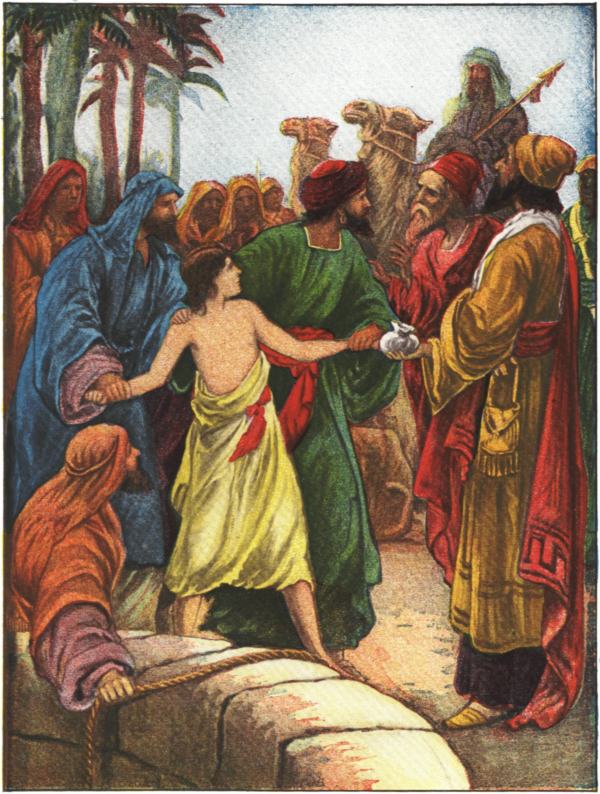
| Joseph Sold into Captivity |
By treating the Joseph Narrative as fiction rather than as history, Brueggemann does not lose the value of the stories in it. He makes it possible, rather, to focus on the story itself rather than the actors. The tendency otherwise is to give our attention to the actors and attempt to psychoanalyze them—figure them out. The story, when treated as history, is not important in and of itself but for what it reveals about it characters. If the story is fictional, however, our attention shifts to the author and the story itself. It shifts to a deeper level of meaning in which the story becomes a witness to Israel's faith in the era of Exile when it was likely written. And there is the added value of laying aside the need to defend the Bible's factuality at all points, which so often obscures its deeper meanings and spiritual value by forcing us to worry about superficial issues such as demonstrating that Jonah could survive for three days in the belly of a fish or proving that David really did write the psalms attributed to him in the Book of Psalms.
Equally to the point, the Joseph Narrative is just as historical whether it be treated as literature or as a factual account of actual events. It gives witness to the faith of its author and its times and thus reflects the historical experience of the Jewish people. It is as true spiritually and no less inspired. Treating it as literature, in truth, helps to awake us from the dreamworld of modernity with its narrow understanding of reality and its obsession with factuality.
Labels:
Bible,
Biblical Literalism,
Book of Genesis,
Facts,
History,
Modernity,
Truth
Friday, July 19, 2013
God's Resilient Purpose
In his commentary, Genesis (John Knox, 1982), Walter Brueggemann observes that the "Joseph Narrative" (chapters 37-50) in Genesis and Jeremiah 18 reflect a similar perspective on God's plans for the Hebrew people. He writes, "In neither the Joseph narrative nor the Jeremiah passage is it an immutable plan which is always and everywhere the same. Rather, we are dealing with Yahweh's intent for his people to which Yahweh may be faithful in a variety of ways. No more than the narrator in our text does Jeremiah doubt that Yahweh has a resilient purpose for his people." (p. 376).
A universe where there is no God and a cosmos where God runs the whole show both seem to be unworkable propositions, as best we can tell from our senses, with our minds, and with our hearts. They are both empty of purpose and meaning. What makes most sense is something somewhere in the middle ground between No God and All God. God must be Present but not in such a way as to impinge on human freedom—something like the process of evolution which runs by a set of rules, has direction, and encourages diversity and experimentation. Freedom within boundaries. Freedom within a resilient purpose! Jesus of Nazareth is our ultimate experience as Christians with God's resilient purpose for humanity. He was God's creative, resilient response to our continued intransigence as a race, and in the Spirit God continues to work with and around us toward the one goal of the Kingdom, which is God's ultimate resilient purpose. Amen.
Thursday, February 14, 2013
Reality, Truth, & Scripture
![]() |
| Jacob Set Up a Pillar at Rachel's Grave (Gen. 35:20) |
The Wikipedia article on "Jacob" states, "Most biblical scholars and historians of ancient Israel today view the patriarchical narratives, including the life of Jacob, as late (6th and 5th centuries BCE) literary compositions that have ideological and theological purposes but are unreliable for historical reconstruction of the presettlement period of Israel’s past."
The average reader and some professional historians might conclude, thus, that the Genesis stories about Jacob (and more generally) are "not true" and have no historical value. That is a wrong conclusion. In a very important sense, whether or not there was a "historical Jacob," is neither here nor there. The story is historically accurate and even factual—in the sense that it accurately reflects the real religious experience of ancient Israel and truly reflects the nature of the life of faith in a given historical period. Now, that period may not be the "presettlement period" before the Hebrews took possession of Palestine. It may well be that it reflects the time of the Exile and post-exilic era, the time when scholars think these stories were stitched together into the Book of Genesis. Nonetheless, the book of Genesis is a reliable document in the historical reconstruction of ancient Israel's life and faith.
Historians ask two kinds of factual questions. First and more precisely, did the events recounted actually happen? Second and more broadly, what does the account tell them about the past? In this case, the historian has every reason to doubt whether the events recorded in Genesis actually too place. Many of them seem improbable, and there is no corroborating evidence. What the historian can safely assume, however, is that the form and content of the Book of Genesis story do reflect the real world of ancient Israel. In this more general sense, Genesis is historical and a valuable historical document.
As scripture, then, we have confidence in the story of Jacob in at least two ways. First, we know that it accurately reflects a moment in our faith tradition that remains important to us today because of its influence on the course of our history and because of what we can learn about our faith from it. Second, scripture for us is inspired, that is the Spirit speaks through it to us. For most Christians, it is important that the voice of the Spirit be grounded in historical reality. Ours is an incarnational faith. We know from the study of the past (history) that this portion of scripture is grounded in historical realities. In faith, we trust in the spiritual fact that the Spirit thus speaks through these stories across the span of generations to us.
Saturday, December 3, 2011
The Whole Bible in One Paragraph
In his introductory remarks to Genesis 1:1-2:4 in his 1982 commentary on the Book of Genesis, Walter Brueggemann writes,“The main theme of the text is this: God and God’s creation are bound together in a distinctive and delicate way. This is the presupposition for everything that follows in the Bible. It is the deepest premise from which good news is possible. God and his creation are bound together by the powerful, gracious movement of God towards that creation. The binding which is established by God is inscrutable. It will not be explained or analyzed. It can only be affirmed and confessed. This text announces the deepest mystery: God wills and will have a faithful relation with earth. The text invites the listening community to celebrate that reality. The binding is irreversible. God has decided it. The connection cannot be nullified.” (Genesis, p. 22-23)
The Bible relates the story of God's mysterious relationship with creation. It is a story filled with powerfully good news because the heart of that relationship is God's grace for creation. If we bring these insights into the 21st century, what we find again is that God's creation is evolutionary. God is even now graciously creating us through God's faithful presence in the Spirit. Amen.
Subscribe to:
Posts (Atom)