We should maintain that if an interpretation of any word in any religion leads to disharmony and does not positively further the welfare of the many, then such an interpretation is to be regarded as wrong; that is, against the will of God, or as the working of Satan or Mara.

Buddhadasa Bikkhu, a Thai Buddhist Monk


Showing posts with label Minnesota Golden Gophers. Show all posts

Monday, December 1, 2014

It's the Culture, Stupid

While many mainline churches are healthy, most are not.  They are in decline.  They share in a culture of decline that is marked not only by statistical decline but also by avoiding talking about their decline.  In a strange sort of way, they are acquiescing to their own decline and eventual demise.  Pastors play a large contributing role in all of this, but it is the churches themselves that play the major role.

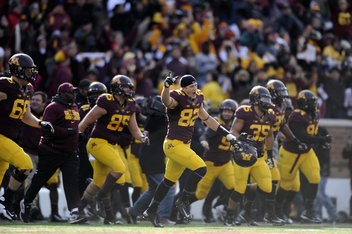
Hold that thought.  When recently asked (here) why he has been so successful in turning around the football program at the University of Minnesota, head coach Jerry Kill answered, "I guess the No. 1 thing is the culture, trying to get everybody on the same page...That was difficult. It always is, by the way, when you take a new job.”  Football success wasn't possible without a change in culture.  That change didn't guarantee that the Golden Gophers would suddenly become a relevant program, but without the change in culture there was also no possibility that it would becoming a winning team.  One key cultural change Kill identified, for example, was improving the players' grades.

Returning to the church, it is clear that declining local mainline churches require a change in culture.  It is, unfortunately, far more difficult to sell that need to congregations than it is to young football players who want to win football games.  Churches are prone to actively resist such change.  They are frequently committed to the proposition that they can overcome decline by continuing to do what they are doing, but only better.  There is a reason.  Change might accelerate decline.  Better the devil you know than the one you don't.

Nonetheless, it is all about changing the culture of decline.  The problem with all of the how-to manuals and books and audio cassettes and websites dedicated to that change is that culture is a profoundly local thing, even the culture of decline.  What works in one place may well not work at all in another.  The one constant is the need to change the local church's culture of decline.  And one crucial place to begin is to talk about it.  Not talking means not changing.  Changing a church's culture also requires finding leverage points, which are easier to change and will promote changes in other places—such as introducing a small group ministry into the church.

In any event, it is all about the culture.

Monday, June 30, 2014

On the Boundaries of the Spirit

We are not only living in the postmodern age, but we are also entering the post-religion age as well, which is to say that spirituality and religion are still generally identified with each other.  Christianity and Islam still provide the standard models for what it means to be spiritual.  But, as we dip our toe into a new era where spirituality is expressed in different, less classically religious ways, we are finding that the boundaries between what is spiritual and what is not are shifting.  The Spirit is encountering us in unexpected places and non-traditional ways.

A sports news posting entitled, "Strike a pose: Gophers embrace yoga" provides a striking case in point.  It reports that University of Minnesota Golden Gophers football head coach Jerry Kill and Gopher strength coach Eric Klein have introduced a regular course of yoga exercises into the football team's training program.  The rationale is that yoga restores the players physically and mentally, helping them to recuperate from the stresses of playing big time, Big Ten football.  It also helps them became more flexible, which will reduce injuries.  Gopher yoga instructor, Christine Ojala, explains that she is teaching the players to, "access the breath in a more informed and intelligent way." She observes that, "Yoga is one of the best methods for restoring the mind, body and spirit to their essential, balanced and strong states of being."

In Protestant Christian circles, prayer is generally understood to be talking to God. It is, to quote the website All About Prayer, "our direct line with heaven. Prayer is a communication process that allows us to talk to God!...To many people, prayer seems complicated, but it is simply talking to God." Asian spirituality, an increasingly important post-religious spiritual tool, is more about listening than it is about talking.  It often invites practitioners to learn to be still, to allow healing to take place.  In Western prayer we speak to God; in Asian meditation technologies the Spirit talks back.  Even when said before football games, prayer is mostly about religion and church.  For most westerners, yoga and other forms of meditation are spiritual practices that do not carry those same associations.  In them, the Spirit crosses the traditional boundaries, makes new connections, and finds new ways to entice us forward toward the full bloom of the Kingdom.  Amen.

Friday, November 1, 2013

Intangibles

Last Saturday (October 26th), the Minnesota Gophers football team defeated the Nebraska Cornhuskers, a team that the  Gophers had not defeated since 1960.  Few saw this win coming.  Nebraska is the more talented team and has a solid, almost storied winning tradition.  Minnesota had not been playing well in Big Ten play up to last Saturday, in spite of an unexpected win over Northwestern. Jerry Kill, the Gophers coach, was on medical leave to deal with epilepsy.  And not only was the  victory unexpected, but even less expected was the fact that on Saturday Minnesota was clearly the better team on the field.  They did to Nebraska what Nebraska normally does to everyone else—pushed their opponents around and dominated them physically.

The question is, why?  The how is not as hard to explain.  Minnesota played a better game.  But, why?  In reading the various descriptions of the game, it becomes clear that the Gophers won and the Cornhuskers lost because of intangibles—metaphysical realities that cannot be measured and deny empirical analysis but are real for all of that.  Motivation.  Determination.  Loyalty.  Inspiration.  Team Spirit.  Attitude.  The Gophers played inspired football.  Jerry Kill was at the game and spoke to them several times; his presence was inspirational.  The players knew that Coach Kill is going through a hard stretch with epilepsy, and they didn't want to let him down.  His toughness and determination in the face of adversity, furthermore, was an inspiration to them.  All intangibles.  All real.

Now, the Gophers have worked hard on conditioning.  They are a generally well-coached team.  One can never overlook the physical nature of the game, and without all of the hard work and practice they couldn't even get out on the field let alone win.  Every Big Ten team works on conditioning and has a good coaching staff including Nebraska.  The Gophers won last Saturday because of the intangibles, which have to do with the human spirit.  It was a metaphysical victory won on the higher (or deeper) plane of the human spirit.

So, don't believe in God—or believe, but don't claim that spiritual realities are not real.  Don't look at the metaphysical as being phony or funny.  What is deepest in us and most compelling is a reality that is beyond the physical, cannot be measured, and defies empirical analysis.  It is the human spirit.  The image of God.  Amen.

Sunday, October 27, 2013

Inspiration

There’s nothing more dangerous than an inspired football team.

Team member  Brock Vereen's comment on
the Minnesota Gophers' 34-23 defeat of Nebraska, 10/26/13

The team is thriving, rallying around Kill’s spirit and is inspired to carry on in his absence.

From:  Minnesota 'thriving' sans its leader",
commenting on Coach Jerry Kill's leave of absence to deal with medical issues

Wednesday, March 27, 2013

When "Good Enough" is Not

In the 2012-13 season, Minnesota Gophers men's basketball coach, Tubby Smith, led his team to 21 victories and a place in the NCAA Tournament, the "Big Dance," at the close of which he was promptly fired in spite of a winning record over six seasons.  Smith restored a degree of stability and respectability to a program that has been through periods of turbulence and mediocrity.  Smith was not fired because his teams could not win.  He was fired because they had trouble winning Big Ten games and February games—winning, that is, the games that mattered the most.  He improved the team by one or two levels but then didn't seem capable of taking them to the "next" level.

That being the case, a debate has been raging in the Minnesota sports press between those who feel that Minnesota is doing "well enough" under Tubby and not likely to do any better under anybody else.  It isn't ever going to become an elite Big Ten men's basketball team and Tubby is good enough.  With still more passion, those who support firing Smith are not happy with "good enough" and want to see Minnesota take its basketball program to that next level where winning Big Ten seasons and NCAA berths are givens.

It could be years before fans in Minnesota learn whether firing Coach Smith was a good move or
dumb one (or somewhere in between).

In any event, the whole situation has its parallels in many mainline churches today.  In times of declining membership, attendance, and resources, churches frequently make do with "good enough," especially when it comes to leadership and what  is expected of leaders.  Make do.  Cut corners.  Go with the flow.  In sum, settle for good enough.  In some situations, good enough has to be good enough, but in others good enough is deadly.  It allows a downward spiral to continue when it need not.  In still other cases, there is the possibility of a new church growing out of the ashes of a dying congregation, smaller and with fewer resources but not tied to a building and a dying program—a church with a new vision and a new calling.  Often enough, then, "good enough" is worse than no good at all.  Amen.

Wednesday, January 2, 2013

Just Maybe

Tubby Smith, U of M Mens Basketball Coach

I thought, patient readers, that I would let last weekend go without any Minnesota sports comments, but the opportunities for joy remain few enough that I just can't do so.  It all started last Thursday with a bittersweet loss by the Gophers' football team to Texas Tech, 34-31, in the Meineke Car Care Bowl.  Bitter, because the Gophers could just as well have won that game but let it get away from them; sweet because they played toe-to-toe with a team widely expected to beat them easily.  On Saturday, the Vikings defeated their rival-of-rivals, the Packers in a game that almost no one thought they would win and, thereby, got themselves into the NFL playoffs.  In the complicated math of the NFL, the Vikings victory also prevented the Chicago Bears, almost the rival-of-all-rivals, from making it into the playoffs—sweet.

The icing on the cake was the Gophers' mens basketball team.  On Sunday and playing at home, the 9th ranked Gophers defeated Michigan State 76-63 in a game that they could just as easily have lost and in year's past would have lost.  AP reporter,  Jon Krawcynski, in an article entitled, "NO. 9 MINNESOTA TOPS NO. 18 MICHIGAN ST 76-63," concludes, "Maybe this is a different team after all."  That is, maybe this Gophers' team will compete at a high level for an entire season and this March find its way deep into the NCAA playoffs.  Maybe.

No theology today.  Just the warm after glow of a nice New Year's gift from the gods of sports.  Happy New Year!  Herb

Monday, September 10, 2012

A Good Weekend in Minnesota

Maya Moore, Minnesota Lynx
Those of you who stop by Rom Phra Khun regularly know that I'm a former Minnesotan who remains a fan of Minnesota sports, which means I belong to an often-frustrated, seldom really happy tribe.  But, once-in-awhile, it is good.  This past weekend was one of those golden moments.  The Gopher's led off on Saturday with a dominant win over a lesser opponent, which was heartening given the way they have in recent years frequently lost to apparently lesser opponents.  Then, yesterday, Sunday, the Lynx won handily for their 11th win in a row, the Twins won a walk-off game against the Cleveland Indians; and (can it be true?) the Vikings snatched a victory out of the jaws of defeat in an overtime win over Jacksonville (usually the snatching goes the other way).  It all makes for a nice Monday morning.  And for the icing on the cake, my home town Luverne (MN) Cardinals won their second game of the young football season.

It is nice to see the sun peek out from behind the clouds now and again!

Saturday, September 1, 2012

Definitions Matter

Taj McWilliams-Franklin
On last Thursday evening into early Friday morning, the Minnesota Golden Gophers football team won an "ugly" game against a less than stellar opponent.  Afterward, one of the Gophers was quoted (here) as saying, "An ugly win is better than a pretty loss." Friday evening, the Minnesota Lynx struggled early against a weaker opponent and had to pull out a victory in the second half. One of the Lynx's players, Taj McWilliams-Franklin, said (here) of the game, "Champions find ways to win in the face of challenges.'' She went on to say, "Michael Jordan had his moments when he didn't play well against lower teams, but he found ways in the end."

In sports, these sentiments are hardly remarkable.  Whatever the sport, its players play to win.  Good teams and good players have off days, but they still need to find a way to win.  It is better to win ugly than to loose pretty.  As a rule, it is better to play poorly but come out on top rather than playing well but still lose the game.

The question is whether or not this basic rule translates well into the rest of life and especially into the church.  A case can be made that it does, even for church folks.  "Winning ugly" suggests a scrappy, never-say-die attitude that works through adversity.  It also reflects a certain level of self-confidence and creativity when these qualities are especially necessary.

There is a difference, however, between winning ugly in sports and winning ugly in the church, and that difference is in the definition of "winning".  In the church, "winning" is often a matter of losing, coming out second rather than first, giving credit rather than getting it, remaining silent and in the background, and pursuing the example of Christ, the ultimate servant of all.  The thing is, this kind of "losing" has all of the marks that sports folks equate with "winning".  In the Kingdom, it is the losers who win and the winners who lose.  Amen.

Sunday, October 30, 2011

Charlie Brown finally kicked the football

Dear readers, I just can't let this one pass.  In the midst of a tragic, dismal season that has seen the Minnesota Golden Gophers suffer three consecutive trashing at the hands of Michigan, Purdue, and Nebraska, suddenly yesterday the Gophers squeezed out a gutsy, entirely deserved victory over Iowa—in spite of the fact that an Iowa running back had a career day.  To beat Iowa anytime is sweet, but to hand them their head on a platter beyond all expectation, well you would have thought the Gophers had just won the Rose Bowl.  The win couldn't have come at a better time as it restores some confidence in new head coach Jerry Kill and his staff.  So, for a day, for a week, Gopher fans savor the sweet taste of victory, but we won't get used to it.  This coming Saturday the Gophers visit Michigan State.  A victory there would be more than a miracle.  By the way, this morning's headline is taken from a posting on the Minneapolis Star Tribune by Chip Scoggins entitled, "One game, one afternoon, fills stadium with renewed faith."

Thursday, October 13, 2011

Blame Game Reflections

There may not be a major collegiate football program in more dire straights than the one at the University of Minnesota.  Last week the Golden Gophers lost to a mediocre team, Purdue, 45-17.  They were behind at the end of the first quarter 28-0.  The week before they lost to the nationally ranked Michigan Wolverines, 58 to zip.  As horrible as these blow out losses are, the worst of it this season is probably the Gopher's loss to New Mexico State, perennially one of the worst football programs in the nation.

So, what do the good fans of Minnesota do?  According to a recent posting at The Daily Gopher website entitled, "Minnesota Gopher Football: Everybody just cool out," the blame game is on and some, maybe many fans, are laying that blame on the new coach, Jerry Kill.   There's a website, apparently, dedicated to the firing of a coach who has been onboard for only six games.  The posting argues that fans need to cool down, show some patience, and let Kill and his staff work through an admittedly difficult situation.

What makes all of this worthy of our attention is the way the posting begins.  It observes that our society today is a "society of blame" and a society of quick fixes.  When something goes wrong, we become reactive, looking for someone or something to blame—more often someone than some thing.  Once we assign blame, we want that individual gone or that cause fixed right now.  In other words, this is not just about football, the fans of one football team, or the state of the nation although. We're not the only people that play the blame game, and it isn't a recent invention.  Finger pointing reflects something central, deeply embedded in who we are as human beings, and it draws on the uglier side of human nature that we can't deny exists.  Blame kills.  It is a form of violence.

A couple of points: first, the pages of our newspapers and the webpages of our news websites are filled with grist for theological reflection.  Second, the church has been called into being to be a community of those who don't play the blame game, live in frustration and anger, or take things out on others.  We're called to practice the peace we preach.  Not easy, admittedly, but it why we exist.  Now, it is true that bad situations have their causes, and it is important always to discover those causes.  It is equally true, however, that blame game politics seldom gets to the bottom of matters, and by putting everything on a scapegoat usually serves to perpetuate the deeper causes—like why some schools, some programs produce winning teams year after year (think Ohio State) while others struggle for one now and again (think Minnesota).  God is creating us to be better than all of this, and our job is to get beyond blame to the task of moving on with that divine program of ongoing creation.  Amen.

Saturday, September 3, 2011

Optimism Creep

Minnesota head football coach Jerry Kill
Minnesota Gophers' new coach, Jerry Kill, has taken Minnesota by storm.  Formerly at Northern Illinois and other smaller schools, his appointment as the next head coach at the U of M was initially received with something amounting to derision.  But Coach Kill is a down-to-earth, straight shooter who talks a good line by not talking a good line.  The Gophers haven't been much to talk about for five decades, and now everybody and their brother is expecting that to change—maybe not this year, but surely by next year.  The sports media in Minnesota is rife with optimism.  People are excited about the Gophers.  OK.

But, hold on—there's this thing called "optimism creep,"  a term I recently came across in an article (here).   The article describes how every year Washington Redskins fans get pumped up with what turns out to be an unwarranted, false optimism. The closer they get to opening day the more the optimism grows—of its own volition.  Then comes the actual season and, wham, reality returns.  That's optimism creep.


They know about optimism creep all too well in my home state of Minnesota.  Every April the Twins are going to win the World Series "this year."  Every September the Vikings are headed to the Super Bowl "this year."  Last fall, 2010, the men's basketball Gophers were sure to make it deep into the Big Dance "this year."  Optimism was in the air, as it often is in Minnesota before each season starts.  The results are invariably anything from mildly disappointing to disastrous—year in, year out, decade following decade.

So, now it's Saturday, Sept. 3rd, 2011.  The new season begins with a coach who has a record for transforming poor teams into good ones.  The Gophers' opponent, USC, is ranked 25th in the nation.  Minnesota is abuzz.  Everyone knows this year will be a tough one, but still they hope and now believe that Gophers' football has "entered a new era."  Well, maybe.  Or is it just our old friend optimism creep?  The hope that springs eternal says, 'no, but didn't I read somewhere that they're working on a new breed of pigs that fly?  Oh well, Go Gophers!