We should maintain that if an interpretation of any word in any religion leads to disharmony and does not positively further the welfare of the many, then such an interpretation is to be regarded as wrong; that is, against the will of God, or as the working of Satan or Mara.

Buddhadasa Bikkhu, a Thai Buddhist Monk


Showing posts with label God. Show all posts

Monday, February 23, 2015

God: the Problem

It is often claimed that the great doctrinal issue among Christians today is the nature and authority of the Bible.  It is a divide between literalists and non-literalists on the one hand.  Or, again, it a division that pits those hold a high regard for the scriptures versus those who have a less lofty view of the Bible.  It may well be true that the Bible is the great doctrinal issue of our time.  If so, however, the problem of God is not far behind—and probably linked.

In fact, God has always been a problem for the followers of Christ.  Almost from the beginning, we inherited two distinct traditions concerning the nature of God, one from Jewish theology and the other from Greek philosophy.  From Judaism we learned that God is intimately involved in the affairs of humanity, hears and sometimes answers prayers, appears in various guises, and speaks to us.  Yes, God is also the creator of all that is and thus far beyond us—yet the psalmist affirms that God has made us "little lower" than the messengers of heaven (Psalm 8:5).  And we Christians are convinced that Jesus in preeminently God With Us.  Our Greek heritage, however, throws all of this into doubt.  It affirms that God is Beyond all beyonds, unnamable, unimaginable, and even non-existent in the way the created universe exists.  We are warned that the moment we call anything by the name "God," that thing is not God.  We are warned that we cannot even say that, "God is love," because such a statement reduces God to human terms, puts God on a human scale.

If the Bible is the great doctrinal divide of our time, then the nature of God is the great theological divide—and long, long has been.  Stated most directly, the divide is between those who understand God to be in some sense an independent entity that is real as the universe is real and those who believe that God is not an entity in any way that we can call an entity and does not exist as we understand existence.

Like the various doctrines of scripture, so too the various theological positions on the nature of God cannot actually be so easily divided into two neat camps.  But they do represent two tendencies, one seeing God primarily as Present with us and the other understanding God to be Beyond all possible beyonds.

Saturday, December 20, 2014

God's Ways

Sometimes we do dumb things, sometimes they are done to us.  Sometimes we are insenitive, sometimes we are collatoral damage of insensitivity.  Things are said that should not be said or left unsaid when they should be said.  Some things we get over in a day or two, others linger interminably.  Things happen to us that can leave deep scars, and we do things that can leave others deeply hurt.

There is usually no good way out of the situations we get ourselves into.  At least, it seems that way.  In hindsight, however, sometimes the dumb things we do and are done to us turn out to have had something more than a silver lining.  They had unintended good consequences, if we have the wit to see them.  And sometimes a prayer uttered in hurt or embarrassment or confusion is answered, and the clinging fog of life clears for a time.  Things weren't what they seemed to be.  And on occasion we have the wisdom to do or say something that brings healing into the dumb situations we find ourselves trapped within.

Without being naive about it, there are paths through the Valley of the Shadow, the Valley of the Fog.  The wrongs we do and the ones done to us—there are healing ways through them.  Unintended consequences themselves have unintended consequences, which don't exactly make things easier but do eventually bring us out of the fog into the light of day.  Embedded even in our worst are other ways, what those of us who hold a theist's faith might call God's Ways.  Our prayer is, "Lord, help me to find one of your  Ways."  Amen.

Saturday, November 29, 2014

Turning the World on Its Head

"Inversion" is a key biblical motif: it is the way God works in the world.  For Christians, it represents the way we are called to respond to the good news of Jesus.  The biblical model for inversion is the Exodus where God liberated a slave people, transforming their future.  God values that which the world despises, sees weakness as strength, and finds wisdom in places the world ignores.  In the Kingdom, God will stand the world on its head: the great will become the least and the last will become the first.

Inversion is also when an NFL star offensive lineman walks away from a multi-million dollar contract to become a farmer in North Carolina—because of his faith, which calls him to a life of service to those in need.  Jason Brown is the man, and what he did was to buy a thousand acre farm near Louisburg, NC, learn farming, and begin to raise crops to give away to food pantries.  His motivation is his Christian faith, which inspires him to value service over the prestige and the wealth that comes from being a top-level pro-football player.  Read his story (here) and see a video clip of an interview with him (here).  Inversion.  A powerful biblical theme.  Amen.

Monday, September 1, 2014

Avatar & Incarnation

Quite a bit has been written in the blogosphere about the theological implications and message of the 2009 movie, Avatar.  From a sample supplied for me by a Google search on the subject, "avatar and theology," there is obviously the usual range of responses from appreciation to deprecation.  A couple of the ones I looked at, however, caught my attention because they wrestle with the nature of Jake Sully's incarnation in a Na'vi avatar designed by human exobiologists.

One is a post entitled, "Scalp Locks, Gaia, and the Incarnation: History and Theology in James Cameron’s Avatar," by Wen Reagan, which comments on the manner in which a human is put into a Na'vi body. Reagan points out the obvious parallel between the movie's version of incarnation and the Christian understanding of the Incarnation of God in Christ.  He esp. highlights the way in which by the end of the movie the human Jake Sully has become a Na'vi, actually leaving his human body entirely.  Reagan observes, "But in the end, we don’t get a glimpse of Vishnu, safe to retreat from his current avatar and come again in another one. Instead, we get a glimpse of Christ, as Jake takes on the risk of fully embracing the Na’vi by becoming one of them, forever." Garrett East in a post entitled, "James Cameron's Avatar and the Critical Response: An Alternative Perspective," picks up on this same theme of the transformation of a human into another species by arguing that the central theme of the whole movie is the conversion of Jake Sully. He writes, "In essence, I think Avatar could be described as a conversion story," and goes on to observe that this conversion,
requires not only a change of mind and intellectual assent, but a whole new embodied way of life. It requires new eyes, new ears, a new language, and a new heart. It is a relearning of what is right and what is wrong. It is a transfer of allegiance from one people to another (the Na'vi), from one God to another (Eywa). It requires that Jake become nothing less than a new creature in a new creation...We are watching the story of a man who moves from despair, death, hate, and disbelief to hope, life, love, and even faith. When we watch Jake Sully’s story, we are watching a story about conversion.
All of which is to say a central dual theme of the story of Avatar is incarnation and conversion.

Most practicing Christians for most of the last two thousand years have held a view of incarnation not very different from that described in Avatar.  In Jesus of Nazareth, the essence of God was transferred into a human body.  God was in Christ just as Jake was in a Na'vi body.  Now, if we start to think about it, there are differences; but most of the time we don't think about it.  God was in Jesus; Jake was in a Na'vi body.  The movie makes a very important observation, however.  You can't place a person into another body and expect that there won't be any change.

One of the themes of the Book of Genesis is that God does indeed change.  In the story of the Flood, God set a rainbow in the sky as a promise that God would never again use violence against the human race and the rest of creation (Genesis 9:1-17).  Did, then, becoming incarnate in Jesus change God?  If so, how so?  If not, then how can we claim that Jesus was at one and the same time fully God and fully human?  Is it not change an essential element of our nature?

Wednesday, August 27, 2014

Cane Toads & God

Source: animals.nationalgeographic.com
Cane toads are a large, poisonous species of toad that originates in South America that has spread widely throughout northeastern Australia.  A recent ABC Science article entitled, "Toad personalities key to territorial takeover," cites scientific evidence that suggests that the key to the cane toads ability to expand its territory in Australia has to do with "personality".  Some toads are more adventerous than others—bolder, more likely to head off into new feeding territory on their own.  Other toads are more timid and unlikely to go into new feeding territory.  The article concludes that the mix of bold and timid toads is a factor in the cane toads success in Australia.

Who would have thought that cane toads even have personality, let alone that it is apparently important to the species ability to adapt?  Such a possibility causes one to consider the potential role that personality plays in the larger, evolutionary scheme of things.  We know from experience that many other species have personality and that personality is of crucial importance in human social interactions.

The concept of personality is also important theologically.  Christian theology across the board assumes and asserts that God is a person and has the marks of personality (loving, compassionate, cares about justice, is "slow to anger") exemplified for us in Christ.  Trinitarian Christians believe that God is actually three persons (persona), Father, Son, and Holy Ghost.  While professional theologians understand that the Latin term persona does not mean "person" in our English sense, the vast majority of English-speaking Christians translate the "personhood of God" as meaning God has personality.  It can be argued that this idea that God is a person who has personality is but another case of us creating God in our own image, which has pretty much been my own personal view for a long time.  It seems ludicrous on the face of it that the Divine Creator Beyond could in any sense have something as human and mundane as personality.

Still, it is worth considering that personality as a tool of our evolutionary development reflects a predisposition of the Creator, perhaps even an aspect of divine reality.  It remains entirely speculative to assert the personality of God, but it is less speculative to claim that personality is somehow within the "providence of God" and again somehow compatible with "God's will for humanity."  At the very least, it would seem that our having personalities is not a barrier that stand between us and God as such.  Certainly, the way we express personality can be a barrier, but it is not inherently so.

If, then, we apply the English-language conception of person to God as a metaphor we are not asserting something necessarily illogical or out of sorts with modern science—so long as we remember that we are using personhood metaphorically.  It functions thus as a helpful "mask" (the original Latin meaning of persona) of the Divine Beyond, which remains unknown to us directly.  It is not wrong to think of God in personal terms including the ides of having a personal relationship with God.  Whether or not God is a person or has personality, we can legitimately experience God in these terms—and think of God in this way.  It is, we might say, in our God-given nature to do so.

Tuesday, August 26, 2014

Religion and Power

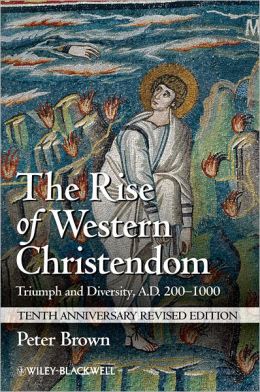
In his preface to the "Tenth Anniversary Revised Edition" of The Rise of Western Christendom, Princeton historian Peter Brown observes that the actual physical and cultural boundary between the Roman Empire and the "barbarians" of northern Europe was not nearly as absolute as the Romans themselves claimed.  The world on either side of the boundary, that is, was strikingly similar in many significant ways.  Drawing on the work of another historian, John Drinkwater, Brown argues that, "the emperor, military, and civilian populations alike needed the idea of a 'barbarian threat' to justify their own existence." (p. xiv)  He goes on to state that, "Altogether the Roman government had a way of rendering absolute boundaries that were, in reality, extremely permeable." He refers to those boundaries as "an ideological Iron Curtain." (p. xv)  The boundaries we draw on a map, in sum, are about power and control, which are fundamental factors in human social organization.  Boundaries are artifacts of our minds that are "socially constructed realities."

And many of the boundaries that we "draw" have nothing to do with maps at all.  They invariably do have a great deal to do with power and control.  Religious doctrines comprise often function as boundary markers.  Believers in a particular set of doctrines stand on one side of a boundary and unbelievers and doubters on the other side.  The Presbyterian Church (USA) has been suffering through a prolonged debate over the boundaries between those who consider homosexuality a sin and those who do not.  We have fought other fights, notably over the nature of the Bible.  In these battles, we engage a very human practice, the describing of boundaries between us, which boundaries are as much about power and control as anything else.  If that were not the case, the constant ecclesiastical splits that have taken place among Protestants since the earliest days of the Reformation make no sense at all.  Once we reach a crucial boundary such as the redefinition of marriage, we refuse to be bound by the authority of those on the other side of the boundary.  We migrate to new institutions and loyalties.

This is all well and good.  It is the way we humans do things.  What is worth noting, however, is the ways in which all of us seek to fit God into our boundaries and make Jesus the lord of our territory alone.  All of us do this.  And it is right here that our human instinct for social control and power fails us for what we call "God" is rendered merely a god of our own making, and we turn our search for the ultimate into a debate over who is right, who is wrong, and who has power and authority.  We erect Roman boundaries to divide a territory that actually isn't all that different on either side of the line however much we convince ourselves otherwise.  It's worth a thought.


Tuesday, July 8, 2014

Somehow Present & Beyond

There lies in our understanding of One, Creator, Personal God a fundamental tension for us between the Creator and Personal faces of God.  How can this One God be both creator of the whole of the cosmos and all that is in it and yet also a presence that we can somehow sense in a personal way?  Our conception of the Incarnation of God in Jesus Christ mirrors that tension.  How could a man be at once human and divine?  How can God be somehow like us and yet completely and incomprehensibly unlike us?  And in our understanding of the Bible we are faced again with this fundamental tension.  How can a clearly fallible, human collection of words still somehow reveal to us the Word that connects us to the divine Beyond?  We call the church, the "body of Christ," and yet again how is it that this depressingly human institution can be a vessel somehow of the Spirit?

This tension between realities lies within us as well.  We discover it most painfully in the question of evil and good.  In our experience, these are not two separate categories that can be neatly divided from each other.  Out of one so often emerges the other.  Even in the darkest storm, we say, there is a silver lining.  We are at one and the same time good and not, evil and not.

How can God be both Beyond and Personal is a question that resonates across our human experience.  Maybe someday we will have an answer.  In the meantime, we live in faith.

Thursday, June 26, 2014

Beyond the Newtonian Jesus

Christian orthodoxy across all denominations and traditions affirms the dual nature of Christ as both human and divine, man and God.  In the Age of Science, the European branches of the faith have largely treated the Doctrine of the Incarnation as if it is a fact on the order of scientific factuality.  Gravity attracts, Columbus discovered the Americas in 1492, and Jesus was human and is divine.  These three "facts," however, exist in three different realms of their own.  Gravity is an observable physical phenomenon.  It requires research to explain it, but explain it or not it is.  The discovery of the Americas is a historical fact, which itself is not observable.  It does not even exist because it lies in the past, which by definition no longer exists in the present.  It is over and done.  We require research to know that it even took place.

The doctrine of the incarnation takes us into a third realm.  All spiritual experiences do.  In and of itself the dual nature of Jesus of Nazareth was not observable, even after his resurrection.  It took the early church centuries of controversy and debate to develop the doctrine.  It cannot be established by observation or by research.  It is a matter of faith that is both experiential and philosophical.  It is philosophical in the sense that it had to be thought through using the powers of reflection and reason.  It is experiential in the sense that on reflection the earliest church saw in their experience of Jesus an experience with God and succeeding generations of Christians have affirmed that we too see in our experience with Christ an experience with God.  None of this fits the profile of a physical phenomenon or historical event.  Jesus did not have a special God organ.  According to the biblical accounts, he was observably human.  And while the doctrine of the incarnation and its development is historical as a doctrine, the purported divinity of Christ is not itself a historical fact.  All that historians can establish is that there was and is a belief in Christ's divinity, not the divinity itself.  Historians are not equipped to deal with spiritual events any more than carpenters are equipped to drill teeth.

For those of us living on the postmodern bridge between the Newtonian world (a.k.a. "modernity") and whatever is coming next, it is excruciatingly difficult to separate divinity from factuality.  For us, God is not a physical phenomenon.  There is no science that deals with God or has the tools to establish the factuality of God in any way that makes scientific sense.  I am personally convinced that one day future science (or whatever comes after science) will discover God, but I don't have a clue what that even means.  Future science will rely on technologies and ways of thinking that have yet to be developed.  In the meantime, we must rely on spiritual sensitivities and the insights we draw from them to discern the Beyondness and the Presence of God.  And we have to unlearn our worshipful respect for facts.  We have to move beyond the doctrine that only what is factual is real.  We have to stop thinking that science is the last stop in our cognitive evolution.

We have to live in faith.

This does not mean we stop thinking critically but precisely the opposite.  It means that when we sense the divine in a sunset and find peace in meditation we accept that we are participating in a different realm of reality—one where Christ is human and divine for those of us who put our faith in him and where the logic of science is flawed, open to criticism.

Monday, June 16, 2014

Chaos & Creation: the Bible

In a guest opinion piece entitled, "Recent Gallup Poll On American's View of Bible Reveals Utter Chaos Regarding Nature and Authority of Scripture," John MacArthur reflects on the relationship of modern American culture to the Bible based on the findings of a recent Gallup poll (here).  As one can guess from the title of the piece, he finds little good in that relationship.  One can sense the anguish and alarm he feels concerning the way postmodern society treats scripture, at the debasing relativism to which the Bible is subjected.  The reader also senses MacArthur's alienation from our increasingly non-dualistic culture, which seems to him to have lost its spiritual center. Postmodern Americans including the majority of American Christians, that is, think that the Bible is open to interpretations from different perspectives.  In MacArthur's understanding, these Christians have replaced the authority of the scriptures with "the authority of self."

Early in the piece, he writes, "Clearly, the prevailing belief in our culture is that while the Bible may be the inspired Word of God, it doesn't mean what it says."  From a liberal/progressive perspective, this is a useful observation that helps clarify our view of the scriptures as being both authoritative and open to interpretation—or, again, both inspired and fallible.  At the heart of it all, lies the basic question of how we experience the divine, which leads us to our understanding of the incarnation as not so much as a doctrine as a matter of God's Presence in our lives.  We are touched by that Presence in different ways including through scripture, emotion, in nature, in relationships, in the fellowship of the church, and paradigmatically in the person of Christ to name a few.  In all cases including Christ and the Bible, God speaks to us within the framework of our humanity.  God is present with us incarnationally.

That is to say, God participates with us in our humanity and in the guise of the Spirit finds multiple ways to touch our lives and bend the arc of our habitually hostile fallibility in the direction of the Kingdom.  God, as best as we can make any sense of this, inspires us from within the human experience.  That is the whole point of our trust in God in Christ: Jesus was clearly human and shared the limitations of physical existence that all of us share.  The Bible, which speaks of God out of many generations of experience with the divine, as clearly exhibits the limitations of any human document.  Both in spite of and because of his humanity, Christ grabbed our attention.  So it is with the Bible.

Returning to the idea that, "...prevailing belief in our culture is that while the Bible may be the inspired Word of God, it doesn't mean what it says," the point that must be made is that the authors of the Bible did mean what they wrote.  They wrote, however, in a very different context than the one we live in today.  We are constrained to understand as best we can that context so that we can have some sense of the original intent of the authors.  The process of discovering that intent, however, requires a specialist training and even then is a tricky, murky exercise at best.  Thus, we do best to also read the Bible seeking to hear contemporary meanings as well trusting that God does communicate with us in that search.

The real difference in all of this, of course, is that "modern" or "Newtonian" Christians believe in absolutes and "postmodern" Christians don't.  Moderns believe that words written in one language two thousand years ago retain their meaning today.  Postmoderns believe that words and their meanings are constantly shifting even today and all the more so when dealing with ancient writings like the Bible.  Moderns are convinced that Christ had to be perfect and the Bible infallible in order for God to speak meaningfully to us, and postmoderns are convinced that God can't possibly speak to us through perfection and infallibility because such things are outside the realm of the human experience.

Apparently, humanity is created in such a way that we need both those who lunge forward in the direction of new ways of thinking and doing and following the path God sets for us in Christ and those who hang back wanting to be sure that we're still on the path.  I guess I understand why the hangers back worry so much about the plungers ahead.  A lot is at stake.  But, that is exactly why we who rush in where angels won't feel we must rush on ahead.  The future is waiting!  And somewhere in it is the Kingdom.

Thursday, April 24, 2014

Searching for Christian Meditation in the Age of Thich Nhat Hanh

In the West, we associate meditation with the East generally and Buddhism in particular even while church historians assure us that we have a rich meditation heritage of our own.  We Protestants are especially ignorant of that heritage because it is associated with monastic Catholicism, something we "put aside" long ago—to our loss, to be sure.  The face of meditation for us is Thich Nhat Hanh, the medium is his impressive literature on its methods and spirituality.

As helpful as he is, there is for us a piece of the spiritual life that is missing, which is a connection with God—the source, the direction, and the inspiration of our personal spirituality.  Christian spirituality is a reaching Out and Up with longing as well as a reaching down in peace, rest, and quiet.  Hence an adjustment is for us helpful in meditation:

The mantra:
Breathing in, I know that I am breathing in;
Breathing out, I know that I am breathing out.
Becomes:
Breathing in, Lord, I know that I am breathing in;
Breathing out, Lord, I know that I am breathing out.
And the mantra:
Breathing in, I embrace being peaceful, calm, and at rest;
Breathing out, I embrace being peaceful, calm, and at rest.
Becomes:
Breathing in, Lord, you inspire me to be peaceful, calm, and at rest;
Breathing out, Lord, I welcome being peaceful, calm, and at rest.
Buddhist insight meditation is an invitation to dialogue with oneself in order to come to rest in the non-self that is the true self.  Christian insight meditation is a divine invitation to dialogue with oneself in the Presence of God in order to come to rest in the Beyond-self that is the true self.  Amen.

Tuesday, March 18, 2014

Belief In God - Why All the Sweat?

In a recent New York Times interview entitled, "Arguments Against God," philosophy professor Louise Antony was asked if she thought if it even much matters whether we believe in God or not." She responded,
Well, I do wonder about that. Why do theists care so much about belief in God? Disagreement over that question is really no more than a difference in philosophical opinion. Specifically, it’s just a disagreement about ontology — about what kinds of things exist. Why should a disagreement like that bear any moral significance? Why shouldn’t theists just look for allies among us atheists in the battles that matter — the ones concerned with justice, civil rights, peace, etc. — and forget about our differences with respect to such arcane matters as the origins of the universe?
From reading the rest of the interview one does not get the impression that Antony is a hard-shell religion hater, and her observations in this answer reflect a real puzzlement about why theists frequently take their theism so intensely seriously.  What's the big deal?  It is a good question honestly asked.  It deserves an answer.

But I'm not sure that there is an answer that is really going to make sense to her.  Earlier in the interview she implies that religious belief systems are all based on rationalizations rather than on rationality as she understands it.  What she considers "reasons" for believing are largely "the result of automatic unconsciousness processing, involving lots of unarticulated judgments."  She apparently feels that beliefs are an inferior way at arriving at truths based on a-rational considerations.  Her puzzlement and views on believing, if I've read them correctly point to a gap in understanding between theists and non-theists concerning the nature of reality that seems almost impossible to cross.  On the theist side of the gap, we make connections that make little sense on the other side.  Let me be clear that I am not talking here about hard-core religious fundamentalists who, in truth reside in another corner of reality much closer to hard-core atheists than to the rest of us.  Both of them live on the other side of another chasm, between dualist/absolutist and non-dualist/relativist ways of thinking, which is if anything wider and deeper than the one between theists and non-theists generally.

So, in any event, it appears almost impossible to explain to Antony in ways that she would comprehend why our faith in God is so important to us or why there is far more at stake for us than a "difference in philosophical opinion."  We can agree with her that we should seek allies among the non-theists when it comes to the struggle for a more just and peaceful society, but be that as it may fundamental questions about the origins and nature of reality are not merely "arcane matters" to us—even those of us who are not intent on defending a seven day creation myth or taking literally cherry-picked dogmas and prejudices from an ancient text that requires a wiser reading than it frequently receives.

It may be that in another entry here I will try to answer Antony's questions about why our faith in God is so important, but before trying such a thing it is important to acknowledge that the answer probably won't be of much help to her.  There is a gap that is really difficult to cross.  What is to be appreciated is that while she doesn't understand theist thinking she is reasonably respectful of it.  That, at least, is a start.

Friday, March 14, 2014

Why do people believe in God?

Why do people believe in God?  There is no direct physical evidence of God known to us now such as would prove God exists like a tree, a universe, or evolution exist.  So, why believe in God?

One answer is that people believe in God because they are socialized into such a belief.  This is certainly true for most Americans.  But, this response begs the question of why people believe in God, because at some point, somehow such belief had to start.  It had to be invented.  So, then, the question is why did people in the past invent God?  And the answer is, "We don't know"—not in the scientific sense of knowing.  There is no documentation, no evidence available to us to answer the question.  We can speculate, but in the absence of even the possibility of evidence our speculations one way or the other carry no weight.  So, while socialization is an explanation for why individuals believe in God, it does not explain why there is such a belief.  We don't know why it exists to be socialized.

Another answer is that people believe in God because they have experiences that they interpret to be divinely inspired.  These experiences are various and include such things as visions and deep spontaneous feelings (of peace, of holy terror, of profound love) experienced while in nature, while meditating/praying, while in group exercises (worship), and even while under stress.  But, again, the fact that people have experiences of God only explains why individuals believe in God.  Such experiences provide no evidence as to where they come from or why they should even exist at all.  Possibly, those who invented belief in God associated certain experiences with a notion of a divine being (or beings) or "spirit-ual" reality of some kind, but if that is what happened why did they make such a connection?  Why did the inventors of belief in God believe in God?  The answer is that we have no way of knowing.

The point here is that for those who put their faith in God faith is exactly that: faith.  It involves received traditions (socialization), personal experiences, pious exercises (worship, meditation, prayer) and reflection on "what makes sense," but at the end of the day it is faith—faith that there is a deeper, divine Reality beyond the socialization, experiences, and the reflection.  That faith can be compelling or it can be mildly interesting, profound or superficial, thought through carefully or blithely accepted at face value; but in all of this it is a faith that "makes sense" to the faithful.  While we don't know, then, why people believe in God, those of us who do have a sense that there is more to reality than what science or the senses perceive, something Deep, Powerful, and profoundly Creative.  For Christians, we sense that we come closest to that Something in Jesus of Nazareth, and we trust that our sense of the holy is so.  We trust in him that it is so.  Amen.


Thursday, March 6, 2014

God and Exclusivism—A Trend

In a posting entitled, "COMMENTARY: The rise of the diminished, ordinary God," Mitchell Stevens argues that people today generally don't see God as the all-powerful deity worthy of worship that they once did. He writes, "Many individuals, particularly athletes or those caught in difficult situations, may still say little prayers, but God is also being given less credit for the outcomes of our struggles. The course of human events — wars, finances, love affairs, basketball games — is more and more seen as determined by humans, not by an increasingly ordinary God."  We, thus, no longer look to God to explain happenings in the world.  We attribute events to human behavior rather than divine intervention.  Fewer people feel bound by the demands that religious institutions make on them.  Stevens concludes, "Religion’s supporters can take comfort in the fact that, so far, most minds still find room for some sort of God. But as religion recedes and we contend less and less with the strictures of ancient holy texts, it is an increasingly distant, indistinct, uninvolved, ordinary God."

The argument is an interesting one and worthy of debate, but at one important point it fails.  In the course of his argument, Stevens claims that, "Most today also hold their religious beliefs more lightly than did their ancestors. And we seem less sure of the beliefs we do have: According to a 2007 Pew survey, only about a quarter of Americans are convinced that their “religion is the one, true faith leading to eternal life.”  Our God, in other words, has grown smaller and become "ordinary" because fewer people are exclusivists.

The assumption is that those who do not believe in an exclusivist religion take their religion less seriously.  Firmly held religion, that is, must be narrow minded.  Thich Nhat Hanh, by this logic, must be somehow less religious or less serious in his religion than was Jerry Falwell.  This is simply not the case.  Quite often those who reject exclusivism exhibit the same depth of commitment to their faith as do those who embrace a one-gospel-saves-all doctrine.  And the fact that three-fourths of Americans reject the idea that their religion is the only path to salvation could well be seen as a mark of a growing spiritual maturity rather than an indication that people take their faith less seriously.  That, indeed, is the key distinction here: the difference between practicing a faith and holding certain beliefs.  The intensity with which we hold certain doctrines, such as the doctrine of salvation, is not in and of itself a measure of the seriousness with which we approach a life of faith.  In Peace Is Every Step, Thich Nhat Hanh goes so far as to make the rejection of exclusivism his first "precept of the Order of Interbeing."  That precept reads, "Do not be idolatrous about or bound to any doctrine, theory, or ideology.  All systems of thought are guiding means; they are not absolute truth."

It may be that today the general public takes God less seriously, but the decreasing prevalence of exclusivism is not a measure of the seriousness with which people take their religion.  That's the point.

Saturday, February 8, 2014

Rethinking "God says"

The idea that God speaks to us is found in the Bible starting in Genesis and going right on through the New Testament.  In his commentary on the book of Hebrews, Hebrews (John Knox Press, 1997), Thomas G. Long makes the point that the idea that God speaks to us is a metaphor, and he then lists quite a number of ways in which God "speaks".  As one works through the list, it seems that God speaks primarily through human experiences—experiences of prayer, worship, an inner presence, hearing stories, in theological debate, in nature, even experiences in committee meetings.

That being the case, it may be helpful to those who wrestle with traditional conceptions of God to reframe the metaphor of a speaking deity into one that focuses on spiritual experiences, that is experiences in which the Holy Spirit touches us in the deeper places of our heart and gut.  This may be particularly helpful in a culture that is inundated with heaping mounds of media generated words that we have learned not to trust.  We simply do not share the biblical understanding of the power of the spoken word, which is that spoken words are themselves actions.  We are more apt to say that a picture is worth a thousand words or to disparage speeches or even books as "just so much verbiage."  "I've heard that before," we utter in boredom and disbelief.  And we would rather a person walk the walk than talk the talk.  We say, "talk is cheap."

In our culture, on the other hand, experiences matter.  They are valued.  So, for some and maybe many it just makes more sense that God the Spirit touches us than it does that God speaks to us.

Saturday, December 7, 2013

God Calls Jonah to Preach to Nineveh, that Great & Wicked City

God called Jonah to preach to Nineveh, that great and wicked city.  And Jonah said,

I will not advertise
this crazy scheme
of Yours.

God, what a farce
that men should sin and find
escape.

I mean, of course,
not me
but all our mutual

antagonists.
Dear God, kind God, don't listen
to their prayers.


"Reprimand to a Naive Diety"
Thomas John Carlisle, You! Jonah!
page  7

Saturday, November 9, 2013

On Becoming Human

You can survive on your own.  You can grow strong on your own.  You can even prevail on your own.  But you cannot become human on your own.

Frank Buechner
Listening to Your LIfe, 13

Friday, November 1, 2013

Intangibles

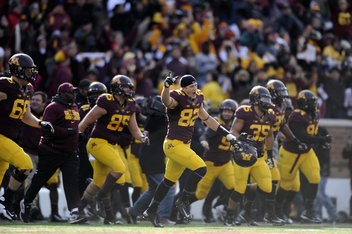
Last Saturday (October 26th), the Minnesota Gophers football team defeated the Nebraska Cornhuskers, a team that the  Gophers had not defeated since 1960.  Few saw this win coming.  Nebraska is the more talented team and has a solid, almost storied winning tradition.  Minnesota had not been playing well in Big Ten play up to last Saturday, in spite of an unexpected win over Northwestern. Jerry Kill, the Gophers coach, was on medical leave to deal with epilepsy.  And not only was the  victory unexpected, but even less expected was the fact that on Saturday Minnesota was clearly the better team on the field.  They did to Nebraska what Nebraska normally does to everyone else—pushed their opponents around and dominated them physically.

The question is, why?  The how is not as hard to explain.  Minnesota played a better game.  But, why?  In reading the various descriptions of the game, it becomes clear that the Gophers won and the Cornhuskers lost because of intangibles—metaphysical realities that cannot be measured and deny empirical analysis but are real for all of that.  Motivation.  Determination.  Loyalty.  Inspiration.  Team Spirit.  Attitude.  The Gophers played inspired football.  Jerry Kill was at the game and spoke to them several times; his presence was inspirational.  The players knew that Coach Kill is going through a hard stretch with epilepsy, and they didn't want to let him down.  His toughness and determination in the face of adversity, furthermore, was an inspiration to them.  All intangibles.  All real.

Now, the Gophers have worked hard on conditioning.  They are a generally well-coached team.  One can never overlook the physical nature of the game, and without all of the hard work and practice they couldn't even get out on the field let alone win.  Every Big Ten team works on conditioning and has a good coaching staff including Nebraska.  The Gophers won last Saturday because of the intangibles, which have to do with the human spirit.  It was a metaphysical victory won on the higher (or deeper) plane of the human spirit.

So, don't believe in God—or believe, but don't claim that spiritual realities are not real.  Don't look at the metaphysical as being phony or funny.  What is deepest in us and most compelling is a reality that is beyond the physical, cannot be measured, and defies empirical analysis.  It is the human spirit.  The image of God.  Amen.

Sunday, October 20, 2013

Listen to Your Life

Listen to your life.  See it for the fathomless mystery that it is.  In the boredom and pain of it no less than in the excitement and gladness: touch, taste, smell your way to the holy and hidden heart of it because in the last analysis all moments are key moments, and life itself is grace.


Frederick Buechner, Listening to Your Life (1992), p. 2

Thursday, October 10, 2013

Warfare & the Rise of Civilization

In a research paper entitled, "War, space, and the evolution of Old World complex societies," a team of researchers led by Dr. Peter Turchin of the University of Connecticut, Storrs, reports the findings of its research into the causes of the spread of ancient complex societies.  It employed a computer model, which predicted with 65% accuracy where ancient civilizations actually arose.  While climate, geography, and the presence of agriculture are important contributing factors in the model, the team found that the primary factor for the emergence and growth of complex societies was warfare.    The report states, "We have argued here that this pattern was due to the emergence and spread of technologies enabling more intense forms of warfare that, in turn, created selection pressures for the cultural evolution of norms and institutions, making possible cooperating groups numbering in the millions."

If correct, people of faith have to ask some hard, unsettling questions about "the way God works" in the world.  It is one thing to see in war an example of human brokenness, but it is quite another to claim that warfare is a primary carrier of civilization.  That claim is counterintuitive in a seriously uncomfortable way.  How is it that a God of love built the hurt and horror of war into our creation?  This question is, of course, but a variation of the whole question of the relationship of God to evil.

For those of us who are people of faith, then, we stand somewhere between two realities.  One is evil.  The other one is the equally or still more compelling realities of love, beauty, and the way in which the universe is constructed to be hospitable to life on Earth.  We have witnessed and felt the power of a deeper spiritual reality, and without pretending that there are any easy answers to the other reality of evil our intuition as Christians is that God's will as we see it in Christ is ultimately not crucifixion but Resurrection.

It is a statement of faith when one says, "The reality of evil is so compelling I cannot believe in God."  There is no proving that a-theism is correct.  The same is true when one says, "The reality of love is so compelling that I must believe in God."  There is no proving that a theistic faith in God is correct.  That's why it is faith.  And any person of a theistic faith who is not uncomfortable with the provisional nature of faith is not paying attention to the real world that is the arena of our faith.  Once we get comfortable with our faith in God it turns into an idolatrous ideology.

Monday, September 23, 2013

The Small & the Large of It All

In a recent interview translated into English and published under the title, "A Big Heart Open to God," Pope Francis I reflected on what it means for a Jesuit priest to become the Bishop of Rome.  Asked how his Jesuit background helps him as pope, Pope Francis replied,
Discernment...discernment is one of the things that worked inside St. Ignatius. For him it is an instrument of struggle in order to know the Lord and follow him more closely. I was always struck by a saying that describes the vision of Ignatius: non coerceri a maximo, sed contineri a minimo divinum est (“not to be limited by the greatest and yet to be contained in the tiniest—this is the divine”). I thought a lot about this phrase in connection with the issue of different roles in the government of the church, about becoming the superior of somebody else: it is important not to be restricted by a larger space, and it is important to be able to stay in restricted spaces. This virtue of the large and small is magnanimity. Thanks to magnanimity, we can always look at the horizon from the position where we are. That means being able to do the little things of every day with a big heart open to God and to others. That means being able to appreciate the small things inside large horizons, those of the kingdom of God.
 Our tendency is to think of God in terms of largeness, as that which exceeds the boundaries of the universe and of reality as we understand it.  God's power, knowledge, and presence are thus virtually limitless.  Pope Francis' reflections remind us that there is another dimension to God, what we might almost call the quantum side of the divine.  God is small as well as large, close as well as distant, within as well as Beyond.

God resides in a touch, a song, and a flower.  God also resides in a spat, a disagreement, and an off day when nothing seems to go like it should.  And somehow the largeness of God and God's smallness, God's distance and intimacy, are both Present in the touch, the song, the flower, and the depressing moments of life.  Somehow.  The large is swallowed up in the small and the small magnified by the large.  Discernment of the way in which God resides in the small and large opens us to the possibility of becoming magnanimous, that is to live on a deeper spiritual plane beyond meanness, pettiness, and anxiety.  It means seeing God's closeness in such a way as to be drawn closer to God.  It does not mean gaining control of the divine or seeing "the true nature" of the divine.  It means being drawn in a direction beyond being in control and understanding.  What is small is magnified and made sacred.  What is large and inherently sacred is personalized and remerges in the world of the mundane, and we are "able to appreciate the small things inside large horizons, those of the kingdom of God."