The decline of the church in the U.S., has any number of ramifications, some obvious and others less so. One of the "less so" ramifications is the continuing loss of the biblical understanding of the Sabbath as time off from the cares of daily life, time for refocusing on the deeper things underlying the grind. In times gone by in our nation, the rhythm of life was six days of labor and a seventh day for putting aside that labor, dressing up, going to worship (which was a source of entertainment and intellectual stimulation), and slowing down. Today, committed church folks don't slow down on the weekend; they cram in, rather, an alternative set of hectic activities. On retirement, they get busier with as much or more busy-ness as beforehand. It is not just that there is less space for church even among the committed. There is less time for rest. And more than that, our modern, multitasking society is losing its capacity for rest, esp. for Sabbath rest.
Sabbath rest is partly time for prayer, reading "spiritual literature" unhurriedly, and reflection. It is time for meditation. It is partly time for sitting quietly, taking a walk, sharing an unhurried meal with a friend, and smelling the roses. It is a time for not doing, not accomplishing. It is not goal oriented time but rather time for being lazy. It is, as one happy example, time spent sitting around a fire in the evening with the forest gone quiet, watching the dancing flames, seeing the shadows they cast on the surrounding trees, hearing the long trilling call of a loon, and simply being at rest. A cup of hot chocolate or coffee or tea—or not. Sabbath rest is the stillness of the night forest discovered in other places in our lives where for a moment we hear the echoes of peace quieting for that moment the busyness of our busyness.
The decline of the church and the decline of Sabbath rest are not unrelated. Renewal of the latter is not unrelated to the renewal of the former, if by the church we mean the community of faith rather than the religious institution. Amen.
We should maintain that if an interpretation of any word in any religion leads to disharmony and does not positively further the welfare of the many, then such an interpretation is to be regarded as wrong; that is, against the will of God, or as the working of Satan or Mara.
Buddhadasa Bikkhu, a Thai Buddhist Monk
Friday, April 11, 2014
Saturday, April 5, 2014
Thoughts on Noah, the Movie
So, Friday afternoon we went to see the movie, Noah, at a movie complex in Watertown, NY. There is a ton of reviews of the movie, many of which can be read at Rotten Tomatoes, so let me simply share some thoughts rather than do a full critical analysis.
However the critics may feel about the various aspects of Noah, from a theological perspective the movie embodies a fascinating contemporary dialogue between the biblical story found in Genesis 6-9 and modern culture. Both the original tale and the modern remake are mythic descriptions of God's struggle with destructive, prideful humanity, the modern movie version being a remythologizing of the story in a contemporary context. There are both similarities and differences, but it is the differences that are most interesting and instructive.
In the original, God is very clearly present, while in the movie "the Creator" is hidden and speaks through visions that are open to interpretation. In Genesis, Noah is the very prototype of the faithful man, but in the movie he is constantly conflicted and apparently misinterprets God's will concerning the survival of the human race. He also comes across as something of a more up to date zealot. And where the emphasis in Genesis is on the destruction of wicked humanity, a key theme in the movie is the environmental salvation of Planet Earth and its non-human life. In the movie's version of the epic, Earth was undergoing a massive environmental crisis that was impoverishing humanity as well as destroying the rest of life on the planet.
While reviewers note a number of striking parallels with The Lord of the Rings trilogy (the rock encrusted, over-sized "Watchers" of this movie, for example, look suspiciously like stony versions of Peter Jackson's visualization of Tolkien's Ents), there is an important difference. The boundaries between good and evil are generally clearly drawn in Tolkien's trilogy; good guys are good and bad guys are bad. That is less the case in Noah; Noah himself acts unwisely at times and comes across as only relatively good. His son, Ham, is a flawed figure who for a time allies himself with the evil protagonist of the film, Tubal-cain (who is rotten to the core). Noah himself feels the inherent evil in himself and those he loves, which is why he believed that they must not become the seed of a renewed human race—a fear not shared by the Creator, apparently. This is to say that the biblical story is highly dualistic while this contemporary rendering is much less so. Just as the movie's optics tend to be darkish grays, so does Noah and his family live in a world that is more gray than black or white.
In a moment of theological boldness, the move contains a rendering of Genesis 1 and the seven days of creation that clearly leaves room for evolution. That too brings the story of Noah into the 21st century and aptly illustrates the manner in which the movie is a remythologizing of the biblical original. Our larger society is trending haphazardly away from absolutist dualism with its hard and fast boundaries to a more realist, less dualistic postmodern worldview that is also less bounded by the agendas of organized, institutional Christianity. This movie version of the biblical story is a fascinating rendering of the old, old stories for our time. It is not scripture. It is a comment and even a meditation on scripture that puts the story in a contemporary idiom for our reflection. It invites us to engage in our own dialogue with the story of the flood, and in fact encourages us to actually go back and open our Bibles and read the original script again.
There are a couple of nice touches in the movie. It solves the problem of how to feed and care for all the animals in the ark by having Noah's family mix a potion that when burned as incense puts them all to sleep for the duration (a kind of sci-fi suspended animation apparently). The movie also conveniently has Noah plant a magic seed that grows a huge forest, which solves the problem of where he got all the lumber for the ark; and it has the Watchers assist in building it, which solves the problem of how Noah and his family could build such a huge craft. In short, if there is science fiction, which provides imaginative, even playful commentary on science, then Noah is might be considered as biblical fiction in an almost sci-fi mode: an imaginative, even playful commentary on the Bible.
Reviewers pan some of the acting in the movie; they criticize it from an artistic, cinematic perspective. But, I found it interesting and instructive from a theological and biblical point of view. If you haven't seen it and are concerned for such things as faith, scripture, and theological reflection, I highly recommend it. It is fun.
However the critics may feel about the various aspects of Noah, from a theological perspective the movie embodies a fascinating contemporary dialogue between the biblical story found in Genesis 6-9 and modern culture. Both the original tale and the modern remake are mythic descriptions of God's struggle with destructive, prideful humanity, the modern movie version being a remythologizing of the story in a contemporary context. There are both similarities and differences, but it is the differences that are most interesting and instructive.
In the original, God is very clearly present, while in the movie "the Creator" is hidden and speaks through visions that are open to interpretation. In Genesis, Noah is the very prototype of the faithful man, but in the movie he is constantly conflicted and apparently misinterprets God's will concerning the survival of the human race. He also comes across as something of a more up to date zealot. And where the emphasis in Genesis is on the destruction of wicked humanity, a key theme in the movie is the environmental salvation of Planet Earth and its non-human life. In the movie's version of the epic, Earth was undergoing a massive environmental crisis that was impoverishing humanity as well as destroying the rest of life on the planet.
While reviewers note a number of striking parallels with The Lord of the Rings trilogy (the rock encrusted, over-sized "Watchers" of this movie, for example, look suspiciously like stony versions of Peter Jackson's visualization of Tolkien's Ents), there is an important difference. The boundaries between good and evil are generally clearly drawn in Tolkien's trilogy; good guys are good and bad guys are bad. That is less the case in Noah; Noah himself acts unwisely at times and comes across as only relatively good. His son, Ham, is a flawed figure who for a time allies himself with the evil protagonist of the film, Tubal-cain (who is rotten to the core). Noah himself feels the inherent evil in himself and those he loves, which is why he believed that they must not become the seed of a renewed human race—a fear not shared by the Creator, apparently. This is to say that the biblical story is highly dualistic while this contemporary rendering is much less so. Just as the movie's optics tend to be darkish grays, so does Noah and his family live in a world that is more gray than black or white.
In a moment of theological boldness, the move contains a rendering of Genesis 1 and the seven days of creation that clearly leaves room for evolution. That too brings the story of Noah into the 21st century and aptly illustrates the manner in which the movie is a remythologizing of the biblical original. Our larger society is trending haphazardly away from absolutist dualism with its hard and fast boundaries to a more realist, less dualistic postmodern worldview that is also less bounded by the agendas of organized, institutional Christianity. This movie version of the biblical story is a fascinating rendering of the old, old stories for our time. It is not scripture. It is a comment and even a meditation on scripture that puts the story in a contemporary idiom for our reflection. It invites us to engage in our own dialogue with the story of the flood, and in fact encourages us to actually go back and open our Bibles and read the original script again.
There are a couple of nice touches in the movie. It solves the problem of how to feed and care for all the animals in the ark by having Noah's family mix a potion that when burned as incense puts them all to sleep for the duration (a kind of sci-fi suspended animation apparently). The movie also conveniently has Noah plant a magic seed that grows a huge forest, which solves the problem of where he got all the lumber for the ark; and it has the Watchers assist in building it, which solves the problem of how Noah and his family could build such a huge craft. In short, if there is science fiction, which provides imaginative, even playful commentary on science, then Noah is might be considered as biblical fiction in an almost sci-fi mode: an imaginative, even playful commentary on the Bible.
Reviewers pan some of the acting in the movie; they criticize it from an artistic, cinematic perspective. But, I found it interesting and instructive from a theological and biblical point of view. If you haven't seen it and are concerned for such things as faith, scripture, and theological reflection, I highly recommend it. It is fun.
Labels:
Book of Genesis,
Culture and Faith,
Dialogue,
Dualism,
Evil,
Noah,
Science and Religion
Wednesday, April 2, 2014
Boundaries, Imagined and Real
In his outstanding book, Siam Mapped (Hawaii, 1997), Thai historian Thongchai Winichakul observes that traditionally boundaries between nation-states in Southeast Asia were ill-defined regions between power centers that melded into each other at their outer peripheries. One did not cross a boundary but rather travelled through it, gradually leaving one power sphere and just as gradually entering another. At the peripheries, local rulers and people often gave shifting allegiance to two or more centers of power. When the Europeans showed began to take control of most of the region in the 19th century, however, they introduced carefully surveyed, sharply drawn boundaries. They wanted to know the precise extent of their authority for purposes of control and taxation. The "mapping of Siam," thus, was not just about cartography. It was about power.
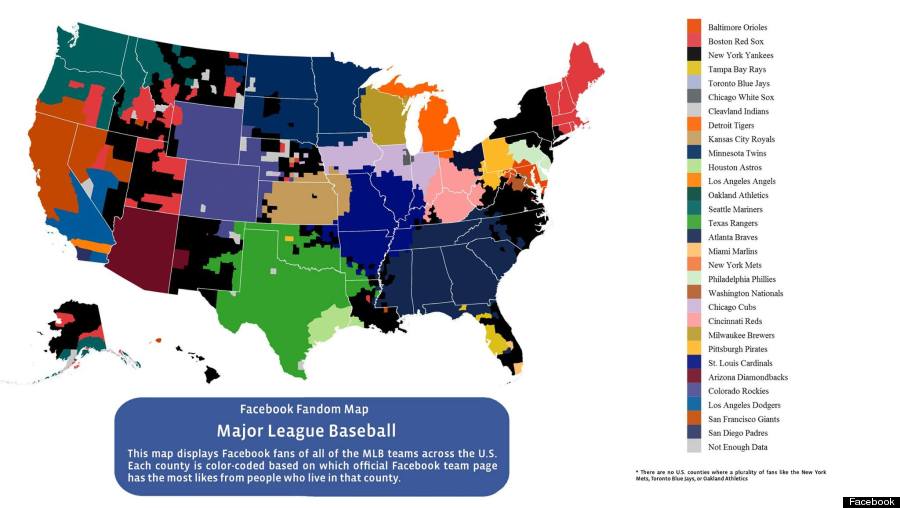
We in the West continue to think of boundaries in this sharp-edged, almost rigid way. A recent posting entitled, "Facebook Data Creates Incredible MLB Fan Map That Proves That Yankees Fans Are Everywhere," provides a striking example of how such mapping of realty is both useful and deceiving at the same time. Illustrating the posting is this map:
The point of the posting is that Yankee fans are everywhere. Its assumption is that sports cartographers are able to draw fine-lined boundaries between geographical areas "occupied" by each major league baseball team. Thus, Minnesota Twins support all but ends at the Minnesota-Wisconsin state line and the Milwaukee Brewers take over.
In truth, it isn't like that. The boundaries of support for each team are far more porous, less well-defined, and more like traditional Southeast Asia than the above map suggests. The actual point of the article, that there are Yankee fans in large numbers all across the nation, itself suggests that sports boundaries are more amorphous that the map suggests. The map evidently uses counties for its basic unit, so that a county that has a bare plurality of Yankee fans is colored Yankee black, while another one that almost has a plurality of support is not Yankee black. Twins support does not abruptly end one county into Wisconsin or Iowa, but it does dribble off so that there are more Brewers fans or Cubs fans east or south of the state line.
The point here is that people who habitually draw maps with sharp-edged boundaries tend to perceive such boundaries in other areas of life. Such boundaries promote rigid identities in all facets of life, and those who think in terms of pencil-thin boundaries tend to draw them when it comes to religion as well. One must be either a believer or an unbeliever, an atheist or a religionist. In reality, even in our hearts the boundaries between faith and unfaith are just not that clear. We have, in fact, a word for those who eschew amorphous shifting boundaries of the heart: "fanatics".
We in the West continue to think of boundaries in this sharp-edged, almost rigid way. A recent posting entitled, "Facebook Data Creates Incredible MLB Fan Map That Proves That Yankees Fans Are Everywhere," provides a striking example of how such mapping of realty is both useful and deceiving at the same time. Illustrating the posting is this map:
The point of the posting is that Yankee fans are everywhere. Its assumption is that sports cartographers are able to draw fine-lined boundaries between geographical areas "occupied" by each major league baseball team. Thus, Minnesota Twins support all but ends at the Minnesota-Wisconsin state line and the Milwaukee Brewers take over.
In truth, it isn't like that. The boundaries of support for each team are far more porous, less well-defined, and more like traditional Southeast Asia than the above map suggests. The actual point of the article, that there are Yankee fans in large numbers all across the nation, itself suggests that sports boundaries are more amorphous that the map suggests. The map evidently uses counties for its basic unit, so that a county that has a bare plurality of Yankee fans is colored Yankee black, while another one that almost has a plurality of support is not Yankee black. Twins support does not abruptly end one county into Wisconsin or Iowa, but it does dribble off so that there are more Brewers fans or Cubs fans east or south of the state line.
The point here is that people who habitually draw maps with sharp-edged boundaries tend to perceive such boundaries in other areas of life. Such boundaries promote rigid identities in all facets of life, and those who think in terms of pencil-thin boundaries tend to draw them when it comes to religion as well. One must be either a believer or an unbeliever, an atheist or a religionist. In reality, even in our hearts the boundaries between faith and unfaith are just not that clear. We have, in fact, a word for those who eschew amorphous shifting boundaries of the heart: "fanatics".
Monday, March 31, 2014
The Way
In the quiet of contemplation and the silence of meditation, the mind seeks rest and the heart to be less a prisoner of anxiety, haste, and stress. And one thing heart and mind discern in the mindfulness of meditation is how these things infect most of our waking moments. We go from being anxiously busy here to being anxiously busy there, and even when we have time for being not busy we fill that time with being busy. Will the Kingdom come through our doing? I wonder, doubt even that it will. Seeking a balance between doing and not doing, having and not having; learning to walk the Path slowly, contemplatively, in meditation: walking without hurrying, balanced, on the way toward peace; and seeing what lies here and there, stopping for a time for the pleasure of stopping. That seems to be the more likely way toward God's Kingdom: Sabbath rest, contemplative, meditative, peaceful, and balanced.
When then a person is mindfully at rest the Kingdom begins to take form. When we find pleasure in the small ordinary things in life, the Kingdom comes. When we allow the anxieties of the daily grind to dissipate into a peaceful moment, the Kingdom is. Being at ease. Resting. It is out of such things as these that the Kingdom is built, and when we live without haste and anxiety—at peace—we create a much different world from the "reality" of today, a world less polluted, less violent, and less inherently unjust—relationships less stressed, contentious, and defensive. Amen.
Friday, March 28, 2014
Which Salvation?
Is salvation individual or is it collective? In the vast majority of American churches, this question does not even arise. We are individually saved or damned. The Bible, however, presents a mixed picture. In the Old Testament, salvation is collective although individuals can be and often are found wanting. The concern is with the people of Israel, the nation. In the New Testament as well, the question of salvation is mixed. The Lord's Prayer in Matthew 6:9-13, for example, reflects a collective view of the Kingdom, that is the salvation hoped for in the coming age: give us, forgive us, rescue us. In the gospels, Jesus is intent on forming a new community that will be the seed for the salvation of Israel. His focus is on that coming but somehow already present Kingdom, and while he certainly realized that there were those who could not enter the Kingdom even they were more of a group, the hypocritical ruling elite, than actual individuals.
All societies have to work out a balance between the individual person and the collective society, but in general even in our day Asian societies tend to lean toward overt emphasis on the importance of the collective. Ancient biblical cultures were still less overtly individualistic than are modern cultures, especially in the West. Salvation, thus, was also much more a matter of the collective society individuals lived within, be it the tribe, the nation, or the church. Jesus' conception of the Kingdom reflects that balance that leans toward the collective. We may go to heaven or hell individually (for those who believe in that sort of eternal judgment), but we will enter the Kingdom together as the whole of the human race.
The real point here is that salvation is a complex and nuanced question, much more so than is widely acknowledged in churches today. It is not only a question of "am I saved," but also one of "are we saved." And there is no question that the spiritual well-being of the church we attend has a direct bearing on our own spirituality—at least for those who take their faith and their community of faith seriously. So, if we see salvation as being a state in which we currently live and not just a future destination then it is as much collective as it is individual. That is to say, the "I" and the "We" in salvation are always in play, always a concern, and always to be taken into consideration. Amen.
All societies have to work out a balance between the individual person and the collective society, but in general even in our day Asian societies tend to lean toward overt emphasis on the importance of the collective. Ancient biblical cultures were still less overtly individualistic than are modern cultures, especially in the West. Salvation, thus, was also much more a matter of the collective society individuals lived within, be it the tribe, the nation, or the church. Jesus' conception of the Kingdom reflects that balance that leans toward the collective. We may go to heaven or hell individually (for those who believe in that sort of eternal judgment), but we will enter the Kingdom together as the whole of the human race.
The real point here is that salvation is a complex and nuanced question, much more so than is widely acknowledged in churches today. It is not only a question of "am I saved," but also one of "are we saved." And there is no question that the spiritual well-being of the church we attend has a direct bearing on our own spirituality—at least for those who take their faith and their community of faith seriously. So, if we see salvation as being a state in which we currently live and not just a future destination then it is as much collective as it is individual. That is to say, the "I" and the "We" in salvation are always in play, always a concern, and always to be taken into consideration. Amen.
Tuesday, March 25, 2014
Theology For Our Day - An Example
It looks like I've fallen into yet another series of sorts, more or less unintentionally—a series looking at Internet as a context for contemporary theological reflection. Jonathan Merritt has recently posted a good example on his blog, On Faith & Culture, that is entitled, "Sochi Cadillac ad encourages worship at the altar of work and stuff." His posting critiques a Cadillac commercial that was shown during the Sochi Olympic games and that aggressively promotes a set of materialistic values, which Merritt feels reflects some of the worst aspects of American values including especially materialism and work-aholism. In the process, Merritt lays the values reflected in the commercial side-by-side with biblical values, and he observes,In my faith tradition—evangelical Christianity—I’m struck by an absence of preaching, teaching, and talking about these kinds of Biblical ideas. Perhaps it is because materialism has become a respectable sin or maybe it is because we need the wealthy to bankroll our massive ministry budgets and mammoth church building projects.Evangelical silence regarding materialism and its associated values, he concludes are a sign of how much all of our churches have Americanized the Christian gospel.
Merritt is surely correct in his analysis, but my point here is merely to illustrate a crucial approach to theological reflection in the 21st century. His subject is a commercial, which is a key form of contemporary communication—a form loaded with values of all kinds packed into neat flavorful, colorful sound and image bites. His approach is to expose the assumed values of our society to the light of biblical narratives, while his medium is a blog. Merritt mixes, that is, the ancient and honorable Christian task of exposing culture to the judgment of scripture with a form of communication that did not even exist a few short years ago. We, of course, still need the more traditional kind of theological reflection that leads to books and retreats, but even those enterprises need to be and inevitably will be informed by e-theological reflection.
Wednesday, March 19, 2014
Another Context for "Doing Theology"
If the internet provides one crucial context for theological reflection today (as I argued here), then a recent posting by Jay Parini entitled, "Why Vermont is not Godless," suggests another obvious but potent context, the decline of religiosity as opposed to spirituality. In a previous posting (here), I defined spirituality as an inner state and religiosity as being a set of practices. We feel spiritual; we do religion. It's an oversimplification to be sure. Until relatively recently, in any event, the church was the key social and cultural context within which the great majority of theological reflection took place. In Vermont apparently that is no longer the case. Presumably, it is also no longer the case in New Zealand (see here).
What seems to be happening is that we are returning to something like the state of the earliest church in the time of the Roman Empire when there was a hodge lodge of religious thinking going on without an effective central agency to exercise control over it. In the churches themselves, there was a whole range of theological responses to the person of Christ, which flourished for centuries before the Bishop of Rome gained some control of the situation. In Protestantism, we returned to a similar situation to a degree although most Protestant denominations have sought to exercise control over the range of "acceptable" theological reflection. Now, control is gone. It is certainly gone in mainline American denominations such as the PC(USA), which has been one reason many evangelical congregations have fled for places where control remains an ideal.
For those who do not concern themselves primarily with the institutional maintenance of existing congregations and denominations, this is an exciting time. For those tasked with that maintenance it is a scary, anxious time.
What seems to be happening is that we are returning to something like the state of the earliest church in the time of the Roman Empire when there was a hodge lodge of religious thinking going on without an effective central agency to exercise control over it. In the churches themselves, there was a whole range of theological responses to the person of Christ, which flourished for centuries before the Bishop of Rome gained some control of the situation. In Protestantism, we returned to a similar situation to a degree although most Protestant denominations have sought to exercise control over the range of "acceptable" theological reflection. Now, control is gone. It is certainly gone in mainline American denominations such as the PC(USA), which has been one reason many evangelical congregations have fled for places where control remains an ideal.
For those who do not concern themselves primarily with the institutional maintenance of existing congregations and denominations, this is an exciting time. For those tasked with that maintenance it is a scary, anxious time.
Labels:
Presbyterian Church (USA),
Religion,
Spirituality,
Theology
Tuesday, March 18, 2014
Belief In God - Why All the Sweat?
In a recent New York Times interview entitled, "Arguments Against God," philosophy professor Louise Antony was asked if she thought if it even much matters whether we believe in God or not." She responded,
But I'm not sure that there is an answer that is really going to make sense to her. Earlier in the interview she implies that religious belief systems are all based on rationalizations rather than on rationality as she understands it. What she considers "reasons" for believing are largely "the result of automatic unconsciousness processing, involving lots of unarticulated judgments." She apparently feels that beliefs are an inferior way at arriving at truths based on a-rational considerations. Her puzzlement and views on believing, if I've read them correctly point to a gap in understanding between theists and non-theists concerning the nature of reality that seems almost impossible to cross. On the theist side of the gap, we make connections that make little sense on the other side. Let me be clear that I am not talking here about hard-core religious fundamentalists who, in truth reside in another corner of reality much closer to hard-core atheists than to the rest of us. Both of them live on the other side of another chasm, between dualist/absolutist and non-dualist/relativist ways of thinking, which is if anything wider and deeper than the one between theists and non-theists generally.
So, in any event, it appears almost impossible to explain to Antony in ways that she would comprehend why our faith in God is so important to us or why there is far more at stake for us than a "difference in philosophical opinion." We can agree with her that we should seek allies among the non-theists when it comes to the struggle for a more just and peaceful society, but be that as it may fundamental questions about the origins and nature of reality are not merely "arcane matters" to us—even those of us who are not intent on defending a seven day creation myth or taking literally cherry-picked dogmas and prejudices from an ancient text that requires a wiser reading than it frequently receives.
It may be that in another entry here I will try to answer Antony's questions about why our faith in God is so important, but before trying such a thing it is important to acknowledge that the answer probably won't be of much help to her. There is a gap that is really difficult to cross. What is to be appreciated is that while she doesn't understand theist thinking she is reasonably respectful of it. That, at least, is a start.
Well, I do wonder about that. Why do theists care so much about belief in God? Disagreement over that question is really no more than a difference in philosophical opinion. Specifically, it’s just a disagreement about ontology — about what kinds of things exist. Why should a disagreement like that bear any moral significance? Why shouldn’t theists just look for allies among us atheists in the battles that matter — the ones concerned with justice, civil rights, peace, etc. — and forget about our differences with respect to such arcane matters as the origins of the universe?From reading the rest of the interview one does not get the impression that Antony is a hard-shell religion hater, and her observations in this answer reflect a real puzzlement about why theists frequently take their theism so intensely seriously. What's the big deal? It is a good question honestly asked. It deserves an answer.
But I'm not sure that there is an answer that is really going to make sense to her. Earlier in the interview she implies that religious belief systems are all based on rationalizations rather than on rationality as she understands it. What she considers "reasons" for believing are largely "the result of automatic unconsciousness processing, involving lots of unarticulated judgments." She apparently feels that beliefs are an inferior way at arriving at truths based on a-rational considerations. Her puzzlement and views on believing, if I've read them correctly point to a gap in understanding between theists and non-theists concerning the nature of reality that seems almost impossible to cross. On the theist side of the gap, we make connections that make little sense on the other side. Let me be clear that I am not talking here about hard-core religious fundamentalists who, in truth reside in another corner of reality much closer to hard-core atheists than to the rest of us. Both of them live on the other side of another chasm, between dualist/absolutist and non-dualist/relativist ways of thinking, which is if anything wider and deeper than the one between theists and non-theists generally.
So, in any event, it appears almost impossible to explain to Antony in ways that she would comprehend why our faith in God is so important to us or why there is far more at stake for us than a "difference in philosophical opinion." We can agree with her that we should seek allies among the non-theists when it comes to the struggle for a more just and peaceful society, but be that as it may fundamental questions about the origins and nature of reality are not merely "arcane matters" to us—even those of us who are not intent on defending a seven day creation myth or taking literally cherry-picked dogmas and prejudices from an ancient text that requires a wiser reading than it frequently receives.
It may be that in another entry here I will try to answer Antony's questions about why our faith in God is so important, but before trying such a thing it is important to acknowledge that the answer probably won't be of much help to her. There is a gap that is really difficult to cross. What is to be appreciated is that while she doesn't understand theist thinking she is reasonably respectful of it. That, at least, is a start.
Friday, March 14, 2014
Why do people believe in God?
Why do people believe in God? There is no direct physical evidence of God known to us now such as would prove God exists like a tree, a universe, or evolution exist. So, why believe in God?
One answer is that people believe in God because they are socialized into such a belief. This is certainly true for most Americans. But, this response begs the question of why people believe in God, because at some point, somehow such belief had to start. It had to be invented. So, then, the question is why did people in the past invent God? And the answer is, "We don't know"—not in the scientific sense of knowing. There is no documentation, no evidence available to us to answer the question. We can speculate, but in the absence of even the possibility of evidence our speculations one way or the other carry no weight. So, while socialization is an explanation for why individuals believe in God, it does not explain why there is such a belief. We don't know why it exists to be socialized.
Another answer is that people believe in God because they have experiences that they interpret to be divinely inspired. These experiences are various and include such things as visions and deep spontaneous feelings (of peace, of holy terror, of profound love) experienced while in nature, while meditating/praying, while in group exercises (worship), and even while under stress. But, again, the fact that people have experiences of God only explains why individuals believe in God. Such experiences provide no evidence as to where they come from or why they should even exist at all. Possibly, those who invented belief in God associated certain experiences with a notion of a divine being (or beings) or "spirit-ual" reality of some kind, but if that is what happened why did they make such a connection? Why did the inventors of belief in God believe in God? The answer is that we have no way of knowing.
The point here is that for those who put their faith in God faith is exactly that: faith. It involves received traditions (socialization), personal experiences, pious exercises (worship, meditation, prayer) and reflection on "what makes sense," but at the end of the day it is faith—faith that there is a deeper, divine Reality beyond the socialization, experiences, and the reflection. That faith can be compelling or it can be mildly interesting, profound or superficial, thought through carefully or blithely accepted at face value; but in all of this it is a faith that "makes sense" to the faithful. While we don't know, then, why people believe in God, those of us who do have a sense that there is more to reality than what science or the senses perceive, something Deep, Powerful, and profoundly Creative. For Christians, we sense that we come closest to that Something in Jesus of Nazareth, and we trust that our sense of the holy is so. We trust in him that it is so. Amen.
One answer is that people believe in God because they are socialized into such a belief. This is certainly true for most Americans. But, this response begs the question of why people believe in God, because at some point, somehow such belief had to start. It had to be invented. So, then, the question is why did people in the past invent God? And the answer is, "We don't know"—not in the scientific sense of knowing. There is no documentation, no evidence available to us to answer the question. We can speculate, but in the absence of even the possibility of evidence our speculations one way or the other carry no weight. So, while socialization is an explanation for why individuals believe in God, it does not explain why there is such a belief. We don't know why it exists to be socialized.
Another answer is that people believe in God because they have experiences that they interpret to be divinely inspired. These experiences are various and include such things as visions and deep spontaneous feelings (of peace, of holy terror, of profound love) experienced while in nature, while meditating/praying, while in group exercises (worship), and even while under stress. But, again, the fact that people have experiences of God only explains why individuals believe in God. Such experiences provide no evidence as to where they come from or why they should even exist at all. Possibly, those who invented belief in God associated certain experiences with a notion of a divine being (or beings) or "spirit-ual" reality of some kind, but if that is what happened why did they make such a connection? Why did the inventors of belief in God believe in God? The answer is that we have no way of knowing.
The point here is that for those who put their faith in God faith is exactly that: faith. It involves received traditions (socialization), personal experiences, pious exercises (worship, meditation, prayer) and reflection on "what makes sense," but at the end of the day it is faith—faith that there is a deeper, divine Reality beyond the socialization, experiences, and the reflection. That faith can be compelling or it can be mildly interesting, profound or superficial, thought through carefully or blithely accepted at face value; but in all of this it is a faith that "makes sense" to the faithful. While we don't know, then, why people believe in God, those of us who do have a sense that there is more to reality than what science or the senses perceive, something Deep, Powerful, and profoundly Creative. For Christians, we sense that we come closest to that Something in Jesus of Nazareth, and we trust that our sense of the holy is so. We trust in him that it is so. Amen.
Thursday, March 13, 2014
The Inter-webs and Theology
The website Digital Book World (DBW) recently posted a review entitled, "Pew: Internet Will Be Like ‘Electricity’ in 2025," which reports on a research publication, "Digital Life in 2025," put out by Pew Research Center "to mark the 25th anniversary of the creation of the World Wide Web." It makes the point that as important as the Internet has become to us, it is going to become only more significant, ubiquitous, and seamlessly woven into daily life in the years ahead. Both the DBW review and the report itself observe that there will be both immense benefits to be gained and serious dangers to be addressed as the Internet becomes ever more a dominant part of our world.The one thing that struck me personally from reading the review article and skimming parts of the report itself is that the Web has become a setting in which to reflect on important theological subjects raised in its various corners by a variety of sites. If all theology is culturally bound and if it must finally be culturally relevant, then it is not too much to say that the Web has become a cultural medium of immense significance not only for life generally but also for theological reflection in particular. Blogs like this one thus become a vehicle for theological reflection, and theology itself becomes a more fragmented, helter-skelter, on the fly, piecemeal enterprise. It is also more 3-dimensional in that we can move around in Web space quickly pulling up links from here and there. And while we can and should debate pros and cons of Internet as a context and medium for theological reflection, the reality is that we have no choice in the matter. Theology has to take place in the world in which it finds itself. It has to use the language, media, and reflect the cultural context of that world.
The ongoing spiritual and intellectual theological enterprise may not change in the ultimate sense, that is in its stretching to understand the incomprehensible and in its quest for the Kingdom, which is the reign of divine peace on this planet. But surely it is having a significant influence on how we "do theology' in a cultural medium that is the very essence of scientific technology. The trick for us is to see the Internet and its scientifically-driven ethos as another arena for the work of the Spirit and the task of theology. I guess that is a prayer. Amen.
Subscribe to:
Posts (Atom)