In his outstanding book, Siam Mapped (Hawaii, 1997), Thai historian Thongchai Winichakul observes that traditionally boundaries between nation-states in Southeast Asia were ill-defined regions between power centers that melded into each other at their outer peripheries. One did not cross a boundary but rather travelled through it, gradually leaving one power sphere and just as gradually entering another. At the peripheries, local rulers and people often gave shifting allegiance to two or more centers of power. When the Europeans showed began to take control of most of the region in the 19th century, however, they introduced carefully surveyed, sharply drawn boundaries. They wanted to know the precise extent of their authority for purposes of control and taxation. The "mapping of Siam," thus, was not just about cartography. It was about power.
We in the West continue to think of boundaries in this sharp-edged, almost rigid way. A recent posting entitled, "Facebook Data Creates Incredible MLB Fan Map That Proves That Yankees Fans Are Everywhere," provides a striking example of how such mapping of realty is both useful and deceiving at the same time. Illustrating the posting is this map:
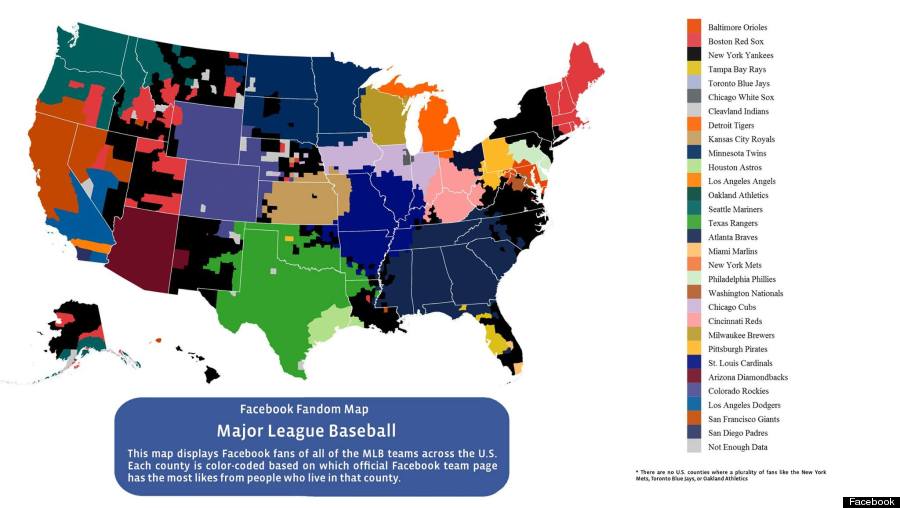
The point of the posting is that Yankee fans are everywhere. Its assumption is that sports cartographers are able to draw fine-lined boundaries between geographical areas "occupied" by each major league baseball team. Thus, Minnesota Twins support all but ends at the Minnesota-Wisconsin state line and the Milwaukee Brewers take over.
In truth, it isn't like that. The boundaries of support for each team are far more porous, less well-defined, and more like traditional Southeast Asia than the above map suggests. The actual point of the article, that there are Yankee fans in large numbers all across the nation, itself suggests that sports boundaries are more amorphous that the map suggests. The map evidently uses counties for its basic unit, so that a county that has a bare plurality of Yankee fans is colored Yankee black, while another one that almost has a plurality of support is not Yankee black. Twins support does not abruptly end one county into Wisconsin or Iowa, but it does dribble off so that there are more Brewers fans or Cubs fans east or south of the state line.
The point here is that people who habitually draw maps with sharp-edged boundaries tend to perceive such boundaries in other areas of life. Such boundaries promote rigid identities in all facets of life, and those who think in terms of pencil-thin boundaries tend to draw them when it comes to religion as well. One must be either a believer or an unbeliever, an atheist or a religionist. In reality, even in our hearts the boundaries between faith and unfaith are just not that clear. We have, in fact, a word for those who eschew amorphous shifting boundaries of the heart: "fanatics".
We should maintain that if an interpretation of any word in any religion leads to disharmony and does not positively further the welfare of the many, then such an interpretation is to be regarded as wrong; that is, against the will of God, or as the working of Satan or Mara.
Buddhadasa Bikkhu, a Thai Buddhist Monk
Showing posts with label Thongchai Winichakul. Show all posts
Wednesday, April 2, 2014
Tuesday, October 23, 2012
Boundaries, Asian, European, & Religious
Thongchai Winichakul's book, Siam Mapped: A History of the Geo-Body of a Nation (1997), has become something of a classic in Tha and Southeast Asia studies. In brief, Tongchai (we always refer to people by their first name in Thailand) examines the ways in which traditional Thai concepts of national space were transformed by European colonialism. Thailand (or Siam, then) was the only nation in Southeast Asia to escape direct colonization, but by 1900 it had British or French colonies on its borders in all four directions.
Here's the thing: before the Europeans showed up, Southeast Asian nations had very loose, ill-defined boundaries. At the center, there was one central power, but as one travelled outward that power slowly diminished and was increasingly shared by rulers of the outer provinces—then shared even more with the princes of the tributary states. Eventually one travelled out of one nation's power sphere and entered, gradually, that of another nation—again going through tributary states, outer provinces and inner provinces until one reached the center of power. These spheres of power waxed and waned, grew and diminished. The far tributary states were often tributary to two powers at once.
By European standards all of this was a chaotic mess. When the British conquered Burma, thus, they wanted to know exactly and precisely what they had conquered. Down to the foot and inch. And they went to great trouble to survey "the" border between Burma and Siam. The Thai political leadership had to learn this European concept of boundaries and space in order to survive it—and they did.
Now, my point: all of this has a great deal to do with the liberal-conservative split in contemporary American Christianity. When it comes to people of other faiths and religions, progressive Christians usually feel more comfortable with the traditional Southeast Asian view of boundaries. They will "borrow" Buddhist meditation, find meaning in Islamic theology, and happily integrate the latest scientific findings into their faith and theology. Conservative Christians more often than not feel more comfortable with the European conception of boundaries when it comes to religion. There is a desire to designate clearly what is "Christian" and what is not. Where nationality is hard to determine in the older view, in the one imported by the Europeans everyone had a nationality that could be clearly determined. In the same way, evangelical Christians usually care a great deal about who is saved (i.e. lives in the territory of Christ) and who is not.
It would be fascinating to know why we have these differences.
P.S. There must be something about October. Just a year ago, I posted another posting that draws on Tongchai's, Siam Mapped (here).
Here's the thing: before the Europeans showed up, Southeast Asian nations had very loose, ill-defined boundaries. At the center, there was one central power, but as one travelled outward that power slowly diminished and was increasingly shared by rulers of the outer provinces—then shared even more with the princes of the tributary states. Eventually one travelled out of one nation's power sphere and entered, gradually, that of another nation—again going through tributary states, outer provinces and inner provinces until one reached the center of power. These spheres of power waxed and waned, grew and diminished. The far tributary states were often tributary to two powers at once.
By European standards all of this was a chaotic mess. When the British conquered Burma, thus, they wanted to know exactly and precisely what they had conquered. Down to the foot and inch. And they went to great trouble to survey "the" border between Burma and Siam. The Thai political leadership had to learn this European concept of boundaries and space in order to survive it—and they did.
Now, my point: all of this has a great deal to do with the liberal-conservative split in contemporary American Christianity. When it comes to people of other faiths and religions, progressive Christians usually feel more comfortable with the traditional Southeast Asian view of boundaries. They will "borrow" Buddhist meditation, find meaning in Islamic theology, and happily integrate the latest scientific findings into their faith and theology. Conservative Christians more often than not feel more comfortable with the European conception of boundaries when it comes to religion. There is a desire to designate clearly what is "Christian" and what is not. Where nationality is hard to determine in the older view, in the one imported by the Europeans everyone had a nationality that could be clearly determined. In the same way, evangelical Christians usually care a great deal about who is saved (i.e. lives in the territory of Christ) and who is not.
It would be fascinating to know why we have these differences.
P.S. There must be something about October. Just a year ago, I posted another posting that draws on Tongchai's, Siam Mapped (here).
Wednesday, October 19, 2011
Boundaries East & West (iv)
This is the fourth posting in a series of postings reflecting on Thich Nhat Hanh's book, Living Buddha, Living Christ (Riverhead Books, 2007; originally published in 1995). The introductory posting, setting the stage for the series, is (here). As we've seen in the previous two postings, Thich Nhat Hanh opens Living Buddha, Living Christ with a provocative challenge to our socially-inherited ways of thinking about our beliefs, secular as well as religious. He wants us to discard the notion that our set of beliefs are truer han those of people who believe differently than we do.Some years ago Thongchai Winichakul, a Thai scholar, published a fascinating book entitled, Siam Mapped: The History of the Geo-body of a Nation (University of Hawaii, 1997). One of its key points is that people in Southeast Asia used to think about national boundaries in ways very different from the West. Boundaries were porous and ill-defined. There was a national center, which was more-or-less under the authority of the central government, and there were the peripheries that were less fully under the control of the central rulers. Cities and territories on the periphery frequently gave loyalty to two different kings or princes. It was the Western colonial powers who in the 19th century introduced distinct, razor sharp boundaries and the notion that every territory had to have one allegiance, clearly defined by its boundaries.
Thich Nhat Hanh is asking us to think about our religious and ideological boundaries the way Southeast Asians used to think about political boundaries. He wants us to see the boundaries of our beliefs (and unbeliefs) as porous and ill-defined. There is a center, which for him, is the practices of our faith, and then there are neighboring faiths, from which we can learn a good deal. Christians, thus, remain Christians because they centrally seek to practice the precepts of Jesus, to walk his Way. But, Christians can learn from Buddhists, Muslims, Jews, Hindus, skeptics, and "non-believers" if only we will hold our boundaries with less rigidity and seriousness. All of this separates believing in Christ from following Christ. For the sake of our inner peace and world peace, Thich Nhat Hanh wants us to follow Christ utterly and fully, but he calls on us to be less assertive and rigid in our beliefs about Christ. He wants us to be "true practitioners" rather than "true believers"—again, for the sake of inner and international harmony, true peace.
In sum, Thich Nhat Hanh advises us to put our faith, that is our trust, in Christ and his Way while taking our beliefs about Jesus less seriously—to the end that we don't treat each other violently or disdainfully.
Tongchai makes the point that the Western colonial powers introduced razor thin, clearly mapped boundaries into Southeast Asia as a matter of power and control. Britain, thus, needed to know precisely what the boundaries of Burma were so that British colonial authorities could exercise their power over the people and territory falling within those boundaries. Ideological and religious boundaries, when sharply drawn, are also about power and control. They are about who is 'in" and who is "out," who exercises authority, power, and control—and who doesn't. In the church, in particular, the insistence that we believe certain things about Christ is not really about following or even trusting in Jesus at all. It is about maintaining institutional control and exercising ecclesiastical authority. Thich Nhat Hanh is correct. We would do better to give ourselves utterly to following Christ, trusting that his Way is best for us, and not put so much store in what we believe about him.
Labels:
Belief,
Boundaries,
Buddhism,
Faith,
Jesus Christ,
Thich Nhat Hanh,
Thongchai Winichakul
Subscribe to:
Posts (Atom)
