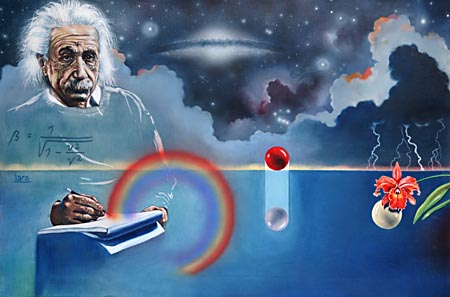
We should maintain that if an interpretation of any word in any religion leads to disharmony and does not positively further the welfare of the many, then such an interpretation is to be regarded as wrong; that is, against the will of God, or as the working of Satan or Mara.

Buddhadasa Bikkhu, a Thai Buddhist Monk


Showing posts with label Book of Nature. Show all posts

Thursday, August 4, 2011

God & Reality (III)

Following on the previous post, "God & Reality (II)":

In the second installment of this series on "God & Reality," we left agnostics and atheists to their own counsels, and now we do the same with those who reject science in the name of faith,  particularly biblical literalists.  The literature arguing for a close relationship between science and religion is huge, and there is no need to try to add to it now.  Instead, what I'm working on here is how the findings of science can help us better understand God, the One who created the realities studied by science.

One of the most important things we're learning from science about reality is that it is in constant flux.  Nothing stands still.  Nothing is permanent.  The only absolute seems to be that there are no absolutes.  This is just as true in the realm of religion as it is for anything else.  Our theologies are constantly changing, evolving.  The Bible continues to change today as scholars discover new ancient texts or figure out meanings that we didn't understand before.  Just as our bodies are seething colonies of ever-shifting cells and microbes so our religions shift and change.  Everything is in flux.  Nothing stands still.  Even the ground we stand on is constantly shifting on tectonic plates, which are in constant motion.

God, we can only conclude, created a universe in flux where change is the norm.  Change is reality.  According to the Bible, God's plan for humanity also changes—or, perhaps better, God's strategy for achieving the divine plan changes.  God created humanity sinless, but that didn't work out.  Eventually, God "called" a Semitic tribe whose patriarch was Abraham to be God's people.  But that didn't work out as they became trapped in slavery in Egypt.  Then God "called" Moses to free the Hebrews and gave them a promised land.  But that didn't work out.  And on it went through Christ to the creation—ongoing creation—of the church.  Everything changes.  Even God's plans change.

The Book of Nature reveals, then, that at the very least God participates in and has a clear affinity for change.  As Christians, we see God's participation in a changing world most clearly in Jesus of Nazareth, a man who also had a seething colony of cells and microbes for a body just like the rest of us.  He was born, grew up, and lived "on the road" during his public ministry, as if to affirm a divine affinity for flux.  As Christians, we sense God's participation in a changing world through the continuing presence of the Holy Spirit, which is constantly prodding and calling us to change, which is what the word "repentance" means after all, a change of heart.

Does all of this say something about the nature of God, at least as best we can understand God?  Stay tuned.

Wednesday, August 3, 2011

God & Reality (II)

Following on the previous post, "God & Reality (I):

Leaving agnostics and atheists to go their separate ways, people of faith are bound to find the analysis in the previous post dissatisfying.  We believe that God is real and engaged with reality as we know it.  Different religions describe the nature of God and of God's relationship to the world in different ways, but the consensus is that in one form or another we can know God.  While Buddhism, for example, is often thought of as a non-theistic religion, some Buddhist thinkers acknowledge that the Dharma can be thought of as "God," just so long as God is not conceived of as being a person.

We Christians base our affirmation of the reality of God primarily on experiences with the divine.  The central experience is with Jesus, which is both historical and contemporary.  Some 2,000 years ago, the founders of our faith had a mind-blowing, life-changing experience with Jesus that we are still trying to wrap our heads around.  Later generations have shared in that experience in their own lives.  Building on the Bible, we affirm that at the very core of it all, we experience God as love.  Christians in different ages, cultures, traditions, sects, and denominations have understood the love of God in different ways, given different interpretations and emphases to that love, but we share across the boundaries of our many Christianities the common sense that God is love, and we experience that love in Christ.

This brings us to a third way of talking about God.  We can speak of God in the abstract as "ultimate being."  We can affirm the living Lord as "love".  And we understand God as creator of all of reality.  The Old Testament affirms from the get-go that God in the beginning created the heavens and the earth.  In the evolution of their faith, the Hebrew people learned that their God was not a tribal god whose throne was in the temple in Jerusalem.  God's throne, instead, stood at the peak of the created universe, heaven, and the whole of the world was God's footstool.  In the tiny universe of the ancient world, this was as universal a view of God as was possible.  It took our understanding of God to a new level.  It transformed God's "kingship" and "kingdom" into something Beyond any human conception of God—even concepts such as "Lord" of the Universe.

God as the creator who encompasses all of reality takes us back to the neutral, abstract idea that God is ultimate reality but with one crucial difference.  We do not know what the relationship of ultimate reality is to mundane reality.  When we claim that God created the universe, we also necessarily claim that we can know certain things about God through the study of the universe, God's creation.  The universe reflects and therefore reveals something of the nature of God.  The abstract notion of God as ultimate reality becomes more concrete and comprehensible in some degree to us whose senses and perceptions are tied to the physical world.

The universe itself reveals God.  It is one of the "two books" of revelation, the Bible and Nature.  The discovery of the Book of Nature, which goes back to the early decades of the invention of science, was an important moment in the evolution of Christian theological thinking.  Rooted in the biblical view of God as creator, it continues to provide a key interface between faith and science.  It reminds us that many early scientists were looking for God in their scientific pursuits and that we should continue their journey today.  Stay tuned.

Sunday, June 26, 2011

Non-Territorial Magisteria

Yesterday's posting presents the argument that religion and science are usually and unnecessarily understood metaphorically as being two domains occupying separate territories in conflict with each other.  It's a useful metaphor for those who want to wage war on each other or profit from that war.  It is also a false metaphor that gets us into all sorts of trouble.

OK.  So, what do things look like if we reject the territorial metaphor?  One example might come from Michael Ruse's 1999 "Review of Stephen Jay Gould's 'Rocks of Ages," in which he critique's Gould's contention that religion and science are "non-overlapping magisteria"  (NOMA).  Ruse argues that NOMA effectively forces theists to have to constantly give away to science because science "rules supreme" in the "empirical realm."  Ruse worries that a strict construction of the boundary between science and religion puts unjustifiable constraints on the freedom of religious people.  He concludes, "One is denying [them] the right to revise and reinterpret one's faith in the light of scientific advances."  He criticizes Gould for not allowing theologians do that very thing, namely reinterpret Christian doctrine in light of scientific findings.  As an agnostic he wants to give theists the "right to explore and develop their beliefs in the light of modern science."

Ruse doesn't seem to realize that Christian thinkers have long exercised that right and many continue to do so today.   Since the days when the earliest church began to articulate its Jewish faith in Greek philosophical terms, Christian theologians have regularly and even aggressively used contemporary thought to restate our faith.  They didn't looked on those philosophies as being enemy territory but rather is being resources for discovering new aspects of our faith.  There is every reason to use scientific findings that way in our day.  When we're not engaged in a zero-sum game protecting the purity of our theological turf, we are free to accept the truth of those findings and learn from them.  They don't change our faith in Christ as Lord and Saviour.  They don't deny the presence of the Spirit in daily life.  And they only serve to expand our understanding of God as Creator.

People of faith who embrace evolution, in short, gain a great deal and lose nothing by walking away from the turf war going on between creationism and scientism.  That's not to say we ignore it so much as to say that we persist in seeing the relevance of both science and faith for understanding and living in our world.  They are resources for living.  Perhaps we should revive the old-fashioned non-territorial metaphor of God being revealed to us in two books, the Book of Nature and the Book of Faith (a.k.a the Book of Revelation, the Book of God).