We should maintain that if an interpretation of any word in any religion leads to disharmony and does not positively further the welfare of the many, then such an interpretation is to be regarded as wrong; that is, against the will of God, or as the working of Satan or Mara.

Buddhadasa Bikkhu, a Thai Buddhist Monk


Wednesday, January 30, 2013

Rushing On - But Where Are We Going?

Teleportation as imagined on "Star Trek"
Anyone who pays attention is aware that science is rushing forward with new discoveries leading to new applications on a variety of fronts.  A recent article on ABC Science, entitled, "Making teleportation 'fuel-efficient'," is but another witness to that fact.  Apparently, teleportation—"the transfer of matter from one point to another without traversing the physical space between them" (Wikipedia)—is not just a theoretical possibility.  It is also a technological possibility, meaning that scientists are now convinced that we can devise ways to transfer matter from one point to another without moving it through the space between those two points.  If I understand the article correctly, this is now theoretically possible at the quantum level, and that fact has important technological applications toward the construction of  "quantum computers."  Quantum computers are the next step in computing, one that will allow computations many magnitudes greater than today's computers can perform.  Apparently, most of the applications of quantum computing haven't even been discovered yet.  That is, we're headed somewhere, but we don't know where that where is or where we will be when we get "there," wherever "there" is.

We really, really need to think about these things in church—even in worship—and not in the luddite fashion of resistance and fear.  We dare not hide behind our theologies because science and its technologies are rapidly leaving our ancient truths in the dust.  Or, better, seem to be doing so.  Religious faith at its best, perceives a deeper plane or a more central aspect to life, which is not physical yet has physical manifestations.  That deeper plane is the world of the spirit and the Spirit.  Spirit is a life-giving, animating, inspired "presence" in that which has life.  The Spirit is the life-giving, animating, inspired "Presence" that impels cosmic evolution forward.  The Spirit has gifted us with love, faith, kindness, compassion, insight and wisdom, patience, and even self-control.  These are not tangible, physical properties, but they are real realities that we sense and experience with an almost physical clarity.

But is science and its technologies taking us in the direction of spirit and the Spirit—or not?  If not, should it?  What is the ultimate purpose of science and its technologies?  Will science one day achieve a breakthrough to that deeper plane, one that brings it into the presence of spirit and the Spirit?  Or is it a hinderance to the human quest for deeper meaning and wisdom?  These are among the most pressing theological questions of our day.  We need to reflect on them more deeply in local worshipping communities—in worship as well as in local study groups.  Ultimately, the right uses of science, the spiritual uses of science will depend on our collective spiritual will to seek the Spirit.  I'm not suggesting that science become somehow more religious but that it become more spiritual.  It is our calling as people of faith to encourage it in that direction.  Amen.

Monday, January 28, 2013

Wrestling with Scripture

If the Bible is a collection of human documents infused with the possibility of the Spirit but still speaking out of the human condition, it can seldom be taken at face value.  We have to discern the Word in the words.  Take, for example, II Corinthians 6:14 to 7:1, which reads in the Good News (a.k.a. Today's English Version) translation:
14 Do not try to work together as equals with unbelievers, for it cannot be done. How can right and wrong be partners? How can light and darkness live together? 15 How can Christ and the Devil agree? What does a believer have in common with an unbeliever? 16 How can God's temple come to terms with pagan idols? For we are the temple of the living God! As God himself has said,

“I will make my home with my people
and live among them;
I will be their God,
and they shall be my people.”
17 And so the Lord says,
“You must leave them
and separate yourselves from them.
Have nothing to do with what is unclean,
and I will accept you.
18 I will be your father,
and you shall be my sons and daughters,
says the Lord Almighty.”

7:1 All these promises are made to us, my dear friends. So then, let us purify ourselves from everything that makes body or soul unclean, and let us be completely holy by living in awe of God.
The passage advocates a radical dualism, an absolute separation of the sheep from the goats.  The Message translation (here) avoids using the words "unbeliever" and "believer," but translates "unbelievers" in verse 14 as "those who reject God" and 15 as those who "mistrust". That is, the passage enjoins those who accept and trust God (i.e. have faith) to separate themselves radically from those who reject and mistrust God (i.e. have no faith).

This may have been good advice to new Christians in the second century.  It is not good advice to mainline Christians in the 21st century.  Our spiritual struggle is, at least in important part, with dualism, absolutism, prejudice, and ideologies of exclusion.  Our calling is to love our neighbors of other faiths, persuasions, cultures, orientations, ethnicities, and beliefs as best we can—to build bridges rather than walls.  This passage seems to demand that we tear down the bridges and reinforce the walls.  What to do?

First, we would do well to acknowledge that the Spirit speaks through scripture to each generation in the language of that generation.  Separation may well have been as much good news to early generations of Christians as it is bad news for us today.  Second, however, we should consider how this passage speaks to us today.  It is a warning that there are ways of thinking and behaving that are incompatible with faith and that there are people who think and behave in those incompatible ways.  That is true enough.  But, should we refuse to work with them and separate ourselves from them?  It depends on who "they" are and what we mean by "separation".

Suppose we seek to understand this passage in a non-dualistic, pluralistic way.  "They," then, become those who behave unjustly, oppressively, and with prejudice against others.  "They," may well be taken as those who fail to display the fruits of the Spirit described in Galatians 5:22-23.  speaking honestly, we are all complicit in that failure.  "They," we must finally admit are us (thank you Pogo).  It is fair to say that we are being called by the Spirit in our age to separate ourselves from behaviors rather than people, attitudes rather than neighbors, and ideologies of separation rather than people who think differently.  Verse 7:1, then, makes a whole lot of sense for our time.  Acknowledging that we cannot be pure, we are still being called by the Spirit to purify ourselves as best we can of such things as dualism, absolutism, prejudice, and dogmas of separation—among other things such as fear and hatred.  This is a life long calling and task.

Saturday, January 26, 2013

If Only

Because of what Christ has done for everyone, we are careful not to assume that people are nothing more than what our eyes and ears tell us about them. In the past we made that mistake with Christ, but we now know a lot more of him than our eyes or ears alone could detect. Whenever anyone unites themselves to Christ, something new is created. What that person was becomes a thing of the past; they get a whole new start in life! This is all God’s doing! God wants to be at peace with us, and so sent Christ to bring about reconciliation. Now God is sending us to continue this same work of reconciliation. To put it another way, what God was doing in and through Christ, was rebuilding the trust and love that are supposed to flow in both directions between the world and God. To achieve that, God agreed not to hold against us anything we had done in the past. This, then, is the extraordinary message of reconciliation which we are now given the job of sharing. We are a bit like a negotiation team who is authorised to issue the appeal on God’s behalf. We represent Christ in the world, and so on his behalf we beg you to hear this message and accept the generous peace deal that God is offering. The way of reconciliation is on the table before you: you’d be mad to turn your backs on it! Even though Christ had never been sucked into sin like us, God lumped him in with us, so as to make it possible to lump us in with him. United with him, we can become examples of all that God considers to be right and true.
II Corinthians 5:16-21 (Laughing Bird Paraphrase)

These verses are one of those places in the New Testament that articulate what Christian faith is about with particular clarity.  It reminds us that faith in Christ teaches us to see things in a new way.  That faith opens a hidden depth in life for us.  It is creative, and the thing faith creates is us.  It is about reconciliation and peacemaking, about love and trust.  Faith connects the dots between the One Who Is Beyond, the Spirit That Is Present, and us.  It inspires us to share those connections with our neighbors.  Amen.

Friday, January 25, 2013

The Party of Christian America

The trend is deeply troubling and bodes ill for the future of the republic.  In Republican controlled states, we see a trend that attempts to effectively limit voting by minorities, gerrymander districts to maximize the vote of non-minorities, and now to manipulate the electoral vote to reduce the chances a Democrat can be elected by the new Democratic coalition of minorities and women.  All of this is being done quite openly and with one goal in mind: preserve, protect, and expand the power of the right wing of the Republican Party in the face of a fundamental demographic shift taking place in the U.S.

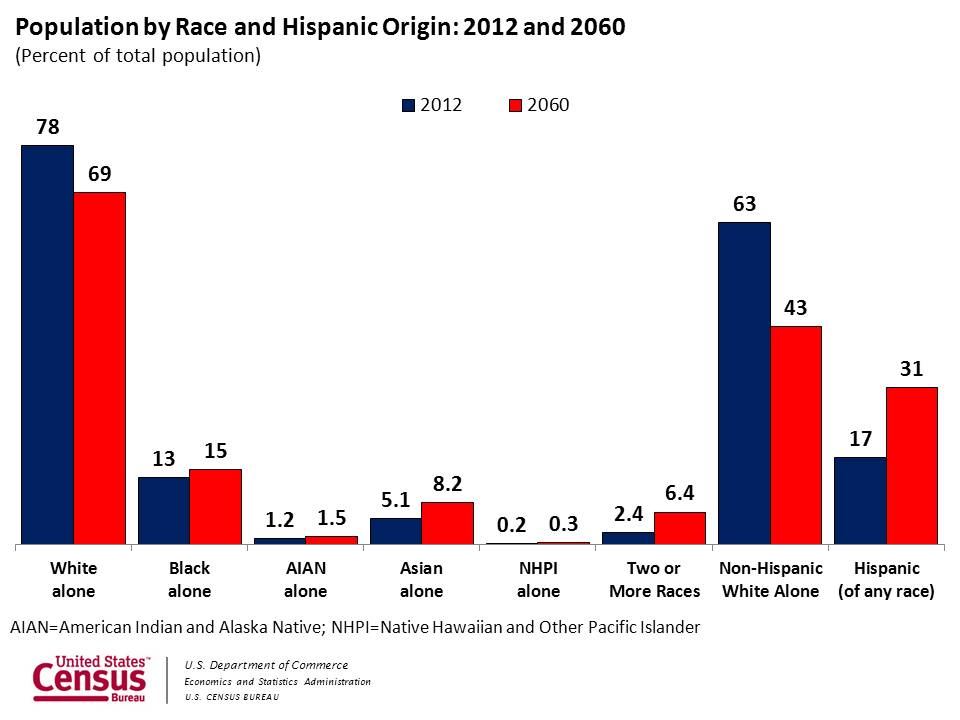
Within roughly 30 years, give or take, the U.S. will be a "majority minority" nation where "people of color" along with Hispanic Americans will comprise the majority of the nation.  The 2012 election has already demonstrated the growing political clout of the emerging minority majority, and it will only grow.  The U.S. Census Bureau observes (here) that, "The U.S. is projected to become a majority-minority nation for the first time in 2043. While the non-Hispanic white population will remain the largest single group, no group will make up a majority." It states that, "All in all, minorities, now 37 percent of the U.S. population, are projected to comprise 57 percent of the population in 2060. (Minorities consist of all but the single-race, non-Hispanic white population.) The total minority population would more than double, from 116.2 million to 241.3 million over the period."  White Americans will lose their status as the majority race in America but remain the largest single minority.  We will also be much less of a Christian nation than now.

In a nation where race still matters, this is scary stuff for a powerful segment of white society.  In effect, that fear has taken over the Republican Party, defining those who do not share in it as RINOs.  We could well rename this new, radical party of the right the "Christian America Party," although not all of its adherents are religious.

It seems inevitable that we are headed for a rocky ride over the next few decades as we collectively navigate the rapids of demographic change in a nation where demographic change matters.  It is to be hoped that our democratic institutions and sensibilities will weather the storms of this change and that we will find our way beyond the Christian America Party's desperate grab for permanent power.

As things stand now, it may succeed in stealing elections, but in the long run it is sealing its own fate.  Generations of Latinos, Asian Americans, and other ethnic-racial minorities will continue to learn what the overwhelming majority of black voters learned two generations ago, namely to vote Democratic as a matter of heritage and habit.  Unless CAP is able to totally corrupt our democratic system, the majority will win out, and the Democratic Party will come to dominant our political landscape in a way neither party does today.  This is not something that any of us should desire.  We desperately need a vigorous but reasonable conservative voice in American politics.  CAP is not that voice.

Thursday, January 24, 2013

Learning to Listen With the Heart

Learning to listen with the heart moves us from the role of observers and enables us to become participants with the Creator in a world full of grace and possibility. 

Elizabeth Canham 
Source: Heart Whispers 

Wednesday, January 23, 2013

Will They Listen?

Gen. Powell
"I think the Republican Party right now is having an identity problem. And I’m still a Republican. I’m a Republican who grew up along with George Bush XLI. I grew up with Ronald Reagan, Cap Weinberger, Frank Carlucci, that Republican Party, the Republican Party of Dick Lugar and John Tower. But in recent years, there’s been a significant shift to the right and we have seen what that shift has produced, two losing presidential campaigns. I think what the Republican Party needs to do now is take a very hard look at itself and understand that the country has changed. The country is changing demographically. And if the Republican Party does not change along with that demographic, they’re going to be in trouble. And so, when we see that in one more generation, the minorities of America, African-Americans, Hispanic Americans, and Asian Americans will be the majority of the country, you can’t go around saying we don’t want to have a solid immigration policy. We’re going to dismiss the 47 percent. We are going to make it hard for these minorities to vote as they did in the last election. What did that produce? The court struck most of that down and most importantly, it caused people to turn out and stand in line because these Republicans were trying to keep us from voting. There’s also a dark-- a dark vein of intolerance in some parts of the Party. What do I mean by that? What I mean by that is they still sort of look down on minorities. How can I evidence that? When I see a former governor say that the president is shuckin’ and jivin’, that’s a racial era slave term. When I see another former governor after the president’s first debate where he didn’t do very well, says that the president was lazy. He didn’t say he was slow, he was tired, he didn’t do well, he said he was lazy. Now, it may not mean anything to most Americans but to those of us who are African-Americans, the second word is shiftless and then there’s a third word that goes along with it.  Birther, the whole Birther Movement. Why do senior Republican leaders tolerate this kind of discussion within the Party? I think the Party has to take a look at itself. It has to take a look at its responsibilities for health care. It has to take a look at immigration. It has to take a look at those less fortunate than us. The Party has gathered unto itself a reputation that it is the party of the rich. It is the party of lower taxes. But there are a lot of people who are lower down the food chain, the economic chain, who are also paying lots of taxes relative to their income and they need help. We need more education work being done in this country. We need a solid immigration policy. We have to look at climate change. There are a lot of things that the American people are expecting and the Republican Party, as they get ready for the next election, really has to focus on some of these issues and not ignore them. Everybody wants to talk about who’s going to be the candidate. You better think first about what’s the party they’re actually going to represent. If it’s just going to represent the far right-wing of the political spectrum, I think the Party is in difficulty. I’m a moderate but I’m still a Republican, that’s how I was raised. And until I voted for Mister Obama twice, I had voted for seven straight Republican presidents."

General Colin Powell, former Secretary of State
January 13, 2013

Tuesday, January 22, 2013

The Shadow of Slavery

Yesterday, January 21, 2013, President Obama delivered his second inaugural address to a crowd estimated at roughly one million souls.  Only time will tell whether or not it will become one of the better remembered inaugural addresses, but whether it stands the test of time or not it is a well-thought out testimony to enduring themes in our nation's life.  It is an articulate meditation on liberal values and a deft summary of the President's vision for the country and of his agenda for his second term.  It is worthy of our reflection and response—worthy of some quiet time reading and meditating.

Different ears will hear different things in the speech.  For me three words leapt from the text: equality, dignity, and change.  I could not but feel that the institution of chattel slavery cast its long, sad shadow across the speech and the day.  We are not shut of slavery nor of the racism that sustained it for more than two hundred brutal, bloody years.  The struggle for civil rights and economic justice suffuse nearly every paragraph of the President's speech, and undergirding them are three things that freedom-starved slaves longed for: equality, dignity, and change.  Racists of every generation including our own resist these same values, or rather reserve them for "their kind" and "their people."  The loathing that Mr. Obama has had to suffer through is a measure of the lingering voice of the slave holders who still, still, still cannot abide the freedom granted their former slaves by the Thirteenth Amendment to the Constitution.  The echoes of Dr. King in his address is the lingering voice of the descendants of slaves who themselves were still not free.  In the last fifty years, we have come a long way, but the President is correct.  No achievement is final, no victory is forever, and our journey is not complete so long as people of color, women, and gays have not achieved full equality and dignity.  Until that day, we must continue to seek change.

Most of us have been intensely disappointed by the politics practiced on Capitol Hill and in many of our state capitals since the election of President Obama in 2008.  It is painful to watch one of our two major parties, a pillar of our democracy, taken hostage by absolutist ideologues.  It has been sad to witness the President's honest attempts to enter into dialogue and cooperation slapped away in a manner that dripped with disdain and disrespect.  Birtherism is a stain on our national conscience, a reminder that equality and dignity are still being contested in our time.  We really do need to change.

That being said, it is also remarkable that we re-elected a "person of color" to a second term of office in spite of the obstacles thrown in his way by those who calculated that they could bring him down by practicing the "politics of 'no'."  It is remarkable that a descendant of slaves stood before us yesterday and called on us to continue the journey.  Slavery still casts its long shadow across our nation, but it is a shadow.  And, as I think about it, perhaps in our generation we are more blessed than harmed by that shadow because it has forced us to see that equality is something that we must grant not just to light-skinned straight men.  Mr. Obama began his address by recalling the Declaration of Independence's bold proclamation that, "We hold these truths to be self-evident, that all men are created equal, that they are endowed by their Creator with certain unalienable rights, that among these are Life, Liberty, and the pursuit of Happiness."  They are also the unalienable rights of women, gays, Muslim Americans, and immigrants from Latin America.  They are also the rights of children who suffer abuse and families that struggle to make ends meet.  Equality.  Dignity.  Change.

Perhaps, just perhaps, lurking within the shadow of slavery is the Spirit working, working, working for the Kingdom.  Our faith encourages us to believe it is so.  Amen.


Monday, January 21, 2013

Remembering Stan Musial

There was a time when the St. Louis Cardinals were located the furthest west of any major league baseball team and many young boys in places like Omaha were almost naturally Cardinals fans.  And even those who weren't Cardinals fans were fans of Stan Musial.  Among my prized boyhood possessions was a signed picture of Musial.  Those were simpler times, I guess, when our heroes came equipped less often with clay feet.  It was also a time when baseball was everything, and Stan Musial was one of the best there was—in his personal life as well as in his accomplishments on the field.  The news that Stan died on January 19th "of natural causes" at the age of 92 thus brings back memories of the boys we were and a baseball era that in retrospect seems golden.  They are good memories.

One wonders what kinds of memories our grandchildren are storing up these days.  They multitask on their electronic devices, and maybe the world is a better place.  It is hard to tell.  We had to climb under our desks in practice air raids, a singularly futile exercise in the face of the threat of atomic devastation.  Now, schools run drills on what to do if a gunman invades the building.  Then, there were all the social ills we have today, but they were better hidden and less discussed—things like child abuse, rape, and crime.  Then we had McCarthyism (not that we boys ever noticed) and now there's the tea party.  And while it is a truism to complain that then baseball was a game and now it is "just" a business and stands under the shadow of the NFL, there is some truth to the truism.  Those were the days when kids were thin, and we spent our hours outdoors.  Obesity wasn't a word we ever heard of.  But, it is a mixed bag, and in some ways the world is better today than it was then.  The one major difference, I think, is that global warming, the greatest danger facing us all, was another thing no one ever heard of or worried about.  It was before Rachael Carson wrote Silent Spring (1962) and changed our perception of the world around us forever.

Who knows if the world of our grandchildren is better than ours was.  It is certainly different.  Still, it was not such a bad thing, growing up in the "Age of Musial."  As I say, his death brings back a flood of memories.  Good ones.  Amen.

Hail to the Chief - Sung

An article on the CNN website entitled, "Why 'Hail to the Chief' remains unsung," notes that the tune "Hail to the Chief" actually has lyrics although they are rarely sung.  Working on the principle that we can find almost anything on Youtube, I went and looked—and sure enough, there is a sung version of "Hail to the Chief."  In honor of President Obama's second inauguration, here it is.  Enjoy.


The Lyrics are:

Hail to the Chief we have chosen for the nation,
Hail to the Chief! We salute him, one and all.
Hail to the Chief, as we pledge cooperation
In proud fulfillment of a great, noble call.
Yours is the aim to make this grand country grander,
This you will do, that's our strong, firm belief.
Hail to the one we selected as commander,
Hail to the President! Hail to the Chief!

God bless the USA!

Saturday, January 19, 2013

Chaos, Idolatry, & Sports

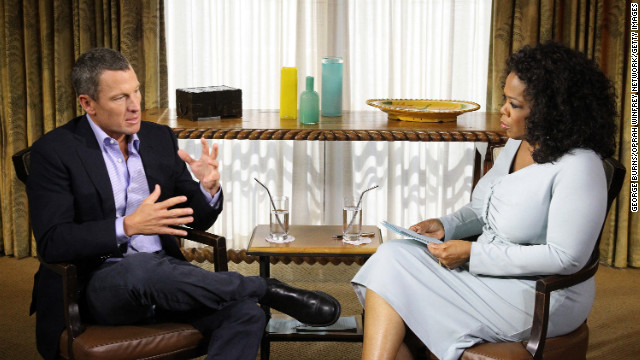
Armstrong confessing to Oprah Winfrey
Source: CNN
Disgraced professional cyclist, Lance Armstrong, is everywhere in the media right now.  His story is a classic rags to riches to disgrace story of a sports icon tarnished beyond recognition.  Not since Tiger Wood's fall from grace has the media had this much fun, clucking and wagging their collective heads—"for shame, for shame."  There are a couple of theological points, at least, to be made of it all.  They have to do with idolatry and chaos.

Chaos is the theological condition of anti-creation or un-creation.  It is that state where God's creative power is absent.  In our lives chaos manifests itself by "sin," but that old-fashioned word is so loaded with baggage that it is hard to use it seriously or even correctly.  Anyone trapped in addiction is living, to one degree or another, in chaos.  Lance Armstrong has been living in chaos, which in his case is composed of cheating, lying, bullying, and self-denial.  He admits as much himself (here).  His disgrace, the media attention, and the skepticism that has widely greeted his confession of sin are all integral elements of the chaotic storm blowing through his life.  The fallout, which has adversely affected so many lives and continues to do so is one of the surest effects of a life trapped in chaos.  There is almost always "collateral damage."

This is where the theological concept of idolatry comes in.  It is a concept that seems especially applicable to the world of sports.  Past Rom Phra Khun postings include reflections on the self-destroying worship of sports success by a South African swimmer, Cameron van der Burgh,who cheated his way to an Olympic gold medal (here) and the awful, hurtful events at Penn State (here).  Idolatry is intimately related to chaos.  It is a face of chaos, a consequence of chaos, and an immensely destructive (un-creative) cause of chaos. Idolatry is that state when we invest worship and trust in anything mundane before and above God.  In sports, success is the god of choice, the prefered spiritual poison of athletes who devote long hours of training often at serious personal sacrifice to be successful—the love of winning, of accolades, and sometimes of financial gain.  When one is willing to do almost anything to be successful, winning has become god.  And chaos ensues.

In our media-driven world, event the media is sucked into the chaos.  Its purveyors become endlessly fixated with failure stories, "rewarding" the disgraced athlete of the moment with still more of its attention and with momentary fame.  We like failure stories, obviously, and that too is part of the chaos that swirls around our stubborn inclination to worship those things that are not worthy of worship.  At the end of the day, we are not constructed to put our faith in mundane things but in The One That Is Beyond And Present—that is Creator, Savior, & Spirit.