We should maintain that if an interpretation of any word in any religion leads to disharmony and does not positively further the welfare of the many, then such an interpretation is to be regarded as wrong; that is, against the will of God, or as the working of Satan or Mara.

Buddhadasa Bikkhu, a Thai Buddhist Monk


Showing posts with label Olympics. Show all posts

Monday, August 20, 2012

Idolatry, or the Art of Turning Gold into Tin

Cameron van der Burgh
Last month, I reflected in two postings (here and here) on the value of the theological concept of idolatry as a real-world analytical tool.  Reports out of the 2012 Olympics provide, sadly, further insights into the power of idolatry in modern life.  In a perceptive article aptly titled, "Shades of Gray on Way to Podium," New York Times reporter, Karen Crouse, points out that various degrees of cheating and manipulating the rules is widespread in Olympic competition.  The badminton players who were disqualified for purposely trying to throw their games were evidently only the tip of the iceberg, according to Crouse. South African gold-medal swimmer, Cameron van der Burgh, who cheated in his pursuit of the gold medal in the 100 meter breaststroke, provided one of the most powerful examples.  The Sydney Morning Herald reported (here) that van der Burgh admitted to using an illegal stroke during the gold medal heat in order to win.  It quoted him as saying, ‘‘If you’re not doing it [cheating], you’re falling behind. It’s not obviously - shall we say - the moral thing to do, but I’m not willing to sacrifice my personal performance and four years of hard work for someone that is willing to do it and get away with it,’’  He was, obviously, willing to sacrifice his moral standards—and in the process break the Olympic oath to follow and respect the rules of the game taken by a representative of the athletes at the opening of the games.

That being said van der Burgh deserves credit as well.  Crouse quotes American swimmer,Brendan Hansen, who finished third behind van der Burgh as saying, “I give him credit for actually having the guts to come out and say something and be honest because maybe that’s what it’s going to take for the organizations running swimming to use the technology at their disposal to enforce the rules.”  There is evidently some risk that van der Burgh could lose his medal because he spoke out.  Hansen himself stated that he did not cheat even though he knew it would cost him the gold medal. He told reporters, “I wasn’t raised to cheat. It’s not something I practice.”

The Olympic gold medal is a potential idol, awaiting the worship of those who seek it.  Crouse treated it as such, worshipped it, and the inevitable result was his worship of the idol cheapened him.  He does not deserve what he won, and he clearly knows it.  Whatever pride or satisfaction he might take in it is tainted.  Hansen, on the other hand, can take pride not only in his bronze medal, but also in the fact that he overcame not only other competitors to achieve it.  He also overcame temptation.  His bronze medal is golden.  Van der Burgh's gold medal is worth less than tin.  His honesty does deserve credit, but his gold is still worth much less than Hansens' bronze.

That is what false worship of human-made idols does to us.  Idolatry cheapens us and taints us.  There is only one "object" worthy of our worship, God.  We approach God and engage in worship only as we are able to put away our own agendas.  That is hard to do, damnably hard.  Fortunately, we aren't called to be perfect at it.  We are called to keep trying.


Monday, August 13, 2012

Worth a Thought

An Al Jazeera news posting entitled, "The cost of Olympic gold," raises the issue of the financial investment involved in winning an Olympics medal, which can be tens of millions of dollars for just one medal.  Only the competitors of nations willing to invest a good deal of wealth in Olympic gold can afford to become top ranked athletes.  It is worth a look and a thought.

Sunday, July 22, 2012

The Meaning of Peace

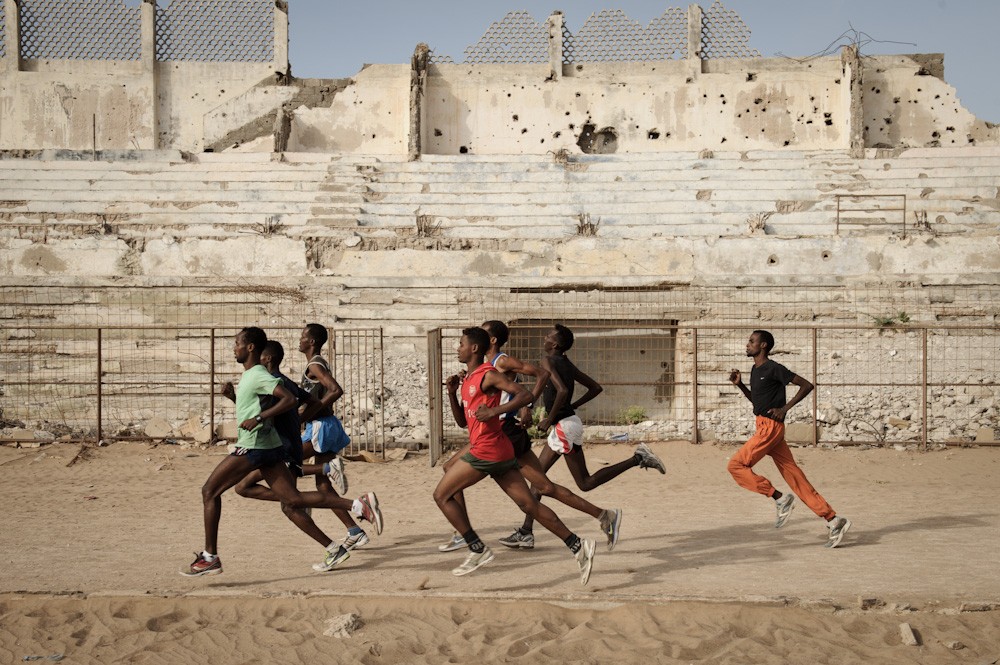
Mogadishu runners
Al Jazeera
Peace is a quality we can easily overlook and take for granted when it is built into everyday life.  In a relatively peaceful place like Lewis County, NY, life is fairly orderly, violence largely hidden and private, and the fields and forests instill a measure of quiet in a largely rural setting.  In spite of personal tragedies, noisy motor vehicles, some poverty, abusive relationships, and just plain human orneriness, it is fair to say that Lewis County is a relatively peaceful place.  We take the peace for granted and don't really think about all of the advantages relative peace gives us.  If we want to run, for example, we can run.

Until very recently, the Somali capital city of Mogadishu has not had this kind of quiet, daily, unobtrusive peace, but now things have changed—a state of affairs described briefly in a news posting at Al Jazeera's English-language website, entitled, "Fragile peace bolsters Somali Olympic hopes."   Mogadishu was a violent place where a small contingent of track & field athletes, runners, found it all but impossible to run, let alone train.  African Union troops now control the city, and a modicum of peace and order has returned.  For these athletes, that peace means they can run, train, and hope for a chance to compete in the Olympics in London.  Peace is a precious thing because it makes such things possible.