We should maintain that if an interpretation of any word in any religion leads to disharmony and does not positively further the welfare of the many, then such an interpretation is to be regarded as wrong; that is, against the will of God, or as the working of Satan or Mara.

Buddhadasa Bikkhu, a Thai Buddhist Monk


Showing posts with label Fundamentalism. Show all posts

Wednesday, November 28, 2012

What to Do With the Christmas Stories?

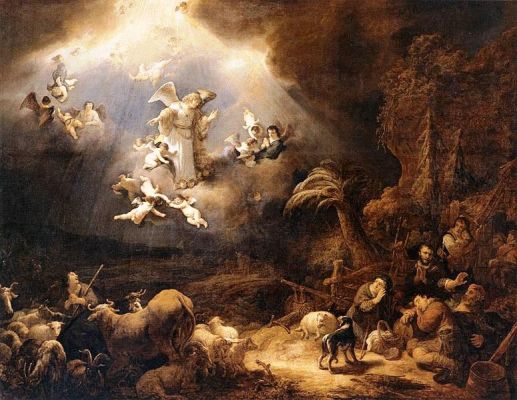
"Angels Announcing the Birth of Christ..." (G. Flinck)
For those of us of a more progressive persuasion, the Christmas stories in Matthew and Luke can be a bit of a problem.  The general consensus among mainline scholars is that the stories didn't actually happen.  They are "just" stories that serve to introduce their respective gospels.  These scholars don't explain where the stories came from or why the early church perpetuated them as fact when at least some of them had to know they weren't.  The origins of the stories, that is, is unknown and perplexing.  And Sunday morning, in worship, is no place to deal with these sorts of issues.

So, what do do with the Christmas stories on Sunday morning?  It is really, really hard to avoid them, obviously.  But here's the thing, they are actually richly textured and deeply meaningful stories in and of themselves.  There is good reason why they have become the most beloved parts of scripture in popular thinking. That being the case, on Sunday mornings in Advent the preacher's task is to "unpack" the meaning of the stories as introductions to the whole of each gospel.  Individual preachers may or may not want to mention scholarly qualms over the historical truth of the events described, but the preacher's task is to dig into the meat of the stories themselves.  Such a tactic leaves the preacher open to the criticism of the religious skeptics" "You are just pulling the wool over your parishioners' eyes—as usual—and playing footloose with the concept of truth."  It also leaves the preacher open to the criticism of the literalists: "YOU DON'T REALLY BELIEVE IN JESUS AT ALL!"

Still, walking somewhere between the secular skeptics and the religious fundamentalists is the best path to take in cases like this.  It isn't, maybe, the most comfortable one, but the skeptics would have us throw the baby out with the bath water while fundamentalists refuse to bathe the baby.  In the history of Christian theology, seeking the middle way (via media) has a long, honorable tradition, and the best way to honor that tradition today is to walk a middle path between the skeptics and the fundamentalists, especially at Christmastime.

How does this actually work?  How do we walk the middle ground and present tell the Christmas story as truthfully and meaningfully as we can?  In a series of postings to follow, I'm going to work at answering just that question.  Stay tuned.

Monday, April 30, 2012

The Decline of the "New Atheism"?

Atheist Richard Dawkins with comedian Ariane Sherine
In an opinion posting entitled, "The Future is Not Looking so 'Bright' for Atheism," theologian Alistar McGrath argues that the so-called "new atheism" is largely a bust when it comes to numbers of adherents.  The actual number of new atheists, whether in Britain or here in the U.S., was never large to start with and is on the decline.  He seems to feel that it was more of a media phenomenon than anything else, and the media has grown weary of it. McGrath observes, "But now its freshness has worn off. Its breezy slogans now seem stale and weary. Soundbites that once sparkled are now dull through endless repetition. Its routine denunciations of religion are becoming more than a little tiresome."  In the course of his commentary, McGrath cites a much longer critical analysis of the new atheism entitled, "Believe It or Not," by David B. Hart, which was posted in 2010.  Branching a little further afield, my good friend Philip Hughes notes (here) that so far as Australia is concerned there is no evidence that the new atheism has had any measurable impact on people's thinking about God in spite of the fact that belief in God has long been on the decline in Australia.

To the extent that the so-called "new atheism" is in decline, that is not a bad thing.  Their discourse has been so largely angry, dismissive, and superficial that they are hard to take seriously, and as I've mentioned more than once in Rom Phra Khun the new atheists in many ways are a mirror image of their arch-enemy, religious fundamentalism.  This is not to dismiss the growing importance of "non-theism" as a faith choice.  It is also not to dismiss the importance of finding ways to engage in thoughtful, mutually beneficial  dialogue with those who do not consider themselves theists.  It is to say that it is a waste of time to try to dialogue with fundamentalists be they of the theistic or the atheistic varieties.  We should be thankful, I suppose, that atheistic fundamentalism is but a weak caricature of the far more potent and dangerous religious fundamentalism.

Monday, August 29, 2011

The New Kinda–Kinda Not Atheists

They loudly, sometimes angrily, and frequently call themselves the "new atheists," and their voices have become a persistent buzz in the public media.  They insist that they do not believe in God, which they habitually spell with a small "g", or any other divine beings.  Yet, from time to time, one hears from them a whisper of something else—in, for example, a PBS interview with one of the gurus of new atheism, Richard Dawkins (here).  In that interview he was asked, "Why do you think that in an age of science so many people, even in the West, and particularly in America, continue to believe in religion?"  Dawkins responded:
"I don't understand why so many people who are sophisticated in science go on believing in God. I wish I did. You'd have to ask them. I know that in some cases what they mean by God is very different from what the ordinary people that they talk to think they mean by God. There are physicists who are deeply awed, as I am, by the majesty of the universe, by the mystery of origins -- the origins of the laws of physics, the fundamental constants of physics, and who are moved by this to say there is something so mysterious that it is almost like God, and maybe use the metaphor of God. God is in the equations. God is in the fundamental constants. And that's fine. I mean, that's just redefinition of that which we find mysterious at the basis of the universe."
Other new atheist authors occasionally avow feelings of awe and mystery in the face of nature and the universe.  They tip toe up to the edge of admitting that there is a "something" out there that is the source of this mystery that lies "at the base of the universe."  Were it not for the way "ordinary people" think about God, Dawkins might even be willing to say that he thinks that there is a something that we might use the word God to describe.  But, in the face of what he considers to be the superstitious beliefs of "ordinary people," he refrains because he doesn't want to associate his views of this mysterious basis of the universe with their unacceptable beliefs. When, furthermore, we read the new atheist literature, what we find is that the "God" they reject is the narrowly constructed God of fundamentalism and biblical literalism.  They heap scorn on this little God who is narrow-minded, violent, judgmental, and damns otherwise innocent unbelievers to eternal hell-fire.  This "God" inspires injustice and prejudice as well as out and out violence in "his" believers who among other things reject the findings of science when they don't accord with their superstitions.  That's fine.  Lots of committed people of faith agree with their assessment of narrow-minded theisms.

So, when they aren't carefully distancing themselves from superstitious forms of theism, do at least some of the new atheists think it possible there is a God, a "something" that lies "at the basis of the universe"?  Yes, some of them apparently do.  Do they thus believe in God?  It all depends on what one means by "believe" and "God."  If God is a mystery at the base of the universe and belief means intellectual agreement to a proposition, then, apparently, "yes" again.  Some of them do "believe" in "God".  They are almost but not quite atheists.  If by "believe," however, we mean trust in God, then "no" they are not theists but atheists.  So, it looks as though they are kinda—kinda not atheists.

Thursday, August 4, 2011

Fundamentalism & the Bible: Worth A Look

For one helpful explanation of why it is not a good idea to read the Bible in a word-for-word literal way, see Randal Rauser, "How fundamentalists undermine the authority of scripture." It is worth a look.