We should maintain that if an interpretation of any word in any religion leads to disharmony and does not positively further the welfare of the many, then such an interpretation is to be regarded as wrong; that is, against the will of God, or as the working of Satan or Mara.

Buddhadasa Bikkhu, a Thai Buddhist Monk


Showing posts with label Feminism. Show all posts

Friday, November 28, 2014

The Book of Samuel as Feminist Literature

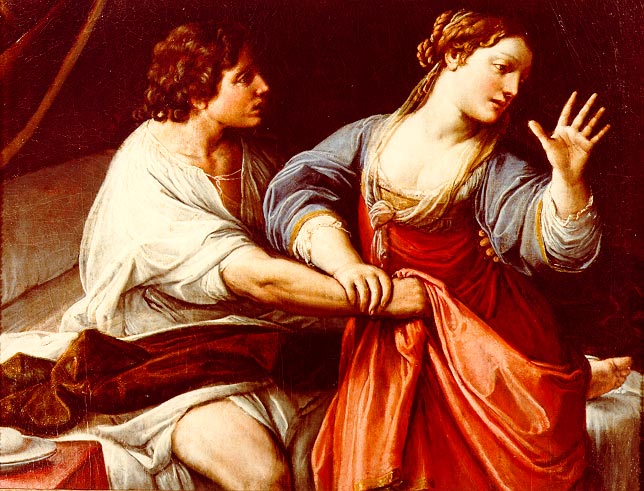
Tiarini's Amnon et Tamar
II Samuel 13 is an awful chapter.  It contains the story of the rape of David's beautiful daughter, Tamar, by her half-brother and David's son, Amnon—and its aftermath.  As the story goes, Amnon "loved" Tamar, tricked her into his bedroom with the unwitting help of his father, and raped her.  His love then turned to loathing, and he forced her to leave him in the face of her pleas that he not double her disgrace.  After two years, Tamar's brother and David's son, Absalom kills Amnon and then flees in fear of his life.  David was left in grief with a chaotic family situation filled with tragedy.  It is clear from the larger story that the ultimate source of all of this was his lust for Bathsheba and murder of her husband, Uriah (II Samuel 11-12).

In both the stories of Bathsheba and Tamar, it is clear that women are treated as the objects of male lust.  In both cases, the consequences of that lust are dire—destructive of the women affected as well as the male perpetrators.  And in both cases, there was no legal recourse in ancient times to protect Bathsheba from David or Tamar from Amnon.  If a man was powerful enough he could do pretty much whatever he wanted with a woman he desired irrespective of her feelings or wishes.  This was apparently especially the case with beautiful women, which adds the further insight that feminine beauty in the stories is at best a two-edged sword—not without its own dangers to the attractive woman.

All of this is fodder for feminist reflection.  In his commentary on I and II Samuel, The David Story (Norton, 1999), furthermore, Robert Alter comments at the beginning of II Samuel 14 (p. 275) that at several critical moments in the David story enterprising, resourceful women intervene to take the story in new directions.  This in a book otherwise dominated by "powerful martial men."  Women, that is, are a central part of the David story but exercise their influence in a way clearly different from men.  In sum, the stories of women in the Book of Samuel describe both the weakness and the power of women's place in ancient Israelite society and inspire reflection on their place in ours.

Whether or not the ancient writer and redactors of the Book of Samuel intended it to be a commentary on the place of women in society is not really the point.  In our context, it is possible to read it that way.  One of the core concerns of the Old Testament is justice.  Yahweh was a God of justice.  When Nathan confronted David (II Samuel 12) that was precisely the point that he made, and it is clear that Bathsheba as well as Uriah were the victims of lustful injustice.  Tamar suffered a double injustice (raped and then rejected).  While it is important to understand the original intention of the author and the subsidiary intentions of the redactors of this story, it is also important for us to read it with 21st century eyes.

The Book of Samuel, in sum, is inescapably a source for reflection on feminist issues and concerns.  Perhaps, unexpectedly.  Generally, overlooked.  But there it is.  Amen.

Thursday, July 28, 2011

Ban the Burqa - Or Not

The Islamic full-body dress for women including the face, the burqa, has sparked one of Europe's hottest social debates.  Belgium and France have banned them and the British are now engaged in their own debate over taking similar legal steps against the burqa.  What makes the debate so intense and difficult is that there are reasonable arguments both for and against permitting burqas to be worn in public.  Women's rights activists in particular find themselves on both sides, often ambivalently so.  On the one hand, what right does the state have to dictate women's dress as long as nudity is not involved?  On the other hand, the burqa is clearly imposed on women and whatever individual women say they feel about it the burqa violates women's rights to full equality with men.  There are also cultural issues involved.  Again, on the one hand, Muslims in Europe are a minority group that  should have its rights protected, including the right to distinctive dress.  On the other hand, minority groups must conform to the generally accepted values of the larger society, especially immigrant minorities, and the burqa is widely unacceptable dress in Europe according to those norms.  Those who oppose the burqas often cite security concerns and that it is a wedge for militant Islam.  Those who oppose banning the burqas say the security issues are minimal to non-existent.

Perfectly reasonable people find themselves on both sides of the divide.  Feminist Mona Eltahawy has written an emotional op-ed piece for the New York Times arguing against the burqa as a Muslim woman.  Liberated young woman, Nesrine Malik, argues with equal vigor (here) for the burqa as a Muslim woman.

The burqa has not become a national issue in the U.S.—yet—but we have our own hot button issues that are debatable because there are reasonable arguments on both sides.  Abortion is such an issue, pitting the rights of the unborn against the rights of women.  The legal establishment of English, pitting the linguistic rights of minorities against the need for a common public language is another such issue.  People become passionate advocates on these issues just because there is a gray area.  And we have to make decisions.  Either abortion is legal or it isn't.  Either we establish one language is the language of legal public discourse or we don't.  Either we ban the burqa or we don't.  Yes, there is wiggle room for some compromise, but at the end of the day we either do or don't.

Two quick thoughts: first, it would seem spiritually reasonable that it is at precisely these points of intense disagreement that people of faith would demonstrate compassion and understanding towards those who differ on hard issues, including other people of faith.  Second, in the real world it doesn't work that way.  Some of the worst, most acrimonious fights over hard issues are fought between true believers on both sides of issues such as the role of women in the church, the way we read the Bible, evolution, and homosexuality.  People of faith should be better than average at dealing with controversial issues, but it turns out that all too often we are no better or even worse at doing so—with serious consequences for society and for the faith.