We should maintain that if an interpretation of any word in any religion leads to disharmony and does not positively further the welfare of the many, then such an interpretation is to be regarded as wrong; that is, against the will of God, or as the working of Satan or Mara.

Buddhadasa Bikkhu, a Thai Buddhist Monk


Showing posts with label David. Show all posts

Friday, November 28, 2014

The Book of Samuel as Feminist Literature

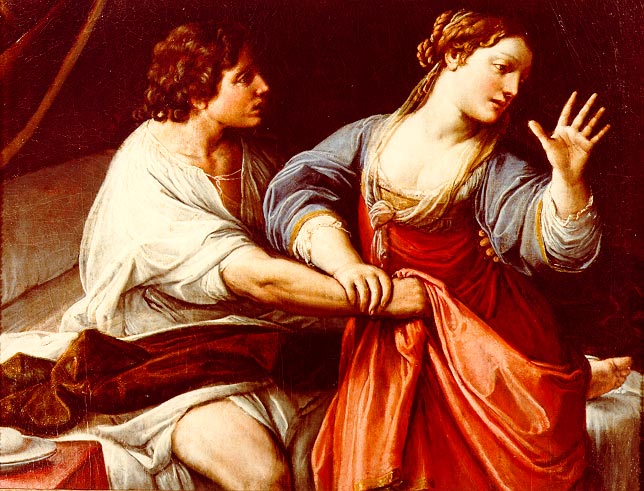
Tiarini's Amnon et Tamar
II Samuel 13 is an awful chapter.  It contains the story of the rape of David's beautiful daughter, Tamar, by her half-brother and David's son, Amnon—and its aftermath.  As the story goes, Amnon "loved" Tamar, tricked her into his bedroom with the unwitting help of his father, and raped her.  His love then turned to loathing, and he forced her to leave him in the face of her pleas that he not double her disgrace.  After two years, Tamar's brother and David's son, Absalom kills Amnon and then flees in fear of his life.  David was left in grief with a chaotic family situation filled with tragedy.  It is clear from the larger story that the ultimate source of all of this was his lust for Bathsheba and murder of her husband, Uriah (II Samuel 11-12).

In both the stories of Bathsheba and Tamar, it is clear that women are treated as the objects of male lust.  In both cases, the consequences of that lust are dire—destructive of the women affected as well as the male perpetrators.  And in both cases, there was no legal recourse in ancient times to protect Bathsheba from David or Tamar from Amnon.  If a man was powerful enough he could do pretty much whatever he wanted with a woman he desired irrespective of her feelings or wishes.  This was apparently especially the case with beautiful women, which adds the further insight that feminine beauty in the stories is at best a two-edged sword—not without its own dangers to the attractive woman.

All of this is fodder for feminist reflection.  In his commentary on I and II Samuel, The David Story (Norton, 1999), furthermore, Robert Alter comments at the beginning of II Samuel 14 (p. 275) that at several critical moments in the David story enterprising, resourceful women intervene to take the story in new directions.  This in a book otherwise dominated by "powerful martial men."  Women, that is, are a central part of the David story but exercise their influence in a way clearly different from men.  In sum, the stories of women in the Book of Samuel describe both the weakness and the power of women's place in ancient Israelite society and inspire reflection on their place in ours.

Whether or not the ancient writer and redactors of the Book of Samuel intended it to be a commentary on the place of women in society is not really the point.  In our context, it is possible to read it that way.  One of the core concerns of the Old Testament is justice.  Yahweh was a God of justice.  When Nathan confronted David (II Samuel 12) that was precisely the point that he made, and it is clear that Bathsheba as well as Uriah were the victims of lustful injustice.  Tamar suffered a double injustice (raped and then rejected).  While it is important to understand the original intention of the author and the subsidiary intentions of the redactors of this story, it is also important for us to read it with 21st century eyes.

The Book of Samuel, in sum, is inescapably a source for reflection on feminist issues and concerns.  Perhaps, unexpectedly.  Generally, overlooked.  But there it is.  Amen.

Saturday, November 8, 2014

Bridging the Gulf: David, Goliath, & Us

One of the most pressing challenges facing mainline churches and pastors is to bridge the gap between scripture and our modern world.  The story of Goliath in I Samuel 17, for example, can be easily dismissed as at best irrelevant to our modern world and at worst as an example of the violent God of the Old Testament.  Thoughtful Jewish and Christian readers will have trouble discovering a spiritual message in the story, which seems to highlight David's prowess as a warrior—and his cleverness.  There are obvious discrepancies between chapters 16 and 17, which to a modern reader are jarring.  The ancient writer seems not have been even a good story teller.  Now, a close study of the chapter relying on commentaries and other scholarly aids, will clear up some of these issues, but for the average reader of the Bible such academic helps do not offer a satisfying means for understanding the modern day relevance of the story of David and Goliath.

One obvious response, of course, is that there are relatively few "average readers" of the Bible in mainline churches, esp. of books like I Samuel.  Even then, a number of those readers would see the story of David and Goliath as being historical and therefore not necessarily in need of theological parsing.  Many others would simply shrug their shoulders thinking that if it is in the Bible then it must be OK.  So, why sweat it?

Well, for one thing the story offers an important example of "inversion," the idea that God turns things upside down for the sake of justice and the furthering of the divine will.  The paradigmatic story of inversion is the Exodus, a motif and paradigm that is repeated in other places in scripture.  More generally, the story of David and Goliath challenges us to appreciate the ways in which our religious fore bearers struggled to understand God's place in their world and lives.  We don't necessarily have to agree with their conclusions or feel comfortable with the blood and guts of the killing of Goliath, but their stories force us to rethink our understanding.  Brueggemann at least gets us started in our rethinking with his observation that, "The story [of David and Goliath] is also set as a paradigm of bold faith in an arena of fear, threat, and defiance."

Short of chucking the Bible, including David and Goliath, entirely, mainline churches need to make a priority of recovering for the whole church the meaning of even the obscure corners of the Bible.  As importantly, mainline congregations need to work overtime at reclaiming a concern for understanding the Bible as a living document.  This is not an easy task in our multi-focused, multi-tasking world where anything "old" is treated with suspicion.  A daunting task - but an exciting one as well for those who take it on.