We should maintain that if an interpretation of any word in any religion leads to disharmony and does not positively further the welfare of the many, then such an interpretation is to be regarded as wrong; that is, against the will of God, or as the working of Satan or Mara.

Buddhadasa Bikkhu, a Thai Buddhist Monk


Showing posts with label Racism. Show all posts

Monday, January 20, 2014

If Only

In 1957 when Governor Faubus of Arkansas refused to desegregate the schools in Little Rock, if President Eisenhower with all of his enormous prestige had personally led a black child up the step to where the authorities were blocking the school entrance, it might have been one of the great moments in history.  It is heart-breaking to think of the opportunity missed.


Frederick Buechner,
Listening to Your Life , 55

Friday, October 25, 2013

Fighting Over a Name (Round Two)

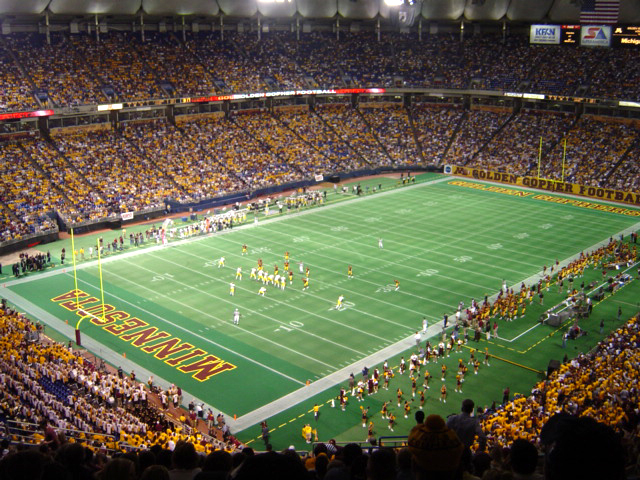
The Hubert H. Humphrey Metrodome
The debate over use of American Indian names or references in sports has come up again in a big way with regards to the name of the Washington, D.C. football team.  The "R word" is clearly a racial slur although there are those (including some Indians) who say that it isn't.  The owner of the team has vowed not to change the name, which he sees as an embodiment of its rich football heritage, but one wonders how long he will be able to hold out against mounting pressure for a change.  It has only made matters harder for him that President Obama has spoken in favor of a new name.

The reason I bring this up is because of a posting on the Minneapolis Star Tribune website reporting (here) that representatives of the American Indian Movement have petitioned the Minnesota Sports Facilities Authority to prevent any display of the the Washington team's name or logo in an upcoming game at the Hubert H. Humphrey Metrodome in Minneapolis.  AIM has threatened legal action if the MSFA ignores or denies its petition.  It is this kind of pressure that is going to make it harder and harder for the team to resist a change.

In an August 2011 posting reflecting on the dispute over University of North Dakota's use of the name "Fighting Sioux" (here), I wrote, "What is most important about the controversy surrounding the use of Indian names and mascots in sports is the controversy itself. It encourages us to be more self-conscious in our attitudes towards Indians and the injustices they continue to suffer. The debate over names is a small step forward in our search for a just, equitable society and thus a good thing...Political correctness in both society generally and the church in particular is a mixed bag at best, but in this case it is important and helpful."  In the case of the Washington football team's name, however, I would argue that the name itself is as important as the larger issue.  It is offensive.  It reflects an ugly side of our history and our nations' unjust, racist treatment of American Indians right down to the present.  It is time for a change.

Tuesday, July 23, 2013

The Issue for Our Times

The right of every American to first-class citizenship is the most important issue of our time.


Jackie Robinson, Brooklyn Dodgers
Quoted (here)

Friday, March 8, 2013

The War Between the States - Round III

The Old South
About a month ago, Michael Lind published an insightful piece entitled, "The white South’s last defeat," subtitled, "Hysteria, aggression and gerrymandering are a fading demographic's last hope to maintain political control."  His thesis is that the real political divide in our nation today is not between right and left but, instead, between South and North.  The "Old South" (white, evangelical, & of British-American origins), Lind insists, has continued to exist down to the present and has successfully maintained political control of most of the states of the Confederacy.  Now, however, that dominance is increasingly threatened and has already been lost in Florida and Texas, which have become minority-majority states.  Other regions of the country have historically undergone this same process, and there was considerable political upheaval when they did.  Now, it is the South's turn.  Lind warns us that, "The demographic demise of the white South is going to be traumatic for the nation as a whole." He concludes, "But the old-stock Yankees in the Northeast and Midwest did not accept their diminished status in their own regions without decades of hysteria and aggression and political gerrymandering. The third and final defeat of the white South, its demographic defeat, is likely to be equally prolonged and turbulent. Fasten your seat belts." (The first two defeats of the white South were the Civil War and the civil rights movement).

If Lind is correct, his thesis suggests that we can look at the future in two related ways.  It looks like we should probably feel more pessimistic about the short-term and more optimistic about the long-term.  That's why we have seat belts—to keep us safe in dangerous times.  Let's just hope that our democratic institutions and habits of mind will be sufficiently strong to carry us through.  Amen.

Tuesday, October 30, 2012

Worrisome

The Associated Press reports (here) that a poll it conducted recently indicates that white racism directed toward African Americans and toward Hispanics, as well, has ticked upward in the last four years since President Obama took office.  The AP observes specifically concerning African Americans that,
In all, 51 percent of Americans now express explicit anti-black attitudes, compared with 48 percent in a similar 2008 survey. When measured by an implicit racial attitudes test, the number of Americans with anti-black sentiments jumped to 56 percent, up from 49 percent during the last presidential election. In both tests, the share of Americans expressing pro-black attitudes fell.
These figures and the whole AP news posting are worrisome.  If it is true that racism and racial prejudice are always wrong and always threaten the nation's well-being—if that is true, then the election of the president has taken us slightly backwards in a very scary direction.  As many of us have felt, much of the motivation behind the tea party movement, the birther movement, and perhaps even congressional intransigence  is racially charged.  The increasingly deep divide among Americans is likewise racial, at least in part.  Looking forward, it is likely that all of this is going to get worse before it gets better.  We are on the cusp of a radical social change as the white percentage of the population continues to dwindle.  Evidently, it is possible that in this coming election the Hispanic vote will already determine who will win the presidency.  A Pew poll (here) taken less than three weeks ago found Hispanic voters breaking for Obama at a 3 to 1 rate.  By 2016 and 2020, the influence of Hispanic voters will grow still more, and with a rising crop of Hispanic politicians it is only a matter of time until we elect our first Hispanic president.

It is hard to believe that the demographic shifts taking place in our nation will be peaceful.  How much overt physical violence will be involved is hard to say, but it is also hard to believe that we aren't in for a period of racially charged political, social, and maybe even economic conflict that will sorely test our political institutions and greatly influence the entire future of the nation.  Little did our colonial ancestors realize the heritage they were leaving us when they decided to import the institution of African slavery into the colonies.  It is God's Law: when we practice injustice we reap the devastating consequences of injustice.  Racism destroys.

Monday, December 12, 2011

Reflections on a Firestorm

The banned couple
There is this tiny Free Will Baptist church in rural Kentucky that recently banned an interracial couple from it worship services by a vote of 9 to 6 (yes, 9 to 6) according to an Associated Press report in the Toledo Blade (see here).  You would have thought that racism was reborn in the South from the response in the media, which has given extensive coverage to what otherwise would be an event of no consequence whatsoever beyond the confines of this little church itself.  According to an article in the Los Angeles Times (here), the Gulnare Free Will Baptist Church in Pike County, Kentucky, has since voted unanimously to overturn the ban, and the church's parent denomination, the National Association of Free Will Baptists, has issued a statement (here) affirming the right of interracial couples to marry and denying that the denomination is racist.

In one sense, it's good this happened.  It has afforded American society and American churches another opportunity to affirm our still imperfect commitment to racial equality and justice.  In another sense, it exposes the fact that even today our churches are still mostly racially exclusive by the apparent choice of all concerned. More largely, we are still a segregated society, and it is not always easy for mixed-race couples and families to live comfortably in our nation.  And in another sense, people of faith can only regret the fact that we in the churches have received "bad press" yet again because of the unloving actions of a few badly misguided "believers".  It's not that we are all so perfect otherwise, but it was Christian folk of both races who provided the motive power for the civil rights movement.  It was the biblical story of the Exodus that inspired the Rev. Dr. Martin Luther King.  It is even to the credit of the members of the Gulnare church that they so quickly came to their Christian senses and righted the wrong done by an ignorant few in the church.

So, we can be sorry and glad that this incident happened.  It demonstrates in one swell foop how far we've come and how far we have to go both as a society and in our faith(s).

Sunday, August 14, 2011

Fighting Over a Name

Fighting Sioux Logo
For years a controversy has raged over the name the University of North Dakota (UND) uses for its sports teams, the Fighting Sioux.  Those opposed to the name feel that it is racist and demeaning to Indians; those who support it believe that it is harmless and, if anything, honors Indian history.  The National Collegiate Athletic Association (NCAA) stepped into the debate in 2005 demanding that UND, along with other schools using Indian names and mascots, change its name.  Eventually, the NCAA agreed to let UND keep the name if the two major Sioux tribes gave their permission: one did, one didn't.  Now, according to the latest reports (here), a final appeal to the NCAA by school and North Dakota state officials to keep the name has failed.  UND either changes the name or faces sanctions by the NCAA and increasing sports isolation from other universities as some schools refuse to compete with UND because of the Fighting Sioux name.  For a compilation of news articles on the Fighting Sioux controversy see (here), and for the most recent editorial about it on GrandForksHerald.com see (here).

In a better world, the name Fighting Sioux would not be a big deal—indeed, it probably wouldn't be any kind of a deal at all.  But, we don't live in that better world.  In our real world, European colonists and their American descendants all but destroyed Indian life in the violent conquest of our continent, which conquest has included large doses of racism and social oppression against Indians.  In the process, our entertainment industry long presented Indians as stereotypical savages and, until recently, celebrated the "taming" of the West and its uncivilized inhabitants.  So, there is reason to question the use of Indian names and images in sports.  Do these names perpetuate exploitation?  Are they demeaning?  Or, is all of this merely another exercise in political correctness?

We need to be honest here and see that these questions can be answered in different ways and that the whole matter is not black and white.  A decade ago, commentator Steve Sailer recounted (here) how one California high school, which called its teams the Apaches, reached out to the Apaches and built good relations based on the name.  Some who had opposed the use of their tribal name changed their minds as a result.  What is most important about the controversy surrounding the use of Indian names and mascots in sports is the controversy itself.  It encourages us to be more self-conscious in our attitudes towards Indians and the injustices they continue to suffer.  The debate over names is a small step forward in our search for a just, equitable society and thus a good thing.  In this case it is also important that it was the Sioux tribal councils that made the final decision.  The controversy has thus returned a modicum of control over their ethnic and cultural identity to the Indians themselves.

Political correctness in both society generally and the church in particular is a mixed bag at best, but in this case it is important and helpful.