We should maintain that if an interpretation of any word in any religion leads to disharmony and does not positively further the welfare of the many, then such an interpretation is to be regarded as wrong; that is, against the will of God, or as the working of Satan or Mara.

Buddhadasa Bikkhu, a Thai Buddhist Monk


Showing posts with label Junk Food. Show all posts

Saturday, May 10, 2014

Bliss Point & Worship

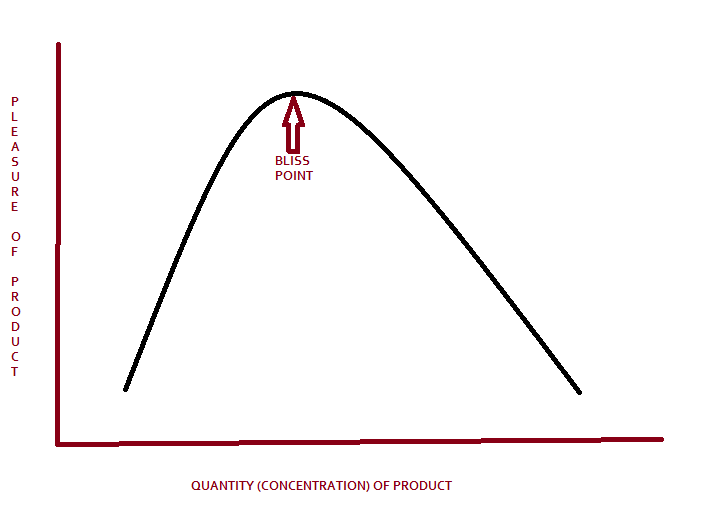
As far back as the post-World War II years, food researchers have experimented with what is now called the "bliss point." Stated simply, the bliss point is that point where a consumer is most happy with a product.  In the food industry, it is the point at which a particular food item is most desirable in terms of taste—assuming cost is not an issue.  For an insightful, fascinating, if trouble article on the concept of the bliss point and its relationship to junk food, see the New York Times article by Michael Moss entitled, "The Extraordinary Science of Addictive Junk Food."

The consequence of mountains of data accumulated in the study of the bliss point of a wide variety of foods is that the food industry has learned how much salt, sugar, and fat in combination with each other to inject into foods to make them attractive to consumers.  Look no further for a primary cause of the obesity epidemic sweeping the nation.  We're human.  We like salt, sugar, and fat.  So we eat foods that optimize these ingredients, the key word being "optimize".  Too much of them in a given food is as undesirable as too little.

I suspect that we could very easily apply the concept of the bliss point (which turns out to be a range rather an a single point) to Christian worship.  A key pillar of the megachurch movement is the lively, upbeat tempo of megachurch worship, which often is conducted by virtually professional musicians, choreographers, and planners.  People are less and less willing to go to worship just because it is worship.  They seek stimulation.  They want a certain level of entertainment, although we never use the word with worship.  They want a return on their investment in time and effort.  Most churchgoers these days consume worship, and if that truly is the case then the concept of a liturgical bliss point is one worth considering.

On the one hand, apply the concept of a bliss point to worship sounds theologically crude, wrong somehow.  Worship should not be about entertainment.  Seeking to discover its "bliss point" feels sacrilegious, irreverent, or whatever other word we might apply.  On the other hand, if we are going to reach audiences in a consumer oriented capitalist culture we had better consider what it is that attracts them.  The answer in the food industry is, "Bliss attracts them."  What then about worship?  Is bliss also what worshippers are seeking on a Sunday morning?  It seems very likely that the answer is, "Yes."

Thursday, August 25, 2011

If Only

Budapest McDonald's
Hungary has come up with a novel way of addressing its own debt crisis, a tax on junk food.  According to a recent news posting on globalpost.com (here), " Hungary is set to impose the world's most comprehensive junk-food tax, which the government hopes will improve eating habits while helping to rebalance its healthcare budget."  The junk food tax passed Hungary's parliament in July and will go into effect on Sept. 1st.  The expected revenue will pretty much pay for the medical care deficits the Hungarian government incurs, and is intended to encourage Hungarians to change their eating habits.  In a letter of congratulations (here), the European Public Health Alliance (EPHA) outlined the European struggle against obesity and related diseases, such as diabetes, which account for 86% of deaths in the European region.  The letter stated that, "cardio-vascular diseases, which are partly diet-related, cost the EU economy in excess of €192 billion a year."  That's over US$130 billion.  The letter concludes, "EPHA wishes you every success in the implementation of this initiative and hopes that this will lead other countries in Europe to take positive action to tackle this issue."

Back in June, we looked at some of the issues concerning junk food and its advertising in a posting describing how megacorporations like McDonald's target children and young people in their junk food advertising (here).  It's good to see some nations taking the issue seriously enough to treat junk food as the public health hazard that it is.  If only there could be more.  Amen.