It is clear that we have lost the capacity as a nation to look on all of this dispassionately and make rational decisions about smart ways to limit access to firearms sufficiently to reduce all of this death while still allowing hunters and other sports folks the opportunity of gun ownership. We have, for a time at least, fallen into the grip of fear and ideology, which have morphed into a deep-seated anger. It is ironic. The very very emotions of fear and anger that makes guns so dangerous are also the things that are preventing us from taking sensible steps to protect ourselves from the violence.
Showing posts with label Gun Control. Show all posts
Showing posts with label Gun Control. Show all posts
Friday, October 4, 2013
Gun Control & Intimate Violence
It is clear that we have lost the capacity as a nation to look on all of this dispassionately and make rational decisions about smart ways to limit access to firearms sufficiently to reduce all of this death while still allowing hunters and other sports folks the opportunity of gun ownership. We have, for a time at least, fallen into the grip of fear and ideology, which have morphed into a deep-seated anger. It is ironic. The very very emotions of fear and anger that makes guns so dangerous are also the things that are preventing us from taking sensible steps to protect ourselves from the violence.

Wednesday, July 24, 2013
(Not) Learning from the Past

A popular variation on these ways to dismiss any actual lessons the past might teach is to make up quotations by historical figures that "prove" one's pet dogma. Take, for example, a posting at CNN entitled, "Jefferson: The face of the modern gun debate: How the third president is our Rorschach test on guns." The posting quotes Saul Cornell, a professor at Fordham University, as stating, ""There are definitely ways you can make Jefferson be a spokesman for Occupy Wall Street or the NRA, but to do so is to take him out of his own time and put him into a debate that is quite alien in his time." Interestingly enough, the examples of false or misinterpreted quotations attributed to Jefferson cited in the posting all tend to support the gun lobby folks rather than their opponents. In any event, the invention of fake quotations is just one way we avoid learning what the past might actually teach us while allowing us to invent a past convenient to our own ideological agendas.
The problem with learning from the past, in sum, is that it more often than not doesn't teach us the lessons we want to learn.
Thursday, May 9, 2013
Gun Control: A Hopeful Development
 |
| Former Rep. Gabby Giffords testifying before Congress |
These figures are still too high. We still need to develop a wise policy concerning firearms, one that gets beyond fear mongering and finger pointing. Otherwise, there will be another Sandy Hook, another Aurora, and another Columbine. Still, we the public seem to be already taking action ourselves to accomplish what Congress can't seem to do—reduce gun violence. For whatever reason, when it comes to guns we are behaving better. That's good. That's hopeful for the future. Sooner or later the current gun debate will quiet down again, and even if we can't get the national legislation we need to improve the situation we face today it seems likely that all of the publicity and debate that has taken place since Sandy Hook will itself have a further positive impact. That is a prayer as well as a reasonable hope for the future. Amen.
Saturday, February 2, 2013
A Sad, Sad Headline
 |
| Darlene Sitler (1959-2012) |
The list of dead does not include Darlene Sitler, choir director of First United Presbyterian Church, Coudersport, PA, who was murdered while playing the organ during worship on Sunday, December 2, 2012, twelve days before Sandy Hook. See reports of her death, at the hand of her ex-husband, (here), (here), and (here). Darlene was a local music teacher and by all accounts loved and respected. She was 53 at the time of her death.
The gun control laws now being discussed probably would not have her life as her killer used a handgun and the shooting was without any prior warning that he would do such a thing. But, that does not mean that we as a society should not continue to try to reduce and reduce again the havoc we are wrecking on each other with guns. As is being noted in the current debate over gun control, it is true that guns do not kill. It is also true that violent, angry, demented, or just plain heartless people use guns to kill—by the tens of thousands every year in America.
It already seems clear that in the current political environment only a limited amount can be done to curb gun violence legislatively. That is sad. One fears that it is going to take another Sandy Hook and one after that and perhaps one after that to move legislation along. How much heartache we are going to endure before even a minimum of common sense moves us to begin the task of bringing gun violence under control? The Second Amendment was intended to preserve our right to form militias not provide the opportunity to gun each other down in the streets. Its modern expansion to include exactly that by its more radical "defenders" defies all spiritual as well as humane common sense. Sadly so.
Saturday, December 22, 2012
Again We Ask, "So What is the Problem?"
 |
| source: skepticink.com |
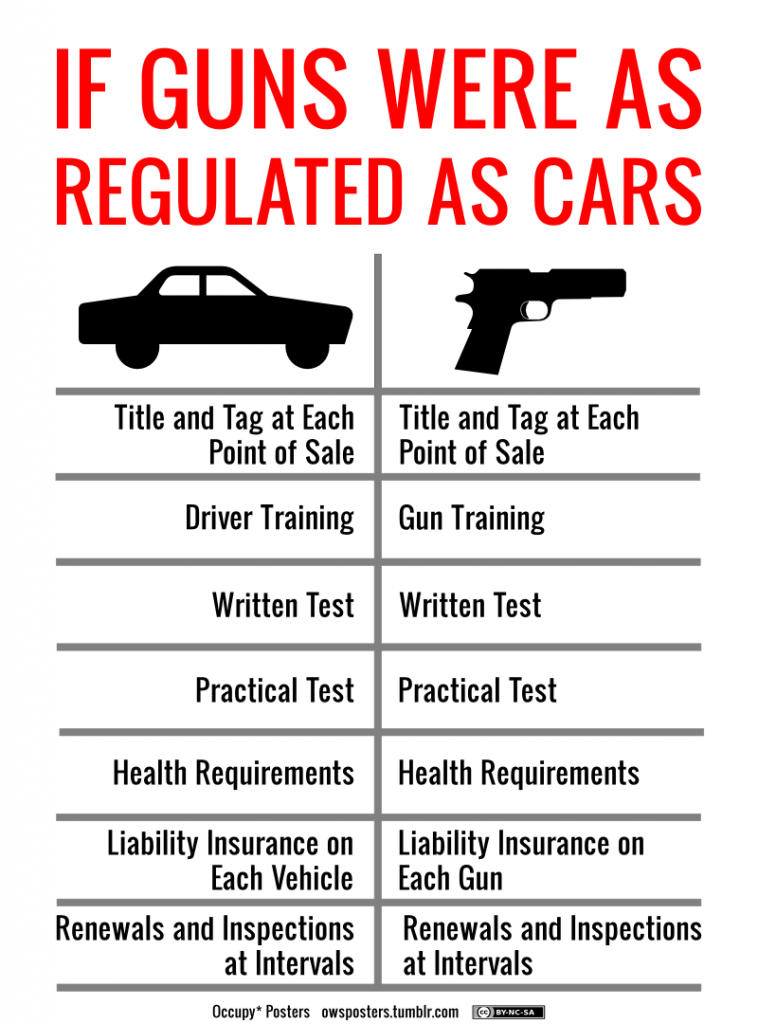
In the United States today there are well-over 200 million firearms in private hands. There is a huge lobby devoted to obstructing any regulation of these firearms, and it has been impressively successful to that end. We are warned that any regulation of firearms puts us on the "slippery slope," which will bring to an end private gun ownership in America. In 2007, over 30,000 people in the U.S. died at the hands of guns, including a significant number of suicides.
Guns are as dangerous as cars, but, when it comes to cars, there is no "slippery slope." There is no paranoia over regulation. Why is the regulation of cars to the benefit of society as a whole acceptable but the regulation of firearms, which are just as dangerous, not? What's the problem?
Tuesday, December 18, 2012
It Feels Different

In all of this, the thing that makes Sandy Hook different is the tone. This one hurt because of the ages of the children and the bravery of the teachers. It is bad enough when something like this happens to 16 year-olds in a high school, but six year-olds and kids who were only seven? This hurts even more. I suspect that Sandy Hook also hurts still more because of the locale—a quiet, safe suburb, one of the last places we associate with violence like this. Yes, the ongoing humanitarian crises in places like Syria take far, far more innocent lives, and, yes, children and innocent by-standers die virtually every day in our nation at the hands of shooters. Sandy Hook, somehow, brings all of that into a new focus esp. because of the ages of the twenty children and also because of where it happened.
For a time, if even for a few days, a week, or a little longer, we are a gentler nation. It is striking how petty the politics in Washington suddenly seems, how strident. And, for the moment, the tug of wills over the so-called "fiscal cliff" has become, at least, a little more civil, less shrill in tone. The question is, of course, will it last? The answer is probably a mixed one. Will the NRA suddenly "come to Jesus"? Probably not. Will the political rhetoric heat up again? Sure. Will the government find to reduce these mass killings? Not likely. Will things go back to "the way they were"? That is harder to say. Superficially, one wonders if anything much will change. But, more deeply, Sandy Hook may well be one more moment on the way to a less violent society.
All of the crime data indicates that we are becoming a less violent nation and that, at least in terms of state-sponsored violence, a less violent world. After Sandy Hook, it could well be that we will become a nation still less tolerant of violence, if only a little less. It could be that we will see gun violence still a little more for what it is, a national public health issue and not a constitutional one. I have long believed that violence begets violence, but perhaps in this case it doesn't. Perhaps in this case violence begets non-violence, which is a step in the direction of peace. Only time will tell, but one senses that these beautiful kids and their brave teachers have not died in vain.
But, what a sad price for peace.
Subscribe to:
Posts (Atom)