We should maintain that if an interpretation of any word in any religion leads to disharmony and does not positively further the welfare of the many, then such an interpretation is to be regarded as wrong; that is, against the will of God, or as the working of Satan or Mara.

Buddhadasa Bikkhu, a Thai Buddhist Monk


Showing posts with label Church Growth. Show all posts

Monday, February 17, 2014

Church Growth


Donald McGavran (1897-1990) is widely credited with founding the "church growth movement," which in its day profoundly influenced more evangelical and conservative international Christian missions with a vision of a more effective approach to evangelism.  In these latter days of declining churches, the spotlight of church growth has shifted to Europe and the English-speaking world.  The challenge is no longer to ignite church growth in places like Africa and Asia but, rather, to save the church from extinction in its old homeland.  One of the central issues concerning the church growth movement, however, is what is meant by "church growth" in the first place.  It was historically often perceived as being mostly about statistics, that is generating large numbers of converts and increasing the number of believers.  Church growth advocates frequently drew on various forms of statistical analysis in their search for the best techniques for increasing conversion rates among targeted populations.  It is widely recognized today that statistical growth alone does not necessarily lead to growing churches in a larger sense.

The Church Growth Research Programme of Anglican Church in Great Britain has recently released a report, "From Anecdote to Evidence," that addresses the issues and questions facing British Anglicans concerning church growth.  It begins (p. 5) with a brief but helpful consideration of the meaning of the concept of church growth that places statistical growth in a larger context, which also includes growth in "holiness, transformation and commitment of [church] members (growth in depth)," and "the fruit of social righteousness and a transformed society (growth in the outworking of our discipleship)," as well as an "increased number of disciples of Jesus Christ (growth in numbers)."  Church growth, that is, involves growth in spiritual depth, numbers, and outreach in ministry.

The real question is, "To what end?"  What is the goal of church growth? The report summarizes the answer to this question by noting that,
It is God alone who gives the growth in the church (1 Corinthians 3: 5-9). So growth is not to be fulfilled for its own sake. It is only good growth when it comes through faithfulness to the gospel. Sometimes, in history, the Church has been faithful and not grown; and at other times, it has been unfaithful, but also proved to be relatively popular.
Growth, then, is not an end in itself, as it often seemed to be in the old church growth movement.  The point is not bigger churches but more faithful ones.  The point is not more spiritual churches either.  Nor is it  more fruitful ministries.  The point is discovering that deeper sense of trust in God in Christ that underlies all forms of growth.  How do we growth in faith?  That is the first and primary question.  Church growth grows from faith and is reflected in such things as a deeper spirituality, larger churches, and effective ministries of service and outreach.

There is, of course, a chicken-and-egg quality to growth in faith and the other forms of growth.  Faith and a deeper spirituality, in particular, often have a reflexive relationship by which they reinforce each other.  The same is often true of ministry and faith as well, as one serves one's faith grows and as one's faith grows one's desire to serve grows.  This reflexive relationship is perhaps least clear with statistical growth.  It is less clear that "successful" churches (i.e. growing in numbers) are necessarily more faithful ones.  All you really need to build a big church is the right demographic situation and a dynamic personality who knows how to attract people.  One can say then that church growth, traditionally, has focused on that aspect of growth least likely to lead to growth in faith.

Saturday, September 14, 2013

AOG & The Spirit

In the midst of the general statistical decline of much of the Christian church in the United States, the Assemblies of God (AoG) stands out as a notable exception.  Its statistics for 2012 (here) show continued solid growth across the board, a fact that has been widely noted in the religious press as well as in the media generally (see here).  The obvious question is, "Why?"  A number of answers are offered in the various news articles including such things as a flexibility when it comes to adapting to local culture, remaining true to its core conservative values, skillful use of social media and modern communication technologies, a focus on minorities and acceptance of women's leadership at all levels of the church, and other factors that may contribute to growth but don't really explain it.

In that light, the observations of one knowledgable commentator, Steve Strang, in a posting entitled, "Pentecostal Fire Still Driving Assemblies of God Growth" are helpful.  He writes, "The baptism of the Holy Spirit and the belief that the power of the Spirit is for today caused the Assemblies of God to start in 1914—only eight years after the Pentecostal revival broke out at Azusa Street in Los Angeles. From talking to leaders, experiencing the services and my firsthand knowledge, I believe this Pentecostal fire is still important and fueling the growth."  Strang elaborates, "Sure, there are many problems with the Assemblies, including how to cope with worldliness that inevitably creeps into the church as well as a drift toward liberalism, modernism, complacency and denominational bureaucratic lethargy. But there is still a desire and a fervor for that Pentecostal power and a desire to reach the world that seems to embody what is happening in the Assemblies of God in 2013."  I added the emphasis.

Mainline congregations can and do grow.  The churches of other evangelical denominations can and do grow.  The difference is that the AoG continues to sustain its growth across the denomination, internationally as well as nationally.  Out here in the mainline world, we have to acknowledge the Pentecostal connection to the Spirit continues to have a life-changing, trends-defying power.  The heart of the matter is not doctrinal nor is it driven by trendy strategies.  At the heart of the matter lies the Spirit.

Sunday, July 14, 2013

Going with the Flow

In Why Christianity Happened (Westminster, 2006), New Testament scholar James G. Crossley adds an intriguing reason for the rise of Christianity to the usual set of factors.  It is widely understood that the Roman Empire created a set of conditions conducive to the expansion of the Christian religion, such things as relatively rapid communications and an era of peace and stability.  Church historians also point to the person of Christ himself and the quality of church life as factors in that growth.  To this list, Crossley adds another factor, which was that an increasing number of citizens of the Empire were attracted to monotheism as a theological choice.  Judaism had something to do with the spread of monotheism, but there were also pagan versions as well.  Thus, when the Jesus Movement cut loose from Judaism and the cultural restraints it placed on converts, there was a ready pool of people primed in a sense to receive this new religious movement (see pages 99-101).

Like a depressingly large number of "facts" when it comes to the history of the Jesus Movement/church in biblical times, this is a matter of speculation although Crossley makes a good case for the argument that monotheism was an attractive, cutting edge theology at the time.  IF he is correct, it suggests that the Jesus Movement took hold because of its congruence with the spiritual temper of its times, not because it stood over against that temper.  It spoke to the spiritual aspirations of at least one key segment of Roman society in spite of the political opposition it provoked.

It only makes sense that any viable religious faith must speak to the spiritual and theological sensibilities  of an important part of society in its time and place.  In our time, that segment of society to which Christianity speaks most fully seems to be increasingly the more extreme end of conservatism,  which embraces dualistic doctrines that are increasingly at odds with the growing secularity and multi-culturalism of international culture.  It seems to speak best to that segment of society that represents where we have been spiritually and theologically rather than where we are going.  That segment is quite large, so Christianity is in no danger of disappearing any time soon; but it does seem that it has lost a key trait that made it the exciting faith of choice for many in Roman times.  It seems to be losing its ability to go with the spiritual flow of our age.  As I say, in ancient times the Jesus Movement spoke to where we were going; today Christianity seems to speak best to where we have been.

This is, of course, a matter of speculation, but it is not unreasonable speculation and is worth a good deal of thought.

Thursday, April 18, 2013

A Measure of Church Health - Seven

In a recent posting entitled, "Eight Diagnostic Questions for a Church's Health," Dr. Chuck Lawless of the Billy Graham School of Missions & Evangelism lays down what amounts to a set of standards by which churches can measure themselves.  If they measure up to the standards, they are healthy. Sixth on his list of questions is:
"Does the church have a strategic plan for future growth? One reason the Enemy so readily succeeds in attacking churches is because he is often a better planner (Eph. 6:11) than most church leaders are. He methodically and strategically attacks the church while most churches operate from Sunday to Sunday. We are not prepared for his attacks. In the same way, most churches would not be prepared for significant growth if God were to grant it. What would the church do if God sent a genuine awakening? Does the church have a vision around which their plans-including facility, staffing, and programming-are developed?"
Once again, I don't want to get lost in a contrarian critique of Lawless' dualistic spiritual warfare perspective.  There is a more important point here, and we should read "through" the devil stuff to it.  The question for mainline churches is whether or not they pursue an agenda that will lead to the "genuine awakening" envisioned by Lawless.  I've already made the point in previous postings in this series that mainline churches need to work on such things as faith-development and faith-sharing.  We need to balance our enviable record in social outreach with an increased emphasis on teaching, practicing, and sharing spiritually—the life of faith.  We need to promote a healthy, vital small group life in our churches, one that will encourage members to share in deeper relationships built on their shared faith in Christ.  Thus, the pressing questions for us are these: are working on developing a deeper faith in our congregation?  Are we prepared for the possibility that the Spirit might superintend efforts in that direction?  Do we have a vision for growing in faith?  Are we pursuing it?  Are we ready for it to make a difference in the life of the church?  These are the questions for us today.

Saturday, April 13, 2013

A Measure of Church Health - Five

In a recent posting entitled, "Eight Diagnostic Questions for a Church's Health," Dr. Chuck Lawless of the Billy Graham School of Missions & Evangelism lays down what amounts to a set of standards by which churches can measure themselves.  If they measure up to the standards, they are healthy. Fifth on his list of questions is:
"Is the church keeping and discipling new believers who join? Suppose a church reached twenty non-believers for Christ in the last year. Did the church see a corresponding increase in attendance? If not, why not? Is the congregation an aging one, and several died within the year? Are longer term members leaving the church as the church changes? Does the church have a poor strategy for discipling new members? Or, more positively, did the church send out a team to begin a church plant? Whatever the cause for the discrepancy between additions and attendance, the church must respond appropriately."
The real question here is more basic: is the church growing numerically at all?  And still more basic: what is the relationship of a church's statistical growth to its health?  Can a church not grow and be healthy?  It does seem possible that a church can have a vibrant, faithful life engaging in effective ministries and yet not grow in numbers, but it is more likely that a healthy church will grow in size.  The quality of its life will attract others to it.  Those "looking for something" will find that something in a healthy church more frequently and fully than not.  So, yes, a healthy church will grow in numbers and display a general balance in age groups.  Theological orientation, it must also be said, is not the issue.  Healthy liberal churches are as apt to grow in numbers as healthy conservative ones.

Let me once not engage in the terminology quibbles that we progressives often quibble about.  We, for example, like to insist that church "growth" is about more than increasing the number of members in a church.  The most important aspects of a growing church, we insist, are more about spirituality, vitality of worship, and other such things than about numbers.   This quibble, however, can obscure the fact that under normal circumstances a church that is growing in faith is likely to be one growing in numbers as well.  In our quibbling state of mind, we might also feel that Lawless seems overly concerned about numbers.  Church growth folks on his end of the theological scale usually are.  Even so and in spite of our quibbles, he and they have a point, which is that healthy churches under normal circumstances should be growing in numbers of people attending worship, participating in church life, and adding their names to the membership rolls.

We have to be careful about our quibbles!  We can quibble ourselves out of facing up to the stern reality of statistical growth.  Numbers are one indicator (in the majority of cases) of health.  This does not mean, of course, that big churches or rapidly growing churches are healthier.  They can and often do build their growth on the shifting sands of a personality cult or social prestige—all of which does not change the relationship of church health to statistical growth.  In the end, not all churches that grow numerically are healthy nor are all churches that do not grow unhealthy, but there remains a general correlation between health and numbers.  Healthy churches are more likely to grow in numbers than not.  Unhealthy churches are less likely to grow in numbers.


Thursday, April 11, 2013

A Measure of Church Health - Four

In a recent posting entitled, "Eight Diagnostic Questions for a Church's Health," Dr. Chuck Lawless of the Billy Graham School of Missions & Evangelism lays down what amounts to a set of standards by which churches can measure themselves.  If they measure up to the standards, they are healthy. Fourth on his list of questions is:
"Is the church reaching non-believers? Here, the possibility of overemphasizing numbers is apparent, but the question must be asked: are non-believers coming to know the Lord through the church's ministry? If the church is growing, is the growth conversion growth (nonbelievers meeting Christ) or transfer growth ("swapping sheep")? Transfer growth is sometimes necessary, but it seldom results in Great Commission growth."
As a mainline progressive, I would usually insist on a "terminology adjustment," but in this case worrying over Lawless' terms (esp. "non-believer" and "conversion growth") could well be a way to avoid an important issue rather than address it.  He believes that bringing people who do not have a faith in Christ to such a faith is one mark of a healthy church, and he is correct in that belief.  While, there are cases and situations where particular churches can be healthy without reaching out with faith to others, by-and-large healthy churches share their faith with people of other faiths and no faith.  They make the gospel available to people who don't know about it.  There is, to be sure, less anxiety to turn someone who is not a Christian into one and less anxiety to get people baptized and into the church.  But, yes, a healthy church shares its good news with others in a way that makes its fellowship available to those in need of a community of faith.

It makes its fellowship available in two ways: by sharing faith and by otherwise being a healthy church that is in and of itself attractive to people in need of a faith community.  Members reach out to visitors, for example, who are "looking for something," and the church embodies the "something" they are looking for.  A healthy church's activities may include people who will not darken the door of a church on a Sunday morning but still find fellowship and a place to think meaningful thoughts in the church.  And, members of a healthy church will be sensitive to times and places when it is appropriate to share their faith with those in genuine need of hearing a kindly, faith-filled word.

A healthy mainline church is much more likely to be concerned about "Great Commandment growth" (Matthew 22:36-40) than "Great Commission growth" (Matthew 28:16-20), not that the two are in conflict.  So, yes, a healthy church is one that effectively shares it faith with others and is able (as a channel of the work of the Spirit) to bring some to faith who previously were not living a life of faith.  In sum, a healthy church is a loving community (always imperfectly so, of course), which extends that love to others in ways that feel loving.  People "naturally" are attracted to such a church and become part of it.  Amen.

Monday, April 8, 2013

A Measure of Church Health - Three

In a recent posting entitled, "Eight Diagnostic Questions for a Church's Health," Dr. Chuck Lawless of the Billy Graham School of Missions & Evangelism lays down what amounts to a set of standards by which churches can measure themselves.  If they measure up to the standards, they are healthy. Third on his list of questions is:
"Is the church driven by a Great Commission focus? Five times in the New Testament, Jesus expressed some form of the Great Commission (Matt. 28:18-20, Mark 16:15, Luke 24:45-47, John 20:21, Acts 1:8). Apparently, preaching the gospel and making disciples mattered to Jesus-and so these tasks must concern churches today. Many churches have become so inwardly focused that church is more about protecting the status quo than about reaching out beyond themselves."
Mainline folks need to take to heart Lawless' third test of a healthy church, but in doing so we also do well to adjust his language a bit.  These are not just quibbles about words, because the words convey attitudes and orientations that are foundational.  Being "driven" by a "Great Commission focus" sounds not quite correct.  What drives a church, I should think, is a focus on faith and on the Spirit.  Such a driving focus has important implications, one of which is a concern for faith-sharing.  Mainline churches have been less than inept about sharing faith with others, be it within or without the church.  They have long spent vast amounts of time talking about plans, programs, and projects but much less time talking about and sharing faith with each other and learning how to talk about and share it with others.  Lawless' observation that many churches focus mostly on themselves is entirely correct and is one of the great failings of mainline Protestantism in the United States.

At the same time, a healthy church is one that balances a number of concerns and ministries, a point I made in the introductory posting of this series (here).  The idea of being "driven by a Great Commission focus" threatens to overthrow that balance by making evangelism the core ministry around which all others revolve.  Churches that have such a dominant view of evangelism may well grow numerically, if the demographics of their locale allow such growth, but they will often find that once they bring converts into the church there is little real faith-development.  When driven by an evangelistic agenda, worship, Christian education, and all of the other ministries and components lose their own integrity.  They become tools for something else and, as these things work out, thereby lose their vital connection to the Spirit.  Bible study, for example, does not explore the depths of scripture, which can be a scary journey, but rather uses scripture to win converts by suppressing the hard questions the study of scripture poses.  The hard questions are avoided because they might "upset someone" and cause them to "lose their faith."

That being said, faith sharing is important.  How much of it a church does is a measure of that church's health.

Saturday, April 6, 2013

A Measure of Church Health - Two

In a recent posting entitled, "Eight Diagnostic Questions for a Church's Health," Dr. Chuck Lawless of the Billy Graham School of Missions & Evangelism lays down what amounts to a set of standards by which churches can measure themselves.  If they measure up to the standards, they are healthy. Second on his list of questions is:

"Is the church a praying church? Legitimate church growth is a gift of God, who empowers His followers and draws others unto Himself. Another danger in church consulting is that we will offer solutions that are based on our ingenuity rather than God's power. For that reason, I want to know that the church is focusing on prayer before, during, and after a consultation. In fact, I expect the church to enlist a prayer team that prays together during the length on the consult. Is your church a praying church?"

A couple of quibbles are in order.  One is the way that Dr. Lawless so easily transposes "church growth" with "church health."  Throughout the eight questions, he tries to be careful about not doing so, but he still does it—starting here, for example, with "legitimate church growth" as a gift of God when his subject is church health, not growth.  Church growth may be a measure of church health in most instances, but it is not always so.  Second, he is very focused here on his own role as a church consultant and apparently is discussing the measures of church health in that capacity.  One wonders how well these measures of church health apply outside of that context.

Quibbles aside, Dr. Lawless is correct.  Prayer is a key aspect of church health, and the spiritual discipline of prayer is generally one of the weaknesses of mainline churches.  The point here is that prayer is not about getting what one prays for and it isn't a test one has to pass to prove that they have "real" faith because they "got what they prayed for."  Prayer is about focus and orientation.  It is an aide to a life focused on God and oriented to the life of faith.  It grounds one in the Spirit—or, better, it helps one better understand and, perhaps, experience how all of life is grounded in the Spirit.  It is also not about warm fuzzy feelings of piety.  Like all spiritual disciplines, it involves patience, persistence, and repetition in the face of "nothing is happening."  "Something" is happening in much the same way that "something happens" when we eat healthfully even though on a daily basis we don't experience any particular change.

Of course, there is prayer and then there is prayer.  Like all spiritual disciplines, it can be abused by the spiritually arrogant.  There are those who boast about how much they pray and self-proclaim how God "answers" their prayers (see Matthew 6:5-6).  It can also be a thoughtless, rote thing—a habit in search of a purpose.  None of this changes the importance of prayer for our personal life of faith or for our church.  Amen.

Tuesday, August 21, 2012

Center of Gravity

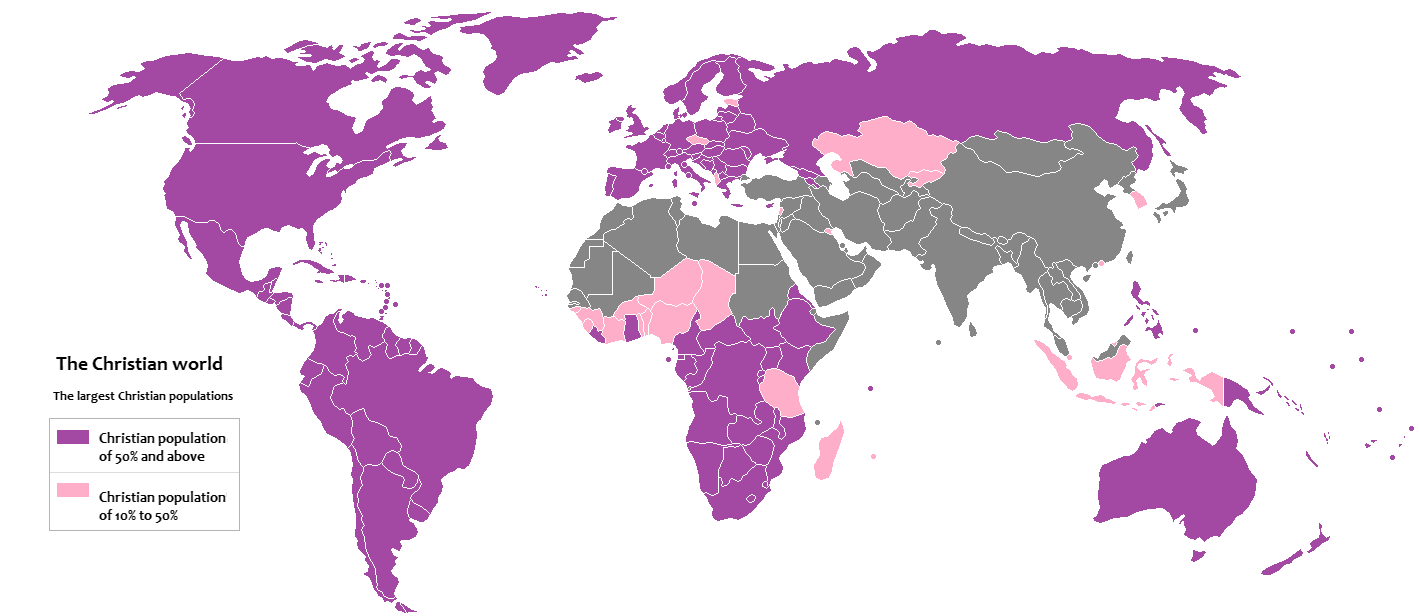
World Christianity
Wikipedia
In a seminal paper entitled, "From Christendom to World Christianity: Missions and the Demographic Transformation of the Church," Prof. Andrew Walls points out that the history of the church has been marked by a series of major demographic shifts. We began in the eastern Mediterranean. Then we moved west and north to Europe. Then we expand that base to include North America, Australia, and New Zealand. Now, we are moving again, this time to the south. A recent news article, "United Methodist Church Continues to Decline in America, but Gains in Africa," provides further evidence that the shift is in full swing.  The title says it all.  While the UMC lost another 72,000 members in 2011, Methodist churches in Africa continue to grow at the pace of over 200,000 mew members per year.  I have noted before that there are now more Anglicans in Nigeria than in the United Kingdom (source).  Walls point is that it has been the western missionary movement that laid the groundwork for this shift.  My point here is that we are left behind to deal with the back end of the shift, the declining and aging end.

Tuesday, February 28, 2012

FPC Log: "Facts on Growth 2010" (ix)

Faith Communities
Today Logo
In late 2011, Hartford Seminary's Faith Communities Today program issued a report entitled, Facts On Growth:2010, which contains important statistical insights into what constitutes a growing church in the early 21st century.  The report considers five key areas of church life: (1) context & composition of the church; (its identity & orientation; (3) worship; (4) programs & recruitment of new members; and (5) leadership.  Under each category, the author, C. Kirk Hadaway, sifts through the data to discern the characteristics of churches that are growing and those that are not.  Some of its findings will surprise no one, but some do, and a key contribution  of the report is the way in which it quantifies most of the parameters of ecclesiastical growth.

Insights include the fact that in metropolitan areas downtown churches were more likely to be growing than suburban congregations, an important change in recent years.  The data confirms that Southern churches, newer churches, and churches with more young people are more likely to be growing churches.  Hadaway notes that churches that, "have a healthy mix of ages tend to be growing, but most important to growth is the ability of congregations to attract younger adults and families with children.” (p. 5)  As has been found in other studies, there is little correlation between theological orientation and growth, although conservative or evangelical churches are more likely to have characteristics that encourage growth.  Hadaway observes that,
“More important than theological orientation is the religious character of the congregation and clarity of mission. Growing churches are clear about why they exist and about what they are to be doing. They do not grow because they have always been at the corner of 2nd and Main. They do not grow because they are focused on themselves. They grow because they understand their reason for being and they do the things well that are essential to their life as a religious organization. One of the stronger correlates of growth was the extent to which the congregation “has a clear mission and purpose.” (p. 8)
Other key factors in growth include a joyful worship life, a commitment to growth, excitement about one's church, and particular types of programs including marriage enrichment.  Hadaway writes, “The programs that produced the strongest relationships with growth were: 1) young adult activities; 2) parenting or marriage enrichment activities; and 3) prayer or meditation groups.” (p. 16)  In the reports' concluding section, Hathaway states that congregational growth is more likely if a church is located in a growing geographic location, has a clear sense of identity, is younger, is spiritually vital, belongs to a conservative denomination, has innovative worship, emphasizes evangelism, and is led by a younger and full-time pastor.  In every category, however, there are growing churches that do not exhibit the usual characteristics of growth.

From all of the data and insights contained in Facts on Growth: 2010, the most important insight seems to be that churches that want to grow have to commit themselves programmatically to growth, have innovative, joyful worship, and run other programs that meet people's needs in their community, such as marriage enrichment courses.

Saturday, October 1, 2011

Evangelism (xxi)

FPC, Lowville, NY
This is the twenty-first posting in this series working on what it means to be a church, based on eight criteria the Mars Hill Church uses to define its branch congregations as churches. The series began (here). We have finally arrived at the eighth and final criterion, which reads, "The church is an evangelistic community where the gospel of Jesus is constantly made visible by its preaching, its witness of the members, and its Spirit-empowered life of love."

In the previous posting, on the seventh criterion, Fellowship, I stole some of the thunder of this last criterion. The point there, you will recall, was that the earliest church grew for a number of reasons including the person of Christ and the quality of its loving fellowship. Evangelism, as such, wasn't a key factor. Paul's commitment to full-time itinerant evangelism was very much the exception rather than the rule.

When I taught early church history to seminarians in Thailand (for about four years or so), I emphasized the fact that it was the quality of church life rather than aggressive evangelism that motivated many to join the earliest churches. In Thailand, generations of missionaries had ingrained in Christian converts the importance of evangelism, emphasizing that it was the most important ministry of the church. So successful had they been in this emphasis, that the churches had virtually become one dimensional churches. Even funerals and weddings were conducted with an eye to evangelizing participants who weren't Christians.  The result was that other vital ministries of the church has never been properly developed, including Christian education and pastoral care.

The lesson from the mission field is that the unmodified, bald statement that, "The church is an evangelistic community" is dangerous to the church.  Churches carry out evangelism as one of their outreach ministries.  Some members and leaders feel themselves called to be evangelists.  But the church has other ministries, other callings, all of which have their vital importance to the life of the church.  Short-term, an evangelistic emphasis may result in rapid statistical growth, but long term it is all but certain to cripple the full life of the church in question.