We should maintain that if an interpretation of any word in any religion leads to disharmony and does not positively further the welfare of the many, then such an interpretation is to be regarded as wrong; that is, against the will of God, or as the working of Satan or Mara.

Buddhadasa Bikkhu, a Thai Buddhist Monk


Wednesday, July 11, 2012

Thinking & Doing

Biblical faith is never cerebral.  It is always lived and acted.


Walter Brueggemann
Genesis, p. 155

General Assembly Summary

The 220th General Assembly of the Presbyterian Church (USA), meeting in Pittsburgh, has been adjourned after a long week of debate over contentious issues as well as carrying out the regular business of the biennial General Assembly.  Those who might be interested can find summaries of the G.A. at The G.A. Junkie website (here).  If you want a quick summary, go to the G.A. Junkie's one page wrap up (here).  The 221stg General Assembly will meet in 2014 in Detroit.

Tuesday, July 10, 2012

A Hero

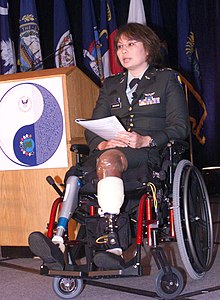
I first became aware of Tammy Duckworth when she first ran for congress in Illinois in 2006 and narrowly lost to her Republican opponent.  I don't think I'm alone in finding Duckworth's story a compelling one.  She served in Iraq as a major in the army and a helicopter pilot who lost both of her legs after being shot down.  An added attraction for me personally is that she was born in Bangkok, Thailand, and like my own daughters has a farang (Western) father and a Thai mother.  She's only a decade older than our oldest daughter.

Duckworth is now running for Congress again, this time against a tea party radical by the name of Joe Walsh (R - IL).  The race has gained some national attention because Walsh has criticized Duckworth for supposedly constantly mentioning her military service and sacrifice (see here).  In the process, he has called her heroism into question.  In light of his criticism of Duckworth, reporter Rick Newman has posted an article entitled, "What Joe Walsh Needs to Know About Tammy Duckworth," which describes her true heroism.  Being shot down, Newman writes, is not what qualifies her for that title.  Rebuilding her life in the face of horrific pain and daunting challenges does. I would recommend readers of Rom Phra Khun take a few minutes to read Newman's description of Tammy Duckworth's heroic struggle to regain her life.

 In my humble opinion, the United States will be better off if the voters of the Eighth District of Illinois replace Joe Walsh with Tammy Duckworth.

If Duckworth does unseat Walsh, she will be the second person of Thai descent to have served in the U. S. Congress.  The first, interestingly enough, served only briefly in 2010.  He is Charles Djou, a Republican who won a special election in Hawaii's First District in 2010 but then lost his seat in the general election of 2010.  He is running for it again this year.

Monday, July 9, 2012

Getting On With It

The 2010 General Assembly of the Presbyterian Church (USA) appointed a "Commission on Mid Councils" to study and recommend ways in which to adapt the structures of the denomination to current realities. The commission completed its report prior to the meeting of this year's General Assembly, which you can read (here) if you are interested.  It is a long, detailed report, which will certainly be important to future historians when they write their histories of the mainline church in the early 21st century.

On page 14 (lines 7-13), the report states, "Our data clearly shows that many Presbyterians are calling for a shift from the top‐down model of our current structure to a model that is characterized by a church‐wide commitment to build up and support local congregations. Generally, congregations do not feel well supported by General Assembly agencies. Only 26% of session‐level respondents rated the Office of the General Assembly (OGA) "excellent" or "very good" and only 33% gave those ratings to General Assembly Mission Council (GAMC). There is a significant disconnect between local congregations and the agencies of the General Assembly."

I should say before anything else that it is easy for me as one who has not been involved in this process to stand on the sidelines and comment.  A great deal of time, effort, and prayer went into the report, which was devoted to listening to the concerns of Presbyterians across the church.  It is not fair to simply dismiss that time, effort, and prayer as wasted, even in the face of the fact that the 2012 General Assembly rejected the recommendations of the commission almost entirely (see here).

That being said, it seems to me sitting here in a quiet, distant corner of the denomination that investing huge amounts of effort in trying to reform national and regional church structures almost certainly isn't going to get us anywhere.  Where the PC(USA) and the other mainline churches will live or die is in the trenches of their local congregations and nowhere else.  It is time, then, that congregations and their leaders work out for themselves the relationships, connections, and real-time structures best suited to their needs.  As a humble example, four churches at the northern end of Utica Presbytery, New York, have taken action in the last 18 months to develop a cooperative partnership that may lead in the near future to a formal agreement to share resources.  All it took was for the two of the pastors involved to decide to "do something" and begin the process of consultation with their own sessions and the other churches.  In fact, these four churches are creating their own "missional structure" without benefit of General Assembly studies, reports, and debates.

One of the recommendations of the commission report was to establish experimental "non-geographic" presbyteries, something more conservative Presbyterians would like to see happen so that they can work together in like-minded presbyteries.  Instead of going through a big institutional struggle, those folks who want to start working more closely with other churches of a like theological mind should just start doing so.  Get together.  Do things together.  Start your own projects and programs.  Don't waste your time trying to change a whole denominational structure, which unsurprisingly is refusing to be changed for your convenience.  It is well past time that church leaders at every level of the church stop investing vast amounts of time doing things that don't really matter any more.  It is time to do what needs done and not worry about how those things fit into the larger structures of the church.

Saturday, July 7, 2012

Gratitude

Gratitude as recognition, receptiviity, and response is a basic attitude and action of the Christian life.  We not only recongize and are aware of God's gifts to us, but also continually find ways of saying thanks to God in worship, prayer, and "whatever we say or do."  Our aim is to live our whole life as a sacred gesture of thanksgiving, a deep bow of gratitude solidifying our relationship with God.


Don Postema
Space for God (1997)
page 76

Friday, July 6, 2012

Gung Ho for God

St. Theophan the Recluse
Theophan or Theophanes the Recluse (1815–1894) was a Russian Orthodox monk and bishop who is now considered a saint. His biography on a website dedicated to him (here) speaks of his goodness, meekness, and willing trust of others, qualities that he felt equipped him for a life of seclusion, study, and spiritual writing. He is thus especially known for his piety and his teachings on Christian spirituality.

That being said, there seems at times to be a quality to his spirituality that suggests a less meek and gentle side to him—or, at least, to his understanding of the Christian life.  One of his quotations in the Wikipedia article linked above, for example, states, "A Christian without zeal is a poor Christian."

Is it possible to be a truly spiritual person and zealous?  The word "zeal" implies a narrowness of mind, an almost obsessive fixation with an object, person, or cause.  It denotes ardor and an unwillingness to be deterred, which can morph into blind prejudice.  Zeal as a spiritual quality is very much not in keeping with the quintessential description of Christian spirituality found in Galatians 5:22-23.  Zeal is hardly peaceful, generous, kind, or patient.  When one thinks of Christian zeal, the Crusades come to mind, which ae not among our finer moments as a people of faith.

Wiktionary defines "zeal" (here) as, "The fervor or tireless devotion for a person, cause, or ideal and determination in its furtherance; diligent enthusiasm; powerful interest."  Although less objectionable than the "feel" of the term, there still seems to be elements of questionable spirituality.  Faith is not passionless, but faith's passion is less self-involved and fixated than seems to be the case with zeal even at its best.  Can one be a faithful follower of Christ and also a zealous one?  The answer is not certain but seems to be, "In theory, possibly,'Yes,' but in practice, more likely, 'No.'"

Thursday, July 5, 2012

True Self & False

I heard a presentation recently that made much of the distinction between "true self" and "false self".  True self is what we as Christians should cultivate and pursue.  False self is the thing that trips us up and has to be overcome.  The speaker urged that false self should be treated with a degree of gentleness, but it remains a problem to be dealt with.  Christian spirituality, at its best, moves us away from false self and toward true self.  It turns out that the concept of true self and false self, according to Wikipedia (here) is a fairly recent idea, introduced by a psychoanalyst in 1960.

OK.  It's a paradigm.  It may have its uses, but there are also some weaknesses involved—things to think about, at least.  There seems to be quite a literature on true and false selves, so those who promote the paradigm may have thought through some of these issues, but they are worth putting "on the table" in and of themselves.

The true-false self paradigm creates a division within us that, first, provides us with the chance to claim that the "bad" things we do are not the true us.  They are not the real us.  It affords us the opportunity to not take ownership for a part of what we are, to deny that part of ourselves as being really us, and to avoid responsibility for what actually is a part of what we are.  Our failings are not a false self.  They are part of our true self, but the true self-false slef paradigm seems to deny that fact.  Second, the paradigm also denies the fact of grayness in our souls.  We aren't day and night "down in there" but twilight, a mixture of dawn and dusk, the good and bad tangled together inseparably.   Third, our mixed nature means that as a rule our strengths can also be our weaknesses.  Stubbornness can, for example, at one moment be a strength seeing us through a  troubling situation and helping us to stand firm in the face of injustice.  It can in other moments be a scary weakness, causing us to visit injustice on others and ourselves.

     Finally, and to me most worrisome, the paradigm of true-false self encourages us to treat a part of ourselves as "the other," which is one of the grave weaknesses of modern human nature.  In the dim past of our evolution, distinguishing "us" from "them"  was evidently a necessary trait valuable to our survival.  Now, it is a mixed bag, but always carries the threat of destruction.  Much of our politics this year is driven by the political Right's fear of the other, embodied in the President of the United States.  In the church, the failure to treat the other who does not think or believe as we do has become a dominant motif of 21st century American Christianity.  It seems unwise and even unhealthy to turn this same dualistic paradigm lose on our inner life, our self.

Wednesday, July 4, 2012

On Being Great

The greatest among you should be your servant.  People who make themselves great will be humbled; and people who humble themselves will become great.


Jesus of Nazareth 
Matthew 23:12
The Kingdom New Testament

Tuesday, July 3, 2012

Did Jesus Walk on Water - or Ice?

One of the consequences of biblical historical literalism is a cottage industry devoted to explaining seemingly impossible biblical events.  Recently, the MSNBC website posted an article entitled, "Did Jesus Walk on Water?  Or Ice?", concerning an international team of climate researchers, which has found that in ancient times under certain conditions ice could possibly have formed on certain parts of the Sea of Galilee.  Their research findings are published (here), if you are interested.

There are three passages in the New Testament that tell the story of Jesus walking on water: Matthew 14:22-33, Mark 6:45-52, and John 6:16-21.  In Matthew's version, Peter also stepped out of the boat and momentarily walked on water until he realized what he was doing.  These passages tell an amazing story about the power of Christ over chaos, which has been partly ruined in these latter days by the skeptical question of whether or not he actually, historically, really and truly, on a given place & time walked on water.  The researchers themselves note that this ancient "spring ice" (water from springs flowing into the sea) would have been small in area, fooled people into thinking someone was walking on water only at a distance, and apt to happen only once every 30 to 60 years.

This latest explanation of how the story could  be "real" makes no sense at all.  Taking the story as the factual recounting of a historical event, the boat the disciples were in was apparently well out to sea, beyond where the ice could have formed.  And if the forming of ice was so freakish, requiring precise conditions, would it have been thick enough to walk on even close to the shore?  Then, there's the problem that Jesus walked all the way to the boat and got in.  So, if there was ice, the disciples would have known it and not been so entirely astonished at Jesus walking out to them.  And the weather was bad, the waves high according to the story.  How did the ice remain stable enough to be walked on?

Biblical-historical literalism demands that stories like Jesus walking on water must be true or false (we're back to the dualism thing).  Given that demand, either these stories describe a miracle or a natural phenomenon, and usually it is a stretch to explain them naturally—as in this case.  We are left with this story either being an account of a miracle or a lie.  And that is a false choice, one that obscures the true power of the story itself.

Monday, July 2, 2012

The Liberal Via Media

Alister McGrath, Christian Theology: An Introduction (p. 103), summarizes theological liberalism this way:
At its best, liberalism may be regarded as a movement committed to the restatement of Christian faith in forms which are acceptable within contemporary culture.  Liberalism has continued to see itself as a mediator between two unacceptable aternatives: the mere restatement of traditional Christian faith (usually described as "traditionalism'" or "fundamentalism" by its liberal critics), and the total rejection of Christianity.  Liberal writers have been passionately committed to the search for a middle road between these two stark alternatives.
The search for a "middle way" is an ancient and honorable theological enterprise that even has its own Latin term, via media.  As I've argued here repeatedly, in our day and age the liberal agenda requires that we engage science—learn from it, dialogue with it, and thereby stake out a viable faith alternative for the 21st century.  My only concern with McGrath's description of liberal theology is that it sounds as if liberalism is defined by what it is against, namely traditionalism and non-theism.  In fact, it is the positive, creative, and faithful search for a contemporary faith in Christ that puts progressive Christianity in the middle between these other ways of searching for faith or non-faith, as the case may be.  In other words, the key concern is to discover a relevant, viable way of living and understanding the faith in the Age of Science, which concern leads us to walk the via media.